
So, what exactly is a diesel engine rebuild? Think of it less like a repair and more like a complete restoration. We're talking about taking the entire engine apart, piece by piece, inspecting every single component, and then replacing or re-machining anything that's worn. It's a meticulous process that brings a tired, old engine back to its original factory specs, giving it a whole new lease on life.
Essentially, it's how you restore that lost power and rock-solid reliability without shelling out for a brand-new engine.
Recognizing When Your Marine Diesel Needs A Rebuild
Your diesel is the heart of your vessel. When it's in trouble, it doesn't just quit; it sends out warnings. The trick is knowing how to read them. Catching these signals early means you can schedule a rebuild on your own terms, in a calm marina, rather than dealing with a catastrophic failure miles offshore. That's a scenario every captain wants to avoid.
Think of it like this: your engine is trying to communicate. These aren't just little quirks that a quick tune-up will fix. They are signs of deep, internal wear—the kind that tells you the core components are reaching their breaking point. Learning to speak your engine's language is the key to staying ahead of major problems.
The Language of Exhaust Smoke
One of the clearest messages your engine sends comes right out of the exhaust pipe. A healthy diesel, once it's warmed up, should run clean with barely visible exhaust. If you start seeing colors, it's time to pay attention.
- Blue Smoke: This is the classic sign of burning oil. Oil is getting past the piston rings, valve seals, or worn cylinder walls and into the combustion chamber. If you find yourself constantly adding oil, blue smoke is the dead giveaway.
- White Smoke: This usually means unburnt fuel is making its way through the engine, often due to a bad injector or low compression. In the marine world, however, it can signal something far more sinister: water or coolant in the cylinder. A cracked head or a bad head gasket is often the culprit.
- Black Smoke: This points to an imbalanced fuel-to-air mix—too much fuel or not enough air. You might have clogged air filters, faulty injectors, or a struggling turbo. While it might seem less critical, it’s killing your fuel economy and coating your engine's insides with carbon.
Listening for Alarming Noises
Your ears are just as important as your eyes. You know the familiar, steady rhythm of your diesel. When a new, strange noise joins the chorus, it’s a red flag.
That deep, metallic knocking sound that gets louder as you increase RPMs? That's a sound that should send a shiver down any captain's spine. It's often the death rattle of worn-out rod bearings, and it means catastrophic failure is right around the corner. Shut it down immediately and call a professional.
Listen for that dreaded "rod knock," a heavy banging that tells you something major is wrong internally. Hissing could be a blown gasket, while a high-pitched squeal often points to a failing bearing. These aren't the normal sounds of a working diesel; they are cries for help. When you start hearing them, a full rebuild is often the only way to fix the deep-seated damage and trust your engine on the open water again.
The Anatomy Of A Professional Engine Rebuild
A professional marine diesel engine rebuild is a whole lot more than just a repair—it’s a complete rebirth for your engine. This isn't about slapping on a few new parts and calling it a day. We're talking about a highly technical, systematic restoration that brings a tired, worn-out engine back to factory-fresh performance and reliability.
Think of it as open-heart surgery for your boat's powerhouse. Every single component is meticulously examined, measured, and brought back to life. Understanding what really happens behind the workshop doors will give you confidence in the process and show you why a proper rebuild is such a worthwhile investment.
Step 1: Disassembly And Deep Cleaning
It all starts with carefully pulling the engine from its bay. Once it’s on the stand, the teardown begins. This is a surgical process. Every part, from the heavy crankshaft and pistons down to the smallest bolts and seals, is methodically removed, labeled, and organized. Nothing is left to chance.
Next comes an intensive deep-cleaning. Years of caked-on carbon, nasty oil sludge, and saltwater corrosion are blasted away using industrial-grade washers and chemical baths. The goal here is to strip every single part down to its bare metal. Only then can we see its true condition and get it ready for a critical inspection.
Step 2: Meticulous Inspection And Diagnosis
With every part sparkling clean, the real detective work begins. This is where a technician's experience really makes a difference. They'll break out precision measuring tools like micrometers and calipers to check every critical tolerance against the original manufacturer's specifications. It has to be perfect.
Key components get a thorough going-over:
- The Engine Block: We inspect it for cracks using methods like magnetic particle testing and make sure the cylinder bores are perfectly round and not tapered.
- The Crankshaft: This beast is measured for straightness and journal wear to ensure it can handle the immense stress of operation without failing.
- Cylinder Heads: They get pressure-tested to find any hidden cracks and are checked to ensure the surface is perfectly flat. This is non-negotiable for a flawless head gasket seal.
- Pistons and Connecting Rods: Each one is weighed and measured to spot any signs of wear, distortion, or fatigue that could lead to a catastrophic failure down the line.
It's completely normal to find the root cause of your engine's problems during this phase.
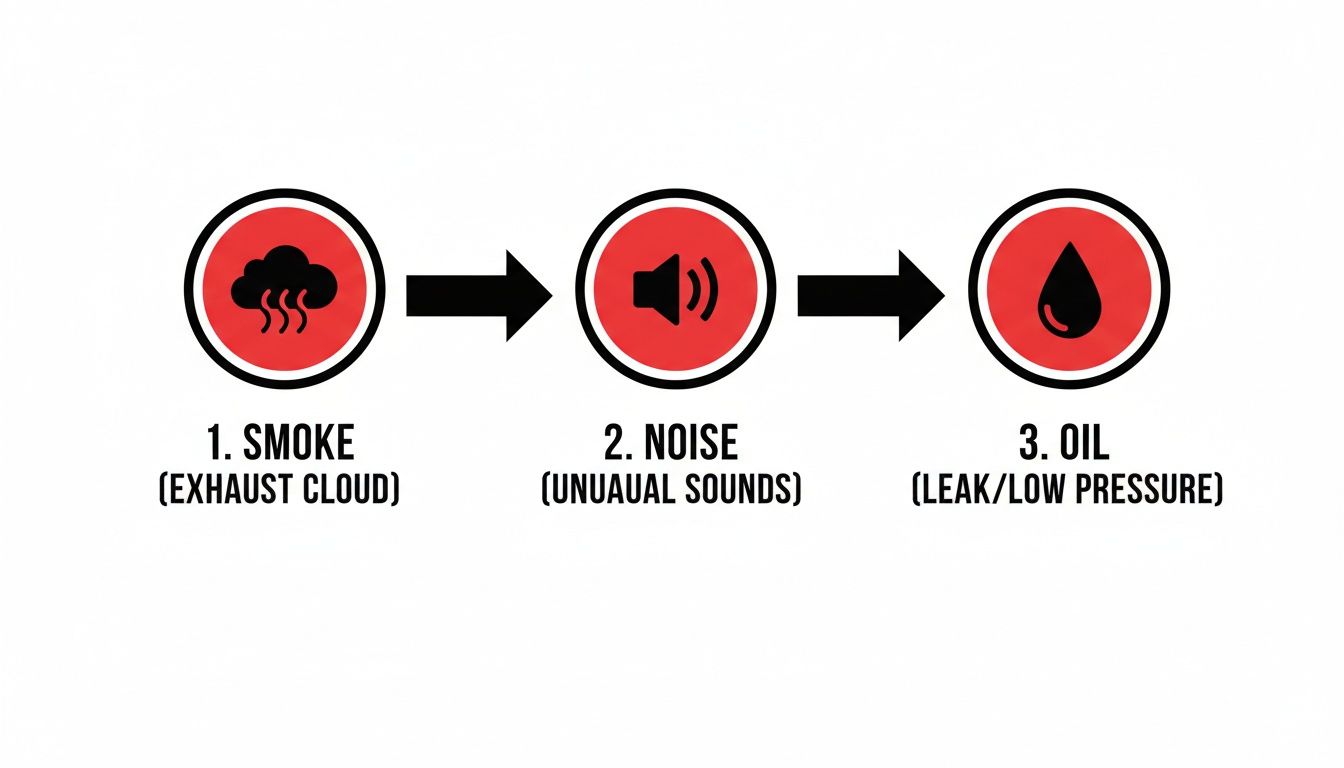
As you can see, symptoms like excessive smoke or strange noises almost always point to specific internal failures that we confirm during this hands-on inspection.
Step 3: Precision Machining And Reassembly
After the inspection, any component that doesn't meet exact factory specs is either replaced with a high-quality OEM part or sent off for precision machining. This is an absolutely critical step in a professional diesel engine rebuild.
A rebuild is only as good as its machined surfaces. Resurfacing the cylinder head, boring the cylinders, and polishing the crankshaft aren't optional—they are the foundation of a reliable, long-lasting engine. This level of precision ensures that all the new components fit together perfectly, creating the tight seals you need for optimal compression and power.
Once all the parts are either new or re-machined to spec, reassembly can begin. This happens in a squeaky-clean environment to keep any contaminants out. Technicians painstakingly put the engine back together in the reverse order of disassembly, torquing every single bolt to precise values and double-checking clearances every step of the way.
Step 4: Testing And Final Validation
The final step is arguably the most important one. A rebuilt engine doesn't just get dropped back into the boat. First, it’s put through its paces on a dynamometer, or "dyno." This machine simulates real-world conditions on the water, allowing technicians to break in the engine properly and spot any leaks, vibrations, or performance quirks in a controlled setting.
This validation process ensures that oil pressure, coolant temperature, and power output are all exactly where they should be. Only after passing these exhaustive tests is the engine certified as ready and reinstalled in your vessel, prepared to give you thousands more hours of reliable service.
Rebuild Vs. Replace: Making The Right Financial Call
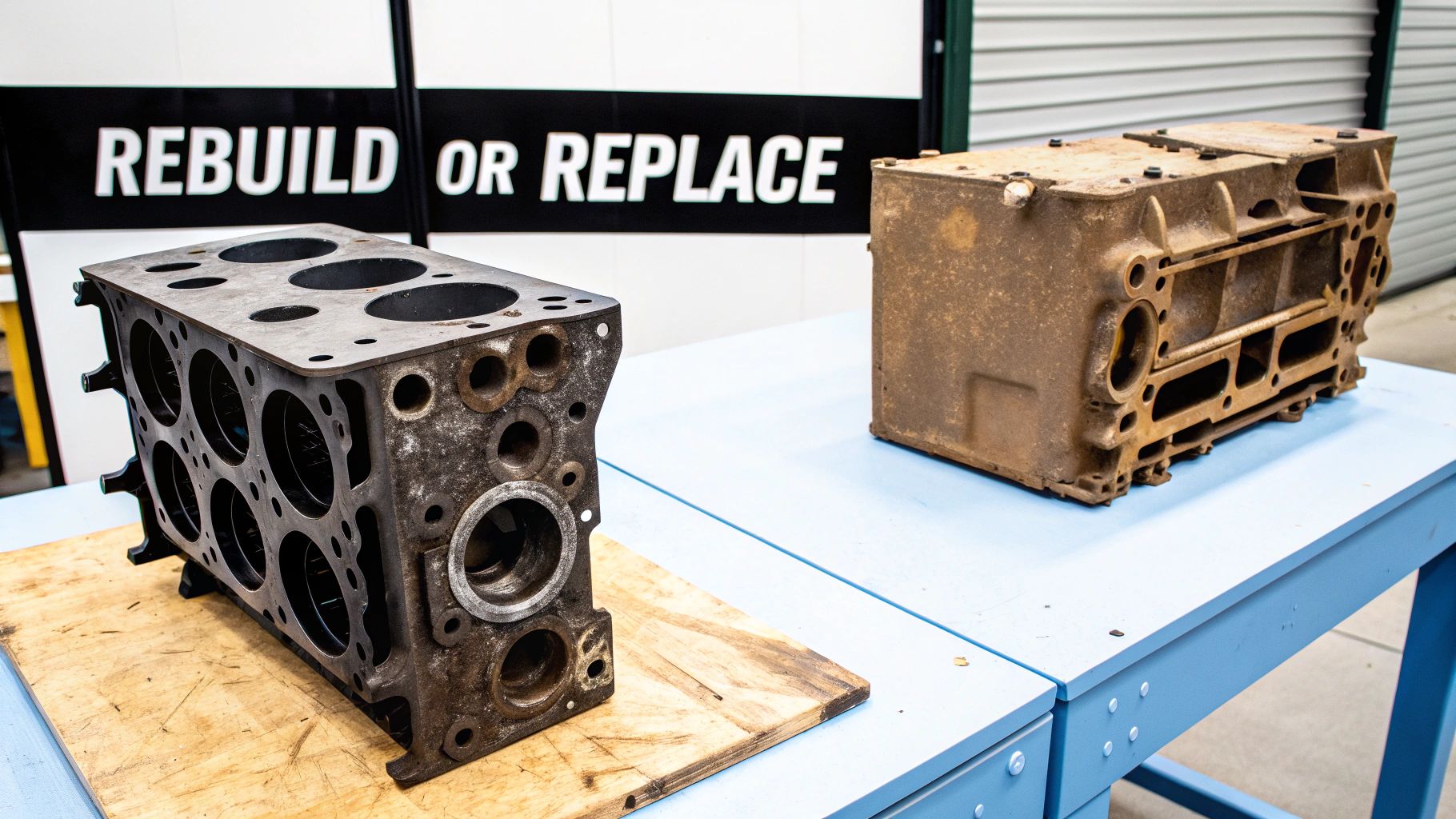
So, the moment of truth has arrived. Your trusty marine diesel is on its last legs, and you're facing the big question every boat owner dreads: do you rebuild or replace it? This isn't just about the initial price tag; it's a critical decision that impacts your boat's long-term value, performance, and reliability.
Get it right, and you’ll restore your vessel's heart, potentially making it better than ever. Get it wrong, and you could be looking at a world of unnecessary expenses, headaches, and extended time on the hard. Let's walk through the pros and cons so you can make a smart, confident call.
The Strong Case For A Rebuild
For a lot of marine diesels, a rebuild is hands-down the most logical path forward. Think of it less like a repair and more like restoring a classic piece of machinery. If the core of your engine—the block, crankshaft, and cylinder head—is solid, a professional rebuild breathes new life into it for a fraction of what a brand-new engine would cost.
But this isn't just about saving money. It's about keeping the soul of your boat intact. Dropping in a new, different engine often means expensive modifications to your engine mounts, exhaust system, or even transmission alignment. Suddenly, that "simple" replacement becomes a complex, costly fabrication project.
A professional rebuild isn't just about getting back to square one. It’s a golden opportunity to bring your engine back to—and often push it beyond—its original factory specs. You can address any known weak points and even bolt on modern, higher-performance parts like better injectors or an upgraded turbo.
This is especially true for those legendary older engine models that were built like tanks. Good luck finding a new engine that fits perfectly into that same tight engine bay.
Plus, rebuilding is the environmentally smarter choice. The global push for remanufacturing is huge, with the market valued at USD 37.79 billion in 2024. A rebuild can slash your costs by 40-60% compared to buying new and cut the engine’s carbon footprint by up to 80% by reusing all those heavy-duty components. You can get a deeper dive into the growth of the engine remanufacturing market and its benefits over at 360iResearch.
When A Full Replacement Makes More Sense
Now, a rebuild isn't a silver bullet for every situation. Sometimes, replacing the entire engine is the only practical, or even possible, solution. If the mechanic's report comes back with words like "cracked block" or "severely damaged crankshaft," you have to face reality. The cost of sourcing and machining those critical core parts can quickly skyrocket, putting you right in the ballpark of a brand-new engine.
A full replacement is also incredibly tempting when you have the chance to upgrade to a significantly more advanced powerplant. Today's marine diesels often boast better fuel efficiency, lower emissions to meet new standards, and are a whole lot quieter. Those are pretty compelling perks for any yacht owner.
If your current engine has a reputation for being unreliable or its parts are getting harder to find than a unicorn, it’s time to stop throwing good money after bad. Investing in a new, fully warrantied engine gives you modern reliability and the peace of mind that comes with a solid support network.
Diesel Engine Rebuild vs. Full Replacement: A Head-to-Head Comparison
To help you see the options clearly, let's put them side-by-side. Use this table to weigh the key factors against your boat's specific needs and your long-term goals.
| Consideration | Diesel Engine Rebuild | Full Engine Replacement |
|---|---|---|
| Upfront Cost | Generally 40-60% less than a new engine, offering significant savings. | Higher initial investment for the engine, plus potential modification costs. |
| Installation | Simpler process as the engine is a direct fit for the existing mounts and systems. | Can be complex, often requiring new engine beds, exhaust, and electrical work. |
| Performance | Restores original factory performance, with opportunities for targeted upgrades. | Offers the latest technology, often with better fuel economy and lower emissions. |
| Warranty | Typically covers workmanship and new parts for a specified period. | Comes with a comprehensive manufacturer's warranty, often for several years. |
| Downtime | Can be longer due to parts sourcing, inspection, and precision machine work. | Can be faster if a direct replacement engine is readily available. |
| Best For | Structurally sound engines, preserving vessel originality, and budget-conscious owners. | Catastrophic engine damage, upgrading to modern tech, or when parts are obsolete. |
Ultimately, the best path forward hinges on a thorough, professional inspection and an honest conversation about your goals for the boat. A trusted marine technician is your best asset here—they have the expertise to diagnose the engine properly and help you make the right financial call for the years ahead.
Budgeting for Your Diesel Engine Rebuild
Trying to nail down a budget for a marine diesel engine rebuild can feel a bit like charting a course in a fog bank. There are a lot of variables, and surprises can pop up. But with a little bit of knowledge, you can get a surprisingly clear picture and avoid that dreaded sticker shock when the final bill arrives.
Think of it this way: the size and complexity of your engine set the baseline. A simple four-cylinder Yanmar is a completely different project than a behemoth V12 MAN or CAT. The sheer difference in the number of parts, the size of the components, and the hours it takes to do the job right creates a massive cost gap from the start.
Breaking Down the Costs
When you get right down to it, the final price is a blend of three main ingredients: the parts, the machine shop work, and the specialized labor to put it all back together. The biggest unknown, the one that can really swing the budget, is what we find once we open it up.
A straightforward "in-frame" rebuild, where we're just dealing with standard wear items, is relatively predictable. We're talking new pistons, rings, bearings, and a set of fresh gaskets. But if that teardown reveals a scored crankshaft, a warped cylinder head, or worse, the scope of the project changes dramatically. Suddenly, you're looking at significant machine work and sourcing some very expensive, hard-to-find components.
Here’s a quick rundown of what really moves the needle on your invoice:
- Engine Brand and Model: Getting parts for a widely used Cummins or John Deere is usually easier and more affordable than sourcing components for a high-performance, less common engine.
- The Extent of the Damage: This is the big one. A rebuild to address simple old age is one thing. A rebuild after a catastrophic failure involving a cracked block is a whole different ball game.
- Parts Quality: You'll face a choice between OEM (Original Equipment Manufacturer) parts and top-tier aftermarket alternatives. OEM parts are a guaranteed perfect fit but always come with a premium price tag.
The Real Value Proposition: Rebuild vs. Replace
While the numbers might seem high at first glance, you have to put them in perspective. A professional diesel engine rebuild almost always lands somewhere between 30% and 50% of the cost of a brand-new engine. This significant saving is a huge reason why the rebuild market is growing so strong, right alongside the overall diesel engine industry, which is projected to hit USD 19.4 billion by 2035.
To put it in concrete terms, rebuilding a large generator engine on a yacht might run you USD 100,000. A brand-new replacement? That could easily soar past USD 300,000. Plus, you're making a smarter choice for the environment—rebuilding saves two to three tons of CO2 emissions per engine by giving core components a second life. You can dive deeper into these industry trends in this comprehensive diesel power engine market report.
Don't just look at the price tag; think about the value. A proper rebuild isn't just a patch job. It's about restoring your engine to its original factory specs—sometimes even better, thanks to modern parts—for a fraction of what a new one would cost.
Budgeting for Time: The Hidden Cost
Finally, you have to account for downtime. A high-quality, meticulous rebuild is not a weekend project. From pulling the engine out of the boat, tearing it down, waiting on parts, getting the precision machine work done, and then reassembling and testing everything—the whole process can easily take several weeks.
Rushing a rebuild is the surest way to guarantee you'll be doing it again soon. Be realistic. Your vessel is going to be out of the water for a while, so plan for it. That patience is an investment. It’s what ensures that when you finally fire it up, you'll have thousands of hours of reliable, powerful service ahead of you. Any good shop will give you a clear, honest timeline from the get-go, including potential hiccups like parts backorders or a backed-up machine shop.
Finding A Marine Engine Rebuild Specialist You Can Trust
Your engine’s second life depends entirely on the hands that rebuild it. Let’s be clear: choosing a specialist for a marine diesel engine rebuild isn't like picking a mechanic to change your oil. You’re hiring a craftsman who intimately understands the punishing saltwater environment your engine calls home.
This decision is the pivot point. It will determine whether you get thousands more hours of reliable performance or a cascade of frustrating, wallet-draining breakdowns. Putting your trust in the wrong hands can turn a smart investment into a recurring nightmare, because a shoddy rebuild will fail, usually at the worst possible moment. Vetting your service provider isn't just a step in the process; it's the most important step. You need a partner, not just a repair shop.
Your Non-Negotiable Checklist
When you start looking at shops, there are a few non-negotiables they absolutely must meet. Think of this as your personal filter, designed to weed out the amateurs and pinpoint the true professionals who will protect your investment. A top-tier provider won't just meet these qualifications; they'll be proud of them.
Here’s what you should be looking for:
- Proven Marine Experience: This is huge. Don't even consider an automotive or industrial engine mechanic. You need someone who lives and breathes marine diesels—someone who truly gets the relentless assault of saltwater, humidity, and constant vibration. Ask to see examples of marine projects similar to yours.
- Manufacturer Certifications: Those certifications from brands like CAT, MAN, MTU, or Cummins aren't just fancy wallpaper. They are proof positive that a technician has received factory-level training and has access to the latest service bulletins and specialized diagnostic tools that others don't.
- Access to Genuine OEM Parts: A rebuild is only as strong as its weakest link. Make sure the shop uses high-quality Original Equipment Manufacturer (OEM) parts or proven equivalents. Slapping in cheap, inferior components is a common shortcut that almost always leads to premature failure.
The engine remanufacturing market is growing for a reason—it’s a smart, cost-effective, and environmentally sound choice. Globally, specialists are extending engine lifespans by 1.5-2 times their original service life, all while meeting modern emissions standards. A properly rebuilt Detroit Diesel DD15, for instance, can be ready for another million miles. You can find more data on the growing diesel services market on coherentmarketinsights.com.
Critical Questions to Ask
Once you have a shortlist, it's time to dig in and ask the tough questions. The way a specialist answers these will tell you everything you need to know about their process, confidence, and commitment to quality. Don't be timid here; your engine's future is on the line.
A great technician welcomes detailed questions. They see it as a sign of an engaged and educated client, not an annoyance. If a shop gets defensive or gives you vague answers, consider it a major red flag and walk away.
Here are the essential questions to ask before you sign anything:
- What does your warranty cover? Get the specifics. Does it cover just the parts, or both parts and labor? What's the warranty period, and what are the exact conditions and limitations?
- What is your quality control and testing process? This is a deal-breaker. Do they dyno-test the engine after it's been reassembled? A post-rebuild dynamometer test is the only real way to verify performance and catch problems before the engine goes back into your boat.
- Can you provide references from recent marine projects? Nothing beats talking to another boat owner. It's the best way to get a real-world feel for a shop's reliability, communication, and the quality of their work.
Smart Maintenance To Extend Your Engine's Life
Let's be honest, the best diesel engine rebuild is the one you never have to do. While a rebuild can feel like a new lease on life for a tired engine, the real goal is to push that day off as far into the future as possible. Smart, preventative maintenance isn't just about ticking boxes on a checklist; it's the single best strategy for protecting your investment and keeping your engine ready to go when you are.
This isn't just about avoiding repairs. It's about shifting from a reactive mindset—fixing what's broken—to a proactive one. When you're ahead of the problems, you control your engine's future, stretching its lifespan and saving yourself a world of headache and expense down the road.
The Power Of Proactive Fluid Analysis
Think of your engine's oil as its bloodstream. It's constantly circulating, and it tells a story about what's happening deep inside. A regular oil change is good practice, but consistent oil analysis is a game-changer. By sending a small sample to a lab, you get a detailed report card on your engine's internal health.
This analysis can spot microscopic metal shavings, coolant contamination, or fuel dilution long before you'd ever notice a symptom. It’s like an early warning system that can alert you to a failing bearing or a leaky head gasket while it's still a minor fix, not a catastrophic failure. For what it costs, this simple test is arguably the most powerful diagnostic tool a boat owner has.
Defending Against Saltwater Corrosion
Down here in South Florida, your engine's cooling system is in a constant fight against saltwater. Salt is brutally aggressive, and even a small leak or blockage in the cooling circuit can quickly lead to overheating and serious internal damage.
A disciplined approach to cooling system maintenance is non-negotiable for any marine diesel. Regularly flushing the system, inspecting zinc anodes, and maintaining the correct coolant mixture are essential tasks that directly prevent the corrosion that eats away at engine blocks and heat exchangers.
You have to stay on top of it. Make these checks a core part of your routine:
- Inspect Sacrificial Anodes: Check and replace the zinc anodes in your heat exchanger often. They're designed to sacrifice themselves so your expensive engine components don't.
- Maintain Coolant Levels: Make sure your coolant is mixed exactly to the manufacturer's specs. This is crucial for both corrosion protection and proper heat transfer.
- Check Hoses and Clamps: Look over every hose for cracks, soft spots, or bulges. Make sure all the clamps are tight and free of rust. A failed hose is a fast track to an overheated engine.
Ensuring Fuel Quality And Cleanliness
A high-performance marine diesel demands absolutely pristine fuel. Contaminated fuel is a direct line to clogged injectors, poor performance, and eventually, a rebuild you didn't need to have. Water, dirt, and microbial growth—the infamous "diesel bug"—are always lurking, especially in our humid climate.
A strict fuel management program is critical. This means regularly draining water from your fuel filters and tanks. Using a quality biocide treatment is also a must to keep algae and other growth from getting a foothold. Clean fuel doesn't just make your engine run better; it protects the entire high-pressure fuel system and can add thousands of hours to its life.
Your Top Questions About Marine Diesel Rebuilds, Answered
Deciding to pull the trigger on a marine diesel rebuild is a big step, and it naturally brings up a lot of questions. If you're like most boat owners we talk to here in South Florida, you want straight answers to make a smart decision for your vessel. Let's clear the air and tackle those common concerns head-on.
Getting these details right gives you the confidence to move forward, knowing exactly what to expect from the process and what it means for your engine’s future on the water.
How Long Does A Rebuilt Engine Last?
Think of a proper, professional rebuild as hitting the reset button on your engine's life. This isn't just a patch job to get you through the season; it’s a complete overhaul designed for the long haul. A high-quality rebuild should give you another 5,000 to 10,000 hours of reliable power, which is right in line with what you'd expect from a brand-new engine.
Of course, that incredible lifespan depends on two things: the quality of the work done during the rebuild and how well you stick to a maintenance schedule afterward. Treat a rebuilt engine right, and it will serve you faithfully for years to come.
Can I Upgrade Performance During A Rebuild?
Absolutely! This is one of the best parts of the process. A rebuild is the perfect time to not just restore your engine, but to actually make it better than it was when it first left the factory.
With the engine completely torn down, you have a golden opportunity to install modern components that weren't available when it was first built. Some of the most popular upgrades we see include:
- Modern fuel injectors for a noticeable boost in power and fuel efficiency.
- A new-generation turbocharger for quicker throttle response.
- An enhanced cooling system to handle the demanding South Florida heat with ease.
A rebuild is your chance to perfect your engine. You can address any of the original model's known quirks or weak spots with superior, modern parts, resulting in an engine that’s tougher and more reliable than ever before.
Rebuild Vs. Remanufactured: What Is The Difference?
People often toss these terms around as if they mean the same thing, but they are very different.
A rebuild is a custom job done on your specific engine. We carefully take it apart, inspect every piece, replace worn components, and reassemble it, often reusing core parts like the engine block and crankshaft if they meet specifications.
A remanufactured (or "reman") engine is different. It’s been restored in a specialized factory environment, brought back to the original manufacturer's exact specs, and typically comes with a warranty that mirrors a new engine.
Is A Rebuild Worth It For An Older Engine?
For many boats, the answer is a resounding yes. If you own a classic vessel or have an engine model known for being particularly tough and overbuilt, a rebuild is often the smartest financial move. This is especially true when a new, modern engine simply won't fit in the existing engine bay without massive, expensive modifications to the mounts, exhaust, and transmission.
When your vessel demands expert attention, you need certified technicians who come to you. GTM International provides mobile marine diesel engine services across South Florida, from inspections and diagnostics to complete rebuilds. Get factory-trained expertise right at your dock by visiting our marine diesel services website to schedule your service.
