
When your injectors are on their way out, you're faced with a classic dilemma: rebuild or replace? It's a question every boat owner eventually confronts.
A diesel fuel injector rebuild isn't just a quick patch-up. It's a meticulous process where a specialist completely disassembles your existing injectors, deep-cleans every component, and replaces all the internal wear-and-tear parts—nozzles, seals, springs—with brand-new ones. The whole assembly is then carefully put back together and calibrated on a test bench to meet the original factory specs.
Think of it this way: the injector body itself is a durable piece of machined metal. It rarely fails. The problem is usually the tiny, precision parts inside that do the real work. A rebuild saves the perfectly good "core" and gives it a new lease on life, often for less than half the cost of a brand-new part.
Is a Diesel Fuel Injector Rebuild the Right Choice?
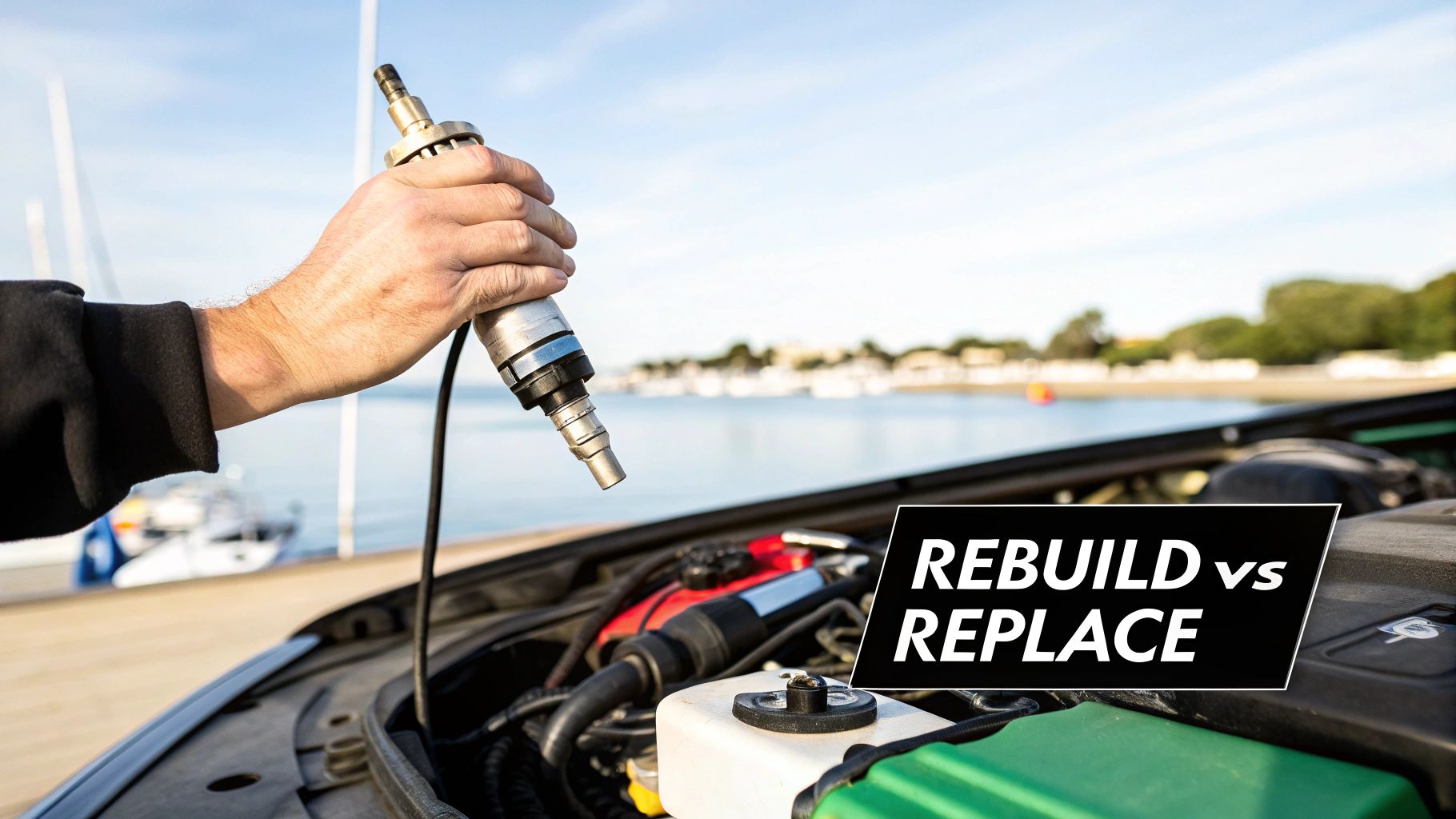
Let's be honest, when your marine diesel starts acting up—belching black smoke, guzzling fuel, or running rough at the dock—your mind immediately jumps to the worst-case scenario and a massive repair bill. Seeing the price tag on a set of new OEM injectors can be a real shock to the system.
This is exactly where a professional rebuild shines. It's not just a "cheaper" option; it's a smart, strategic move to get your engine's fuel system back in fighting shape without breaking the bank. It's about restoring performance, not just replacing parts.
The Value of Restoration Over Replacement
Why throw away a perfectly good injector body when only the internals are worn? Choosing to rebuild delivers the same performance you'd get from a new part, but the savings are huge—typically between 40-60% compared to buying new from the manufacturer.
But this isn't just about saving money today. A high-quality rebuild gets to the heart of what's causing the problem.
- You get your power back. A technician uses a specialized calibration bench to fine-tune the spray pattern, ensuring perfect fuel atomization. The result? Restored horsepower and that crisp throttle response you've been missing.
- Your fuel economy improves. When injectors are firing precisely as the factory intended, your engine burns fuel more completely. That means less waste and more time on the water between fill-ups.
- You get peace of mind. All the common failure points—nozzles, seals, O-rings—are replaced with fresh, top-quality parts. This isn't a temporary fix; it's a move that extends the reliable service life of your engine.
The decision to rebuild is about more than just the immediate savings. It’s a comprehensive solution that restores the heart of your engine’s fuel system, ensuring it operates exactly as the manufacturer intended.
If the main body of your injectors (the "core") is still in good shape, a rebuild is almost always the right call. It’s the most direct path to like-new performance, often backed by a solid warranty, all while keeping your maintenance budget under control.
Rebuild vs Replacement at a Glance
So, how do the two options really stack up? This table breaks down the key factors to help you decide which path is right for your vessel.
| Consideration | Diesel Fuel Injector Rebuild | New Injector Replacement |
|---|---|---|
| Cost | Significantly lower, often 40-60% less. | Highest upfront cost. |
| Performance | Restored to original OEM specifications. | Meets original OEM specifications. |
| Turnaround Time | Can take a few days for shipping and service. | Often available immediately off the shelf. |
| Environmental Impact | More sustainable, as it reuses the core. | Creates waste by discarding old parts. |
| Warranty | Typically comes with a service warranty (e.g., 1 year). | Comes with a manufacturer's warranty. |
| Core Condition | Depends on your existing injectors being in good shape. | Not a factor; everything is new. |
Ultimately, both options can get your engine running right again. A rebuild simply offers a much more cost-effective and environmentally friendly way to achieve the same top-tier performance you'd expect from a brand-new part.
Decoding the Symptoms of Failing Fuel Injectors
Your marine diesel is a tough piece of machinery, but it has its own way of telling you when something's wrong. When it comes to fuel injectors, the problems don't just appear out of the blue. They send out warning signs—subtle at first, but they get louder and louder until you can't ignore them. Knowing how to read these signals is the first step toward getting a proper diesel fuel injector rebuild.
Think of your injectors as the precision instruments of your engine's fuel system. They have to deliver the perfect amount of atomized fuel at the exact right millisecond. When even one starts to lose its edge, the whole engine's performance suffers. The trick is to catch these problems early, before they snowball into something much bigger and more expensive.
The Alarms You Can See, Hear, and Smell
Some of the clearest signs of injector trouble are the ones you can pick up on right from the helm or down in the engine room. They often start small, so it's easy to write them off as a fluke. Don't.
One of the first things you might notice is a rough or unstable idle. That steady, comforting thrum you're used to at the dock is gone. Instead, the engine might vibrate, sputter, or seem to "hunt" for a steady RPM. This is a classic symptom of an injector delivering an uneven fuel supply, throwing one or more cylinders out of sync.
Another dead giveaway is the smoke coming from your exhaust. Pay close attention to the color, as it tells a specific story:
- Black Smoke: This is the tell-tale sign of too much fuel. A worn-out injector nozzle or a stuck-open valve is basically just dumping raw diesel into the cylinder. It can't all burn, so it comes out as thick, black soot. You'll especially see this when you put the engine under load, like when you're trying to get up on plane.
- White Smoke: This usually means the opposite—not enough fuel is burning correctly. A clogged nozzle isn't creating the fine, cone-shaped mist the engine needs. Instead, it might just dribble fuel in, which then vaporizes in the hot cylinder instead of igniting properly. The result is a thick, white smoke that has a sharp, acrid smell.
That leads right to another clue you can trust: your nose. If you smell raw diesel around the exhaust, that's a clear signal that fuel is making its way through the engine without being fully combusted. That's a classic sign of poor injector performance.
Red Flags for Performance and Fuel Burn
Beyond the obvious sensory warnings, failing injectors will hit you where it hurts: your fuel bill and your boat's performance. These symptoms tend to creep up on you, but they're just as important to spot.
A sudden drop in fuel economy is a huge red flag. If you're hitting the fuel dock way more often than you used to, but your running habits haven't changed, your injectors are a likely suspect.
An injector with a bad spray pattern wastes an incredible amount of fuel. The engine has to work harder and burn more diesel just to maintain power. Getting injectors back to spec can often boost fuel efficiency by 5-10%, sometimes even more.
You'll also probably feel a noticeable loss of power or a sluggish throttle response. When you push the throttles forward, does the engine hesitate or feel flat? That's a direct result of cylinders being starved of the precise fuel charge they need to deliver a powerful combustion stroke.
Finally, listen carefully for any engine knocking or "pinging." This sharp, metallic sound is a bad sign. It's caused by fuel igniting at the wrong time in the combustion cycle, often due to a distorted spray pattern from a bad injector. This uncontrolled explosion puts a massive amount of stress on your pistons, bearings, and crankshaft. It's a noise you simply can't afford to ignore.
If any of this sounds familiar, it's time to get a professional diagnosis. A diesel fuel injector rebuild might be exactly what your engine needs.
What Really Happens During a Professional Injector Rebuild?
Ever wondered what goes on behind the workshop doors when you send your injectors in for a rebuild? It’s far more than just a quick clean-up. A true professional rebuild is an intensive, almost surgical process performed in a sterile environment to bring a tired injector back to life.
This isn't about just polishing the outside and swapping a few O-rings. We're talking about a complete teardown and restoration that gets to the very heart of your engine's fuel system. Technicians use highly specialized gear and follow a strict, repeatable process to make sure every single injector performs as well as—or even better than—it did the day it left the factory.
If you're seeing signs like a chugging idle, terrible fuel mileage, or puffs of black smoke, you're seeing the cry for help.
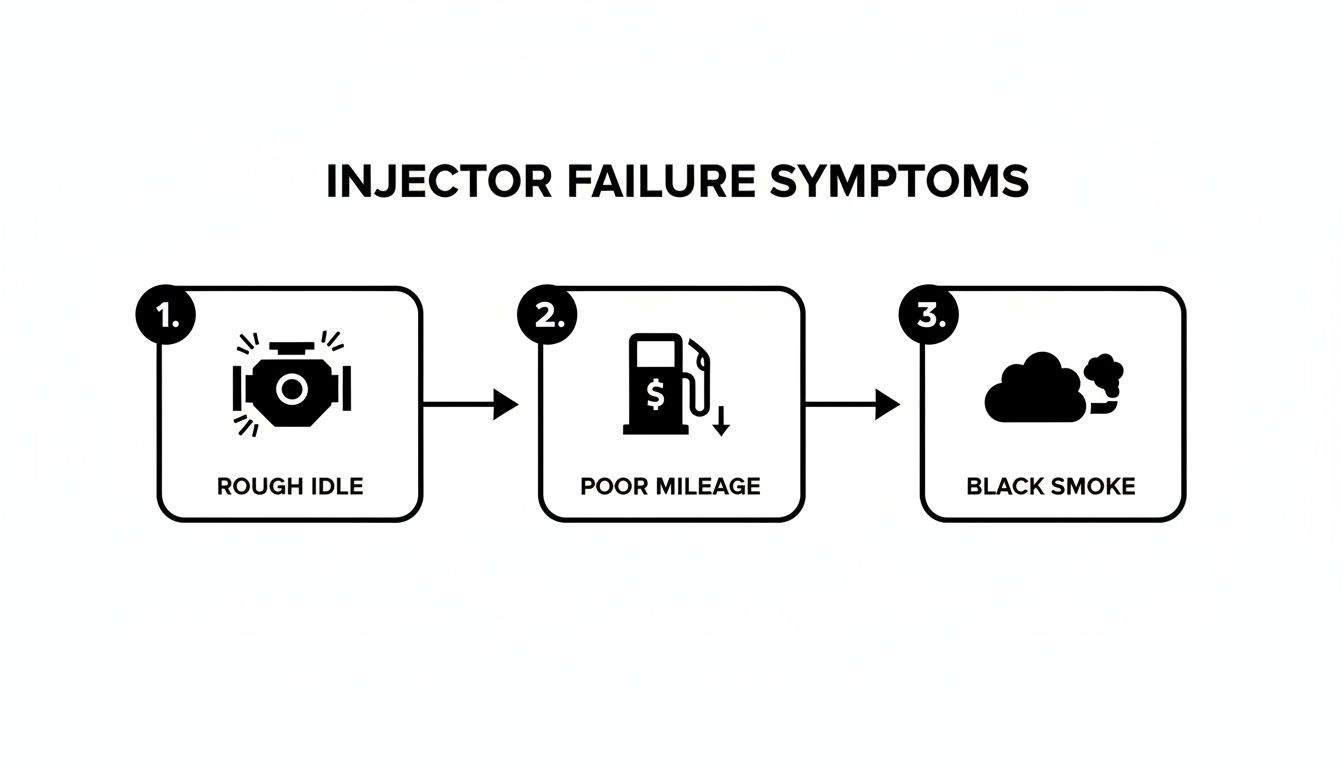
Those symptoms mean your injectors aren't atomizing fuel properly. Instead of a fine mist, they’re dribbling or spraying unevenly, which wastes fuel, costs you power, and puts unnecessary strain on your engine.
Step 1: The Initial Health Check (Bench Testing)
The first thing that happens is a full diagnostic workup. Before a single tool touches them, your injectors are mounted on a computerized test bench, like a high-end Bosch EPS machine. This isn't just a simple flow test; this rig puts the injectors through their paces, simulating everything from a calm idle to full-throttle, open-water runs.
This initial test gives us a baseline report card, grading each injector on critical metrics:
- Fuel Delivery: Is it pushing the right volume of fuel at every pressure level?
- Spray Pattern: Is the fuel coming out as a perfectly shaped, atomized cone, or is it a sloppy, streaming mess?
- Response Time: How fast is the electronic solenoid firing? We're talking measurements in microseconds.
- Back-Leakage: Is fuel seeping past worn internal parts? This is a huge pressure killer.
This "before" snapshot is absolutely vital. It tells the technician not just if an injector has failed, but exactly how it's failing, creating a precise roadmap for the rebuild.
Step 2: Full Teardown and Deep Cleaning
With the diagnosis in hand, it’s time to operate. Each injector is carefully disassembled in a dedicated clean-room environment. This is non-negotiable—a single stray particle of dust can jam a freshly rebuilt injector and send you right back to square one. Every tiny piece—the nozzle, needle valve, springs, solenoid, and seals—is methodically separated.
Next, all those components take a bath in a heated, industrial-grade ultrasonic cleaner.
Think of it like a jewelry cleaner on steroids. The tank uses high-frequency sound waves to create millions of tiny, imploding bubbles. These bubbles act like microscopic pressure washers, blasting away years of stubborn, baked-on carbon and varnish from every nook and cranny. It's a level of clean you could never achieve with solvents or brushes alone.
This process is the foundation for a successful rebuild. It ensures every part is spotless for inspection and that no hidden gunk is left to foul up the final product.
Step 3: Microscopic Inspection and Component Replacement
Once squeaky clean, every internal part goes under a high-powered microscope. A trained eye scans for imperfections that are invisible to the naked eye—tiny cracks, pitting on the nozzle tip, or wear patterns on the needle valve. We’re looking for wear measured in microns, because even the slightest flaw can completely throw off the spray pattern and ruin performance.
This is where the real "rebuild" part of the process happens. Anything that doesn't meet the original factory specifications gets tossed. Worn components are replaced with brand-new, top-quality parts, which almost always includes:
- Nozzle Assembly: This is the #1 wear item and the single most important part for a perfect spray pattern.
- All Seals and O-Rings: Every rubber and copper seal is replaced to guarantee against leaks.
- Internal Springs and Valves: These tiny parts control the timing and pressure, and they fatigue over time.
About the only thing that gets reused is the main injector body, which is just a solid chunk of steel. Everything that moves, seals, or wears is replaced.
Step 4: Precision Reassembly and Final Exam
With a full set of new internals, the injector is painstakingly reassembled in the clean room. Every screw and component is torqued to precise factory specs—too tight or too loose, and the whole thing is off.
Then, it’s back to the test bench for the final exam. The rebuilt injector is run through the exact same battery of tests as when it first came in. The goal is simple: it has to perform identically to a brand-new unit. The machine generates a final "after" report, showing perfect flow rates, split-second response times, and a flawless spray pattern. This report is your certificate of quality, proving the injector is fully restored and ready for service.
This rebuild ecosystem is a massive part of the marine and automotive industries. The global market for diesel common-rail injection systems was valued at around USD 3.7 billion, and it's projected to climb to USD 4.9 billion by 2033. That growth highlights the huge demand for both new and expertly rebuilt components. You can discover more about the diesel injection system market and its continued importance.
The Money Talk: Rebuilding vs. Replacing Your Injectors
When your engine starts acting up, you’re suddenly faced with a big decision: rebuild the problem parts or replace them entirely? For diesel fuel injectors, this usually comes down to one question—which option makes the most financial sense? The answer isn't just about the number on the invoice. It's about weighing the upfront cost against long-term performance and the total value you get for your money.
For most boat owners, a professional diesel fuel injector rebuild is the smartest path forward. It’s a chance to get your engine running like it just left the factory, but at a price that won’t completely torpedo your maintenance budget.
The savings are significant and immediate. Opting to rebuild your existing injectors can cut the cost by 40-60% compared to buying a brand-new set from the manufacturer. That's not pocket change. On a V8 or V12 marine diesel, we’re talking about a difference of thousands of dollars—money you can put toward other essential upkeep.
More Than Just Upfront Savings
While saving a chunk of cash right away is great, the real financial win from a professional rebuild shows up over the long haul. A properly rebuilt and calibrated injector isn't just a "fixed" part; it's a precision instrument that has been completely restored to its original glory. That restoration has a direct, measurable effect on how much fuel you burn.
Think about it. When an injector's spray pattern starts to fail, it's basically just dribbling fuel into the cylinder instead of atomizing it. That unburnt fuel goes right out the exhaust as black smoke, and you get less power for every gallon you pump. It's a total waste.
A professional rebuild brings back that perfect, cone-shaped mist of fuel your engine was engineered for. This isn't just a minor tweak—it directly boosts your fuel economy. For a commercial boat, even a small bump in efficiency adds up to massive savings over a season.
This turns the rebuild from a simple repair into a smart investment. It’s a fix that starts paying you back every single time you leave the dock, lowering your operating costs and giving you more range between those painful trips to the fuel pontoon.
A Decision Backed by Data
The cost difference between rebuilding and replacing isn't just anecdotal; it's a core reality of the marine service industry. A quality injector rebuild typically runs between USD 150–600 per injector. A full replacement, especially for newer high-pressure common rail units, can easily top a thousand dollars a pop.
For commercial operators, the math is even more compelling. Achieving just a 1–3% improvement in fuel economy from a set of perfectly calibrated, rebuilt injectors can translate to tens of thousands of dollars in annual fuel savings. As you can learn more about the diesel fuel injector market, you'll see these financial realities are what drive the service industry. It’s all about hard operating-cost calculations.
This shows that the choice isn't just about saving a few bucks today. It’s about setting your engine up for peak financial and operational performance for years to come.
A Detailed Look at Your Options
To truly understand what's at stake, you need to compare these options side-by-side. Is a brand-new part always better? What about a "remanufactured" one you can buy off the shelf? Let's break it down.
Detailed Comparison Diesel Injector Rebuild vs Replacement
An in-depth look at the key differences between rebuilding an existing injector and purchasing a new or remanufactured replacement.
| Factor | Professional Rebuild | New OEM Replacement | Remanufactured Replacement |
|---|---|---|---|
| Upfront Cost | Lowest. Significant savings over new parts. | Highest. You pay a premium for brand-new components. | Moderate. Cheaper than new, but often more than a rebuild. |
| Performance | OEM-Spec. Restored to original factory performance and flow rates. | OEM-Spec. Guaranteed to perform as the manufacturer intended. | Variable. Quality can differ greatly between suppliers. |
| Component Quality | Your original core is used. Wear parts (nozzles, seals) are replaced with new, high-quality components. | All components are brand new and factory-original. | Unknown core history. Quality of replacement parts can vary. |
| Turnaround Time | Fast, often 24-48 hours with a mobile service. | Depends on dealer stock; can involve shipping delays. | Immediate if in stock, but may require shipping. |
| Warranty | Excellent. Reputable services offer strong warranties on parts and labor. | Excellent. Typically comes with a full manufacturer's warranty. | Varies. Often limited and may not cover labor costs. |
| Fuel Economy | Improved. Precise calibration optimizes fuel delivery and efficiency. | Restored. Brings fuel consumption back to factory levels. | Inconsistent. Without precise calibration, may not improve efficiency. |
Looking at the full picture, a professional rebuild of your existing injectors offers the best of all worlds. You get the same top-tier, reliable performance as a new part but at a much lower cost and with the added bonus of long-term fuel savings. For any boat owner who values both their engine and their wallet, it's the clear and logical choice.
How to Select a Qualified Marine Diesel Service

When it comes to a diesel fuel injector rebuild, the outcome has very little to do with the new parts and everything to do with the hands doing the work. You can have the best components in the world, but if the technician lacks the skill and the right equipment, you're just throwing money away. This is easily the most critical decision you'll make in the entire process.
A true specialist restores an injector to its original factory-perfect condition. An amateur simply cleans up the old parts and swaps a few seals, leaving you with the same underlying problems that will absolutely resurface down the line. It's about finding a genuine partner in your engine's health, not just another repair shop.
Look for Factory Certifications and Real-World Experience
The world of diesel injectors isn't one-size-fits-all. A mechanic who spends their days working on long-haul trucks likely doesn't grasp the unique, harsh demands of the marine environment. Your first move should be to check their direct, hands-on experience with marine diesel engines—specifically brands like MTU, MAN, or CAT.
Then, dig deeper and look for certifications from the fuel system manufacturers themselves.
- Bosch, Delphi, and Denso Certifications: These are the gold standard. A shop that's an official Bosch Diesel Center, for instance, has invested serious time and money into manufacturer-approved training and equipment. It's a huge green flag.
- Engine-Specific Training: Ask them directly if their technicians are certified to work on your engine brand. This tells you they understand the entire fuel system, not just the injector in isolation.
These credentials aren't just fancy pieces of paper. They're proof that a shop meets the incredibly high standards required to work on modern high-pressure fuel systems.
Inquire About Their Tools of the Trade
You can't do a professional rebuild without professional-grade equipment. It's that simple. The tools a shop uses are a direct window into its commitment to quality. If you walk in and see a simple pop-tester sitting in the corner of a grimy workshop, turn around and walk out.
You need to ask one question point-blank: "What specific test bench do you use for calibration?" A qualified shop will be proud to tell you. They'll name-drop machines like a Bosch EPS 205 or a Hartridge AVM2-PC. These computerized test benches are the only way to accurately measure fuel delivery, spray pattern, and response time under simulated engine conditions.
Without this kind of technology, a technician is flying blind. They have no way to verify that a rebuilt injector actually meets OEM specifications. Your "rebuild" becomes nothing more than a very expensive gamble.
While you're at it, ask if they reassemble injectors in a dedicated clean room. Modern injectors have internal tolerances measured in microns. A single speck of dust can cause a catastrophic failure.
Verify the Quality of Replacement Parts
A rebuild is only as strong as its weakest component. A classic shortcut for shady shops is to use cheap, aftermarket internal parts. These knock-off components often fail prematurely, which can lead to leaks, poor performance, and even catastrophic engine damage.
Before you agree to any work, demand total clarity on their parts.
- Ask if they use OEM or equivalent parts. Reputable technicians will only install new nozzles, seals, and internal valves from trusted manufacturers that meet or exceed original factory quality.
- Request a detailed breakdown. A transparent quote should list the specific parts being replaced, not just a vague line item like "rebuild kit."
- Confirm the warranty. A shop that stands behind its work will offer a solid warranty—typically 12-24 months—that covers both parts and labor. Be very skeptical of any warranty that's less than a year.
By asking these sharp, informed questions, you go from being a customer to being a savvy boat owner. You’ll quickly be able to tell the real experts from the "parts-swappers," ensuring your injector rebuild restores your engine's power, efficiency, and reliability for years of trouble-free running.
Your Diesel Fuel Injector Rebuild Questions Answered
Alright, let's get down to brass tacks. You know the what and the why of an injector rebuild. Now it's time for the practical questions—the ones that really matter when you're deciding to pull the trigger on a service. We're talking about downtime, warranties, and all the real-world details that every boat owner needs to nail down before moving forward.
Getting straight answers to these questions is how you go from being uncertain to feeling completely confident in your maintenance plan.
How Long Does a Diesel Fuel Injector Rebuild Usually Take?
This is the big one, isn't it? Every owner's worst enemy is downtime. The good news is, once the injectors are out of the engine and in the hands of a pro shop, the actual bench work is surprisingly quick.
For a typical set of six to eight injectors, you can expect the whole process—testing, teardown, ultrasonic cleaning, reassembly with new parts, and final calibration—to take about 2 to 5 business days. This can shift a bit depending on how busy the shop is or if your specific injectors are a more complex model.
Keep in mind, that's just the time the injectors spend on the workbench. If you're using a mobile tech who's also handling the pull-and-install from your engine room, you need to add that time into the equation. Always ask for a complete time estimate from start to finish so you know exactly how long your boat will be out of commission.
What Kind of Warranty Should I Expect on Rebuilt Injectors?
Think of a warranty as more than just a piece of paper. It's the technician's handshake—their promise that they stand behind their work and the quality of the parts they used. Any reputable shop will back their rebuilds with a solid guarantee.
The industry standard is usually a 12-month warranty. This should cover any defects in the new internal parts and the labor that went into the rebuild. If you see a warranty for less than 90 days, or worse, no warranty at all? That’s a massive red flag. Run, don't walk.
When you're looking at the warranty, ask about a few specifics:
- What's Covered: Does it include just the parts, or the labor to fix an issue too?
- Any Limits?: Are there any operating hour caps on top of the 12-month period?
- Claim Process: If something does go wrong, what’s the exact process to get it sorted out?
A strong warranty is your peace of mind, plain and simple. It’s your insurance that this investment is protected.
Can All Types of Diesel Injectors Be Rebuilt?
For the most part, yes. The vast majority of diesel injectors, from old-school mechanical units to modern common rail systems, are designed to be serviced. Their core design—a tough steel body that holds parts designed to wear out—is what makes them perfect candidates for a rebuild.
But there are a couple of exceptions. Some of the newest, most complex piezoelectric injectors can be tough to rebuild simply because aftermarket parts aren't widely available yet. The more common issue, though, is catastrophic physical damage to the injector itself.
An injector is usually a lost cause if it has:
- A cracked or warped body from severe overheating or a botched installation.
- Deep internal scoring from a major fuel contamination event.
- Physical damage from a serious engine failure, like a dropped valve.
Any good technician will start with a full inspection to make sure your injectors are even rebuildable. If a core is too far gone, they'll tell you right away before a single dollar is spent on labor.
Will Rebuilt Injectors Affect My Engine's Warranty?
This is a huge question for anyone with a newer boat still under the manufacturer's warranty. The answer is a bit nuanced, but the law is generally on your side.
While some manufacturers might try to tell you that only brand-new OEM parts will preserve your warranty, federal law says otherwise. In the U.S., the Magnuson-Moss Warranty Act protects consumers from this. It prevents a manufacturer from voiding your warranty just because you used a quality rebuilt or aftermarket part.
The key thing to remember is that the burden of proof is on them. The engine manufacturer has to prove that the rebuilt injector specifically caused the failure they are denying coverage for. If your engine is still under warranty, the safest play is to read your policy carefully and have a frank discussion with your marine tech about the best path forward.
When your marine diesel engine demands expert attention, you need a service that comes to you. GTM International provides factory-certified, mobile diesel diagnostics and repair across South Florida, ensuring your vessel gets the professional care it needs without the hassle of a trip to the yard. For reliable performance and peace of mind on the water, contact our team for expert marine diesel service.
