

If you think of your engine as a living, breathing machine, the fuel injectors are the critical valves of its heart. They deliver precise, high-pressure bursts of diesel fuel right where it's needed most, at the exact moment it's needed, to create power. On the big names in marine diesel—MTU, MAN, and CAT—the fuel injector location is almost always the same: mounted directly in the cylinder head for each individual cylinder.
This design allows the injector to spray a fine mist of fuel straight into the combustion chamber. It’s the secret to their incredible power and efficiency. But, this prime real estate comes with a catch—they're always tucked away, usually under a heavy valve or rocker cover, making them impossible to see without getting your hands dirty.
Uncovering the Fuel Injector Location
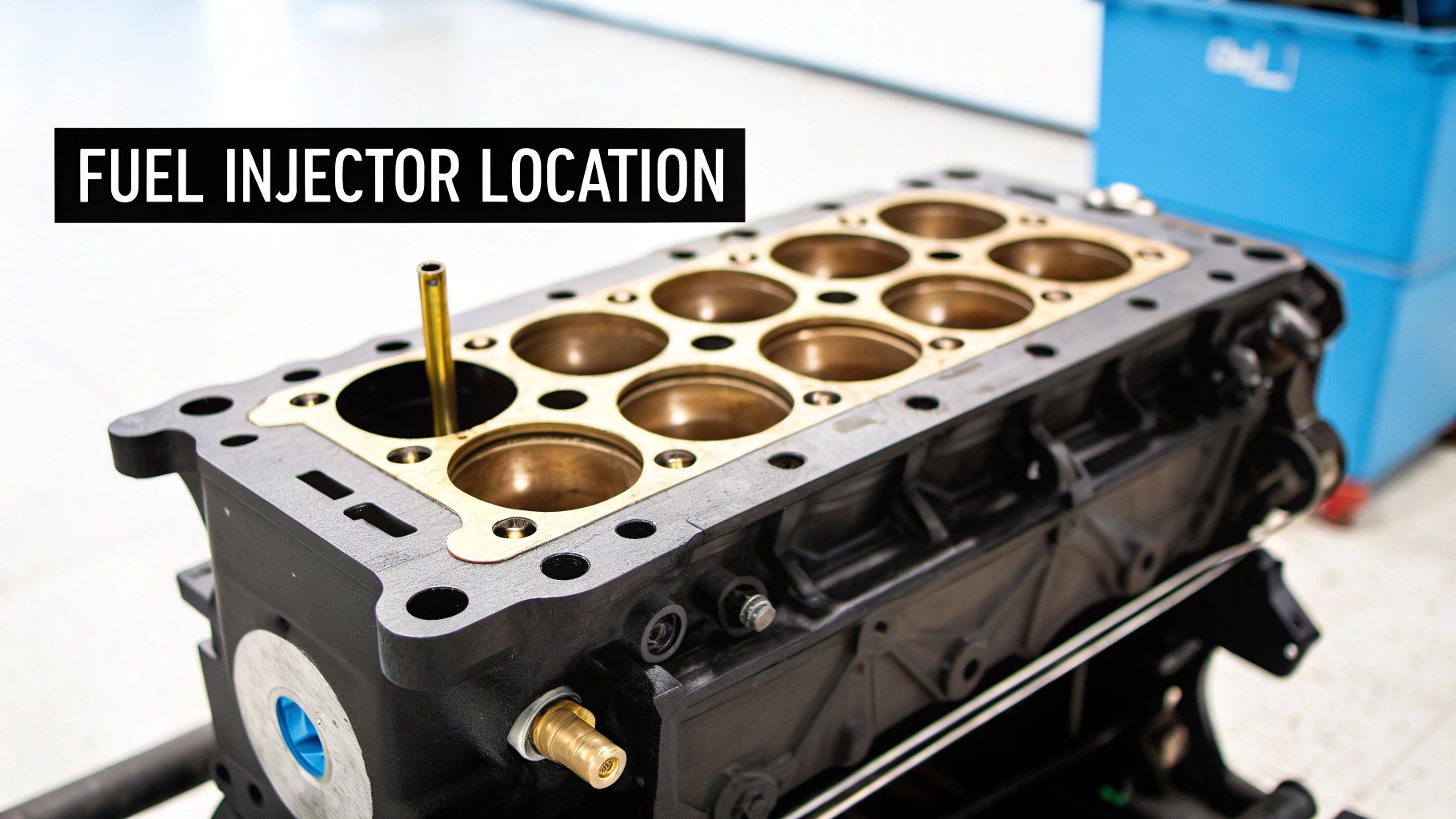
The spot where an injector lives isn't a random choice; it's the result of some serious engineering focused on one thing: perfect combustion. By placing the injector vertically right in the cylinder head, the fuel spray gets a direct, unobstructed path into the chamber. This "direct injection" method is what gives modern marine diesels their punch.
Of course, this means accessibility takes a backseat. Since the injectors are buried deep in the core of the engine, they're always protected by a major component like a valve cover. A quick look-see just isn't an option. You have to remove a few things first.
Common Hiding Spots on Major Brands
This design is pretty much standard across the board for the big three. The laws of diesel physics demand this setup, though you'll see small variations from one brand to the next.
- MTU Engines: On an MTU, you’ll typically find the injectors hiding under a large, central valve cover. The giveaway is the high-pressure fuel lines snaking their way to each injector.
- MAN Engines: It's a similar story with MAN engines. The injectors are nestled under the rocker covers, but you can often spot them by the distinct electrical connectors that are part of the common rail system.
- CAT Engines: No surprises here. On a CAT, the injectors are also located in the cylinder head. You'll need to pull the valve cover assembly to get a clear view of them.
To make things a bit simpler, here's a quick reference table showing where to start your search.
Quick Guide to Fuel Injector Locations on Popular Marine Engines
| Engine Manufacturer | Common Fuel Injector Location | Typical Covering |
|---|---|---|
| MTU | Vertically in the cylinder head | Central valve cover |
| MAN | Vertically in the cylinder head | Rocker covers |
| CAT | Vertically in the cylinder head | Valve cover assembly |
As you can see, there's a clear pattern. The injector's job is so critical that it's placed right in the heart of the action, protected by layers of hardware.
The fuel injector's position in the cylinder head is everything when it comes to performance and maintenance. They're almost always mounted vertically, squeezed between the intake and exhaust valves in modern 4-valve layouts, and hidden from view. You can dig deeper into the engineering behind this by reviewing some technical findings on marine engine reliability.
Because these injectors are out of sight, you can't rely on a simple visual check to spot a problem. That makes it incredibly important to recognize the symptoms of a failing injector, which is exactly what we'll cover next.
Why Injector Location is Ground Zero for Engine Problems
A fuel injector’s location isn’t just a random spot; it’s a brilliant piece of engineering, placed right in the heart of the action to squeeze every ounce of power from every drop of fuel. But that prime real estate—buried deep inside the cylinder head—is also one of the most violent, unforgiving places on the entire vessel. Imagine trying to keep a Swiss watch running perfectly inside an active volcano. That's the injector's reality.
This little component is under constant siege. We're talking about combustion temperatures that can top 1,500°F and pressures that spike over 25,000 PSI, all while fending off a never-ending assault of carbon buildup. This brutal environment means the fuel injector is, by its very nature, a wear-and-tear part. It's designed to eventually fail, simply from doing its job.
The Direct Line from Location to Failure
The injector’s punishing workplace is the real reason behind so many engine headaches. Because it sits on the front lines of combustion, it takes the full force of the heat, pressure, and contamination. It’s no surprise, then, that fuel system problems are one of the biggest culprits behind marine diesel engine trouble.
The connection is startlingly clear. In fact, studies of marine diesel engines show that a staggering 70% of major breakdowns inside the combustion chamber can be traced back to a fuel injector malfunction. Digging deeper, the data reveals that injectors are responsible for over 60% of all damaged parts found in these analyses. If you're curious, you can dive into the numbers yourself in this detailed analysis of marine engine failures.
This isn’t just a minor detail for your mechanic to worry about; it's a fundamental vulnerability every yacht owner needs to grasp. The very design that gives your engine its muscle also creates this specific, predictable point of failure.
Why You Can’t Afford to "Wait and See"
Because they're buried deep in the engine, it's easy to take an "out of sight, out of mind" approach to fuel injectors. But that's a massive gamble. A failing injector doesn't just quietly give up; it can set off a disastrous chain reaction that brings your voyage to a grinding halt.
Think about it: a bad spray pattern from a worn injector can wash lubricating oil right off the cylinder walls. This leads to scored pistons, damaged liners, and in the worst-case scenario, a completely seized engine. The fallout goes way beyond just losing a little power.
Once you understand that cause-and-effect, it’s obvious that proactive service isn't just a good idea—it's essential insurance against a catastrophic, trip-ending breakdown. The harsh environment injectors live in leads directly to a few common culprits:
- Carbon Buildup: Soot from combustion acts like concrete, clogging the tiny nozzle holes and wrecking the fuel spray pattern.
- Heat Damage: The intense, constant heat can warp the injector’s internal parts, leading to fuel leaks or poor atomization.
- Pressure Fatigue: Imagine a spring being compressed and released thousands of times a minute. That’s what’s happening inside, and eventually, the seals and springs wear out, messing up your engine's timing and fuel delivery.
Since the fuel injector location makes a quick visual check impossible, learning to spot the symptoms of a failing injector is your best defense against getting stranded miles from shore.
How to Visually Identify Injectors on MTU, MAN, And CAT Engines
Knowing the general neighborhood of your fuel injectors is one thing, but being able to walk right up and point them out on your specific engine is a whole different level of confidence. Let's treat this like a field guide for spotting these critical components on three of the biggest names in marine diesel: MTU, MAN, and CAT.
Even though they all live under the valve covers, each brand has its own distinct "tell"—a visual fingerprint that gives away their location.
Getting good at this isn't just for your own curiosity. It means when you call a technician, you can describe exactly what you're seeing, clearly and accurately. This simple skill can seriously speed up the diagnostic process, leading to a faster, more effective, and often less expensive service call. The goal isn't to do the repair yourself; it's to be an informed owner.
Finding Injectors on MTU Engines
With most MTU power plants, the simplest trick is to just follow the fuel. Your eyes are looking for the rigid, high-pressure fuel lines. These aren't flexible hoses; they're hard metal tubes built to handle insane pressures, running from the fuel rail directly to each cylinder head.
Trace one of these lines to where it meets the engine. You’ll see it hook into a fitting that vanishes under the big, central valve cover. That connection point is your bullseye. The fuel injector is seated right below it, securely in the cylinder head. You won't see the body of the injector without popping the cover, but you'll know exactly where it is. For a closer look at these engines, our guide to MTU diesel marine engines has more detail.
Identifying MAN Common Rail Injectors
MAN engines, particularly the modern common rail models, give you a different clue to follow: the electronics. You'll still have the high-pressure fuel line, but running right alongside it is a dedicated electrical connector for each injector. That wiring harness is the dead giveaway.
To find them, just scan the top of the engine. You're looking for a neat series of identical wires all heading to the same spot on each cylinder, disappearing under the rocker covers. These wires are the brains of the operation, telling the injector precisely when to open and for how long. Follow that electrical road map, and it'll lead you straight to every injector. The clean, symmetrical layout is pure MAN engineering.
An injector works in an incredibly hostile environment, constantly battling immense heat and pressure. This is what causes wear. That inevitable breakdown is the number one cause of engine performance problems and, eventually, failure. It’s a clear, predictable path from normal operation to a serious problem.
The diagram below shows exactly how an injector’s environment leads to wear and, ultimately, failure.
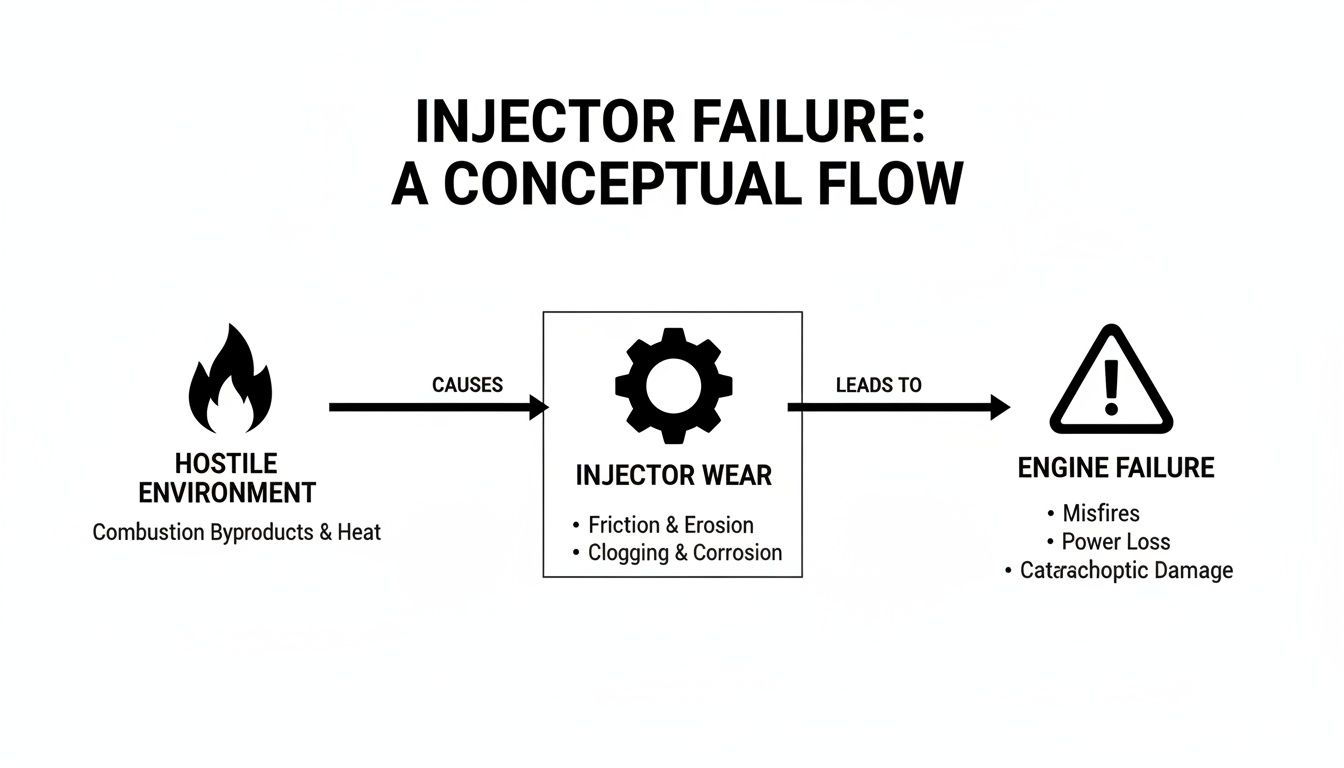
This simple flow really highlights the direct link between the injector's tough job and its limited lifespan.
Locating CAT Engine Injectors
On a Caterpillar engine, the biggest landmark to look for is the common rail itself. This is a beefy, heavy-duty tube or rail that runs the length of the engine, acting as the distribution hub for all the high-pressure fuel. Think of it as a manifold, with smaller individual fuel lines branching off to feed each cylinder.
Your job is to follow those smaller branch lines from the common rail over to the cylinder head. Just like with the other brands, they'll end right at the spot where the injector is seated under the valve cover assembly. The whole system is built tough—you'll notice heavy-duty fittings and components that are bolted down securely. By tracing this fuel distribution network, you can pinpoint every single injector with absolute certainty.
Recognizing the Warning Signs of a Failing Injector
A fuel injector rarely just gives up the ghost without a fight. Long before a complete breakdown leaves you stranded, your engine will start sending out distress signals. Think of these as an early warning system, and learning to read them is the key to preventing a minor service from becoming a catastrophic, trip-ending failure.

These symptoms often start small—a slight hesitation, a puff of smoke—but they almost always get worse. Your job is to connect what you see, hear, and feel to what’s happening deep inside the engine, right where the fuel injector is located in the cylinder head. When you're miles from shore, ignoring these red flags is a gamble you just can't afford to take.
Telltale Symptoms and What They Mean
When a fuel injector starts to go bad, it throws off the incredibly precise balance of fuel and air that your engine needs for clean, powerful combustion. This imbalance shows up in a few classic ways, each one a clue pointing to a specific internal issue.
- Excessive Black Smoke: This is the big one. That thick, sooty smoke is nothing more than unburned fuel pouring out of your exhaust. It’s a dead giveaway that an injector nozzle is "dribbling" raw fuel instead of atomizing it into a fine, combustible mist.
- Rough Idling or Engine Knock: An engine should hum. If it’s shaking, vibrating, or making a metallic "knocking" sound, it could be a sign of trouble. A clogged or misfiring injector means a cylinder isn't pulling its weight, creating an imbalance that you can literally feel.
- Sudden Loss of Power: You push the throttle and… nothing. That sluggish, weak response often points to fuel starvation. A faulty injector simply can't deliver the volume of fuel needed when you demand power.
- Increased Fuel Consumption: Finding yourself at the fuel dock more often? A leaking or inefficient injector is a thief, dumping more fuel into a cylinder than the engine can actually burn. Your performance drops and your fuel bill skyrockets.
A single bad injector doesn’t just hurt performance—it starts a dangerous chain reaction. The unburned fuel from a dripping nozzle can wash away the critical lubricating oil on the cylinder walls. This leads to friction, scoring, and in a worst-case scenario, a completely seized engine. It's a textbook example of how a small part can lead to a massive repair bill.
To help you connect the dots between what you're experiencing and what might be wrong, this table breaks it down.
Troubleshooting Common Fuel Injector Symptoms
This simple chart links common symptoms directly to the most likely injector-related problems, helping you diagnose the issue faster.
| Symptom | What It Looks/Sounds Like | Potential Injector-Related Cause |
|---|---|---|
| Black Smoke | Thick, dark smoke billowing from the exhaust, especially under load. | Injector nozzle is dripping fuel or has a poor spray pattern. |
| Engine Knock | A sharp, metallic pinging or knocking noise coming from the engine. | A clogged injector is causing a lean fuel mixture and improper detonation. |
| Rough Idle | The engine shakes, shudders, or vibrates erratically while in neutral. | An injector is partially blocked or isn't firing consistently. |
| Power Loss | The engine feels sluggish, weak, and slow to respond to the throttle. | One or more injectors aren't delivering enough fuel to meet demand. |
Recognizing these symptoms is the critical first step. Now, let’s talk about why grabbing a wrench yourself might not be the best next move.
Why Accessing Injectors Is a Job for Professionals
So, you know where to find your fuel injectors and you've seen the signs that something might be wrong. It's only natural to feel the urge to grab a wrench and start digging in. But I have to stop you right there. This is one of those moments where a bit of caution isn't just a good idea—it’s absolutely critical for your safety and the long-term health of your engine.
Working on a modern marine diesel fuel system isn't your average weekend project. This is high-stakes stuff, where one tiny misstep can have massive consequences.
The number one reason? Pressure. Colossal, almost unbelievable pressure. Modern common rail systems operate at levels that are hard to even wrap your head around, often pushing past 25,000 PSI. For comparison, a firefighter's hose is only blasting water at about 300 PSI. That pressure isn't just a statistic; it's a measure of raw, destructive power.
The Hidden Dangers of High Pressure
A pinhole leak in a high-pressure fuel line—something you might not even see or hear—can create a jet of diesel fuel so fine and powerful it can slice through work gloves and skin in a fraction of a second. It's called a high-pressure injection injury, and it is a life-threatening medical emergency.
The real danger is how deceptive it is. The fuel contaminates tissue deep under the skin, and because the entry wound might just look like a tiny pinprick with no initial pain, people tragically ignore it until it's far too late. This kind of injury requires immediate, aggressive surgery to prevent devastating tissue damage or amputation.
I'm not saying this to gatekeep the knowledge. I'm saying it to prevent a catastrophic injury. The immense pressures inside a common rail system can turn a simple check into a life-altering event. There is no such thing as a "minor" high-pressure fuel leak.
Beyond the Risk to Your Safety
Even if you manage to avoid getting hurt, the risk of causing expensive, and sometimes irreversible, damage to your engine is incredibly high. Modern fuel injectors aren't just simple mechanical nozzles anymore. They are incredibly sophisticated, electronically controlled components, machined to tolerances thinner than a human hair.
Without the proper training and highly specialized tools, it's dangerously easy to make a costly mistake.
- Damage the Injector Body: The wrong tool or a little too much torque can easily crack the injector casing or snap off the delicate nozzle tip.
- Contaminate the Fuel System: Just one spec of dirt getting into the high-pressure side of the system can take out an injector or even the high-pressure fuel pump. This is why professionals work in environments as clean as an operating room.
- Harm the Cylinder Head: Trying to force a seized injector out can strip the threads in the aluminum cylinder head. That turns a simple injector replacement into a massive engine overhaul that involves pulling the head completely.
These aren't just what-if scenarios; we see these kinds of outcomes all the time from well-intentioned but ill-equipped repair attempts. Understanding the complexity of the job is key, and our guide on how to repair diesel injectors digs deeper into what the professional process actually involves.
Ultimately, knowing where your fuel injectors are located is for smart diagnosis and communication—not for hands-on work.
What to Do When You Suspect an Injector Problem
So, you’ve pinpointed where the fuel injectors live on your MTU, MAN, or CAT engine. You know the warning signs of a failing injector, and you’re well aware of the serious risks involved in trying to tackle this job yourself.
What’s next? This is the most important step for the health of your vessel and your own safety: it’s time to call in the professionals.
Trying to figure out what’s wrong with a high-pressure common rail system without the right equipment is just shooting in the dark. It’s pure guesswork. A certified technician, on the other hand, shows up with advanced mobile diagnostic tools that plug right into your engine’s ECU. This isn't just a basic code reader; it's a window into the engine's brain.
They can pull up specific fault codes, watch live performance data, and see exactly which injector is causing the trouble—all without tearing half the engine apart. This data-driven approach takes all the speculation out of the equation. No more wasted time, and no more replacing parts that were perfectly fine to begin with.
The On-Site Service Advantage
Let's be honest, the biggest win with professional service is saving you a massive headache. Forget the logistical nightmare and steep costs of hauling your yacht to a shipyard. Our mobile technicians come directly to you, wherever you're docked. We handle everything right there on-site, from the initial diagnosis to the final injector replacement.
Here’s a look at how our on-site process usually unfolds:
- Initial Diagnostics: We hook up our specialized computer software to confirm the injector fault and see exactly what the ECU is reporting.
- Safe Removal: Using the correct factory tools, we safely extract the problematic injector without risking any damage to the cylinder head—a costly mistake that’s all too common in DIY attempts.
- Testing and Replacement: We install a brand new or professionally reconditioned injector that meets or exceeds OEM specifications.
- System Calibration: This last step is crucial. We make sure the new injector is perfectly calibrated and integrated with your engine’s management system for flawless performance.
When an injector goes bad, you've got two main options: replace it or rebuild it. A brand-new injector is the quicker fix, but a professional rebuild can often bring a tired injector back to factory-fresh performance for a fraction of the cost. For many owners, it’s a smart financial move.
Dealing with a potential injector problem doesn't have to be a stressful ordeal. Making the call for expert help is the smartest, safest, and most efficient way to protect your investment and get your engine running with the rock-solid reliability you depend on.
With the right team on your side, you can learn more about the diesel fuel injector rebuild process and get back to enjoying your time on the water, worry-free.
Your Top Questions About Fuel Injectors Answered
When you're dealing with high-performance marine diesel engines, questions are bound to come up. Let's tackle some of the most common ones we hear from yacht owners and captains about their fuel injectors.
How Often Should I Have My Injectors Serviced?
This is a great question, but the answer isn't a simple number. It really comes down to the engine manufacturer's recommendations, your total engine hours, and the quality of the fuel you're running.
As a good general benchmark, you should have your injectors professionally inspected during your major service intervals, which usually land somewhere between every 1,000 to 2,000 hours of runtime.
But here's the thing: you can't just rely on the hour meter. If the engine starts acting up—you're seeing black smoke, feeling a drop in power, or hearing it idle rough—that's your cue. Don't wait. Get those injectors checked out right away, no matter how many hours are on the clock.
Will Fuel Additives Actually Clean My Injectors?
Good, high-quality diesel additives can be a fantastic part of your preventative maintenance routine. They do a decent job of slowing down the inevitable carbon buildup on injectors that are already in good shape, helping to keep your whole fuel system cleaner for longer.
Think of it like this: an additive is like taking a daily vitamin. It helps a healthy system stay that way, but it's not a magic cure for a serious problem. It won't fix an injector that's mechanically worn out or clear a really stubborn clog. For that, you need professional diagnostics and cleaning.
What's the Real Difference Between Injector Types?
The biggest difference you'll see in the marine world is between the older mechanical injectors and the modern common rail systems.
- Mechanical Injectors: This is the old-school tech. Each injector is a self-contained unit that builds its own fuel pressure for every single injection. They're simpler, for sure, but less precise.
- Common Rail Injectors: These are what you'll find on most modern high-performance diesels. A single, high-pressure fuel line (the "common rail") feeds all the injectors, and a computer controls them electronically. This gives you incredibly precise fuel delivery, which means better efficiency and cleaner emissions. The trade-off is they run at insane pressures and demand specialized tools and know-how to service properly.
Suspect an issue with your GTM International fuel injectors but aren't sure where to start? Our factory-certified technicians come to you with advanced, on-site diagnostics to pinpoint the problem fast. Contact us today to schedule a service call and keep your vessel sea-ready.
