

An overhaul isn't just a repair; it's a rebirth for your engine. You get to this point when routine fixes and maintenance just aren't cutting it anymore. We're talking about persistent performance problems that point to serious internal wear—the kind of issues that a simple parts swap won't solve.
If you’re constantly topping off the oil, seeing strange-colored smoke from the exhaust, or feeling a definite lack of get-up-and-go, your engine is trying to tell you something important.
When to Overhaul Your Marine Diesel Engine
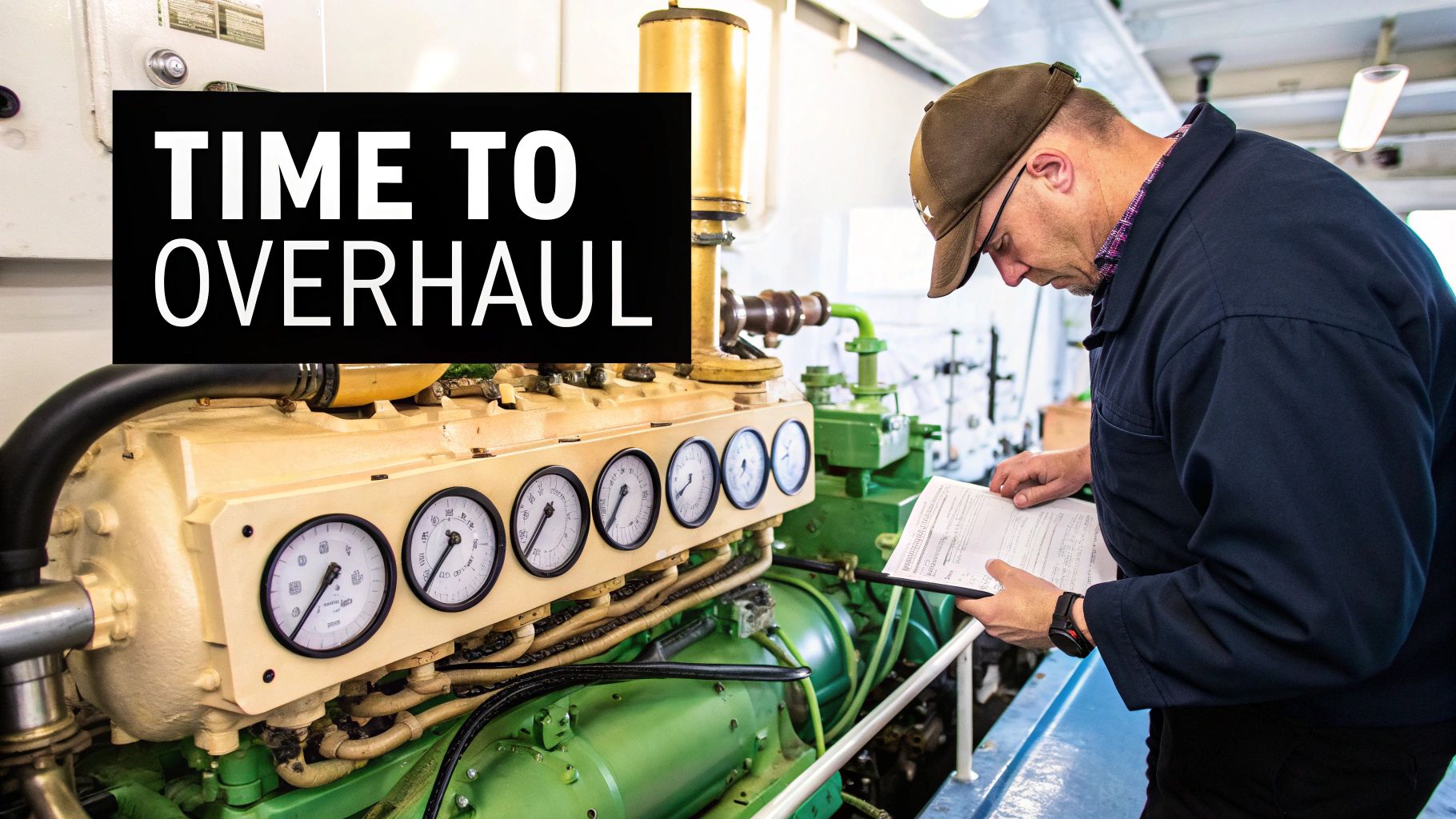
For any yacht owner or fleet manager, deciding to overhaul a marine diesel is a major crossroads. It's a serious commitment of time and money, no doubt about it. But putting it off can lead to something far worse: catastrophic failure at sea.
The trick is knowing the difference between a minor hiccup that needs a quick service call and a deep-seated problem that signals the engine's core components are worn out. Your engine has its own way of communicating, and it's usually through subtle changes in performance. Always trust your gut—if the engine just doesn’t feel right, it probably isn’t.
These symptoms have a sneaky way of creeping up on you, making them easy to ignore until they become too big to overlook.
Decoding Your Engine's Distress Signals
Learning to read the signs is the first step. Think of these symptoms as your early warning system, giving you the chance to schedule an overhaul on your own terms, not as an emergency response to a breakdown miles from anywhere.
To help you get a clearer picture, here’s a quick-reference checklist of common symptoms that tell you an overhaul might be on the horizon.
Overhaul Indicator Checklist
| Symptom | What to Look For | Severity (Low/Medium/High) |
|---|---|---|
| Excessive Oil Consumption | Constantly adding oil between changes. | Medium to High |
| Blue Exhaust Smoke | Visible blue-tinged smoke, especially under load. | High |
| Black Exhaust Smoke | Puffy, dark smoke during acceleration. | Medium |
| Loss of Power | Sluggish acceleration, can't reach previous top RPMs. | High |
| Hard Starting | Engine cranks longer than usual before firing up. | Medium |
| Rough Idle | Shaking or inconsistent engine speed at idle. | Low to Medium |
This checklist is a great starting point, but remember, every engine has its own personality. What's normal for one might be a red flag for another.
Beyond Symptoms: Engine Hours and Duty Cycles
While performance issues are your most immediate clues, engine hours tell a longer story. But it's crucial to remember that not all hours are created equal. An engine with 10,000 hours on a charter boat that’s run hard every day is in a completely different state than an engine with 2,000 hours on a weekend cruiser.
Manufacturers like MTU, MAN, and CAT all provide recommended overhaul intervals, but these are based on ideal conditions. You have to consider your engine’s duty cycle—how hard and how often it works—to truly understand where it is in its lifespan. Keeping a detailed marine diesel engine maintenance schedule is the best way to track this and see major service milestones coming.
The decision to overhaul isn't just about restoring performance; it's a strategic move to preserve your vessel's value and ensure its reliability for years to come. A documented overhaul is a powerful asset in the resale market.
Choosing to overhaul is also a sound financial decision. The market for diesel engine services is booming, with rebuilds being a key driver of that growth. In the non-automotive marine sector alone, the diesel engine market is projected to grow by around USD 14.7 billion between 2024 and 2029. A huge part of this comes from owners smartly choosing to overhaul and extend the life of their existing engines rather than facing the massive cost of a full replacement.
Crafting Your Pre-Overhaul Game Plan
A successful marine diesel engine overhaul is built on a foundation of solid planning, long before the first wrench ever touches a bolt. Think of this pre-overhaul phase as creating a detailed blueprint. Get this part right, and the project will run smoothly, stay on budget, and deliver what you need most: restored power and unwavering reliability.
This is where we move from a nagging suspicion that something’s wrong to proving it with cold, hard data. We're gathering objective evidence, painting a complete picture of your engine's internal health. This isn't about guesswork. It's a systematic investigation that eliminates doubt and lays out a clear path forward.
Frankly, a thorough diagnostic process is non-negotiable. Without it, you're just flying blind. You risk either overhauling an engine that doesn’t actually need it or, even worse, missing a critical underlying issue that will just come back to bite you later.
The Technician's Diagnostic Checklist
Before we even think about committing to a full overhaul, our certified technicians run a series of crucial tests to confirm the engine’s true condition. This isn't just a formality; it's the bedrock of an effective and efficient repair strategy. Each test tells a piece of the story.
- Engine Compression Test: This is the gold standard for checking the health of your cylinders, pistons, and rings. If we see low compression in one or more cylinders, it’s a classic, undeniable sign of wear that points straight toward an overhaul engine diesel service.
- Oil Analysis: A small sample of engine oil gets sent off to a specialized lab for what’s called a spectrographic analysis. It’s amazing what they can find—microscopic metal particles that tell us exactly which internal components are wearing down, whether it’s the crankshaft bearings or the piston rings.
- Borescope Inspection: We use a flexible, fiber-optic camera to get a direct look inside the cylinders. This lets us see the real-time condition of the cylinder walls, piston crowns, and valves without a major teardown. We can spot problems like scoring, heavy carbon buildup, or damage from a past overheating event.
- Fault Code Analysis: On modern, electronically controlled engines, pulling the diagnostic trouble codes (DTCs) is an absolute must. These codes give us a detailed history of the engine's performance, often revealing sneaky sensor failures, injector issues, or other electronic gremlins that are dragging down performance.
Every piece of data we gather helps build the case for an overhaul and, just as importantly, defines the scope of the work needed. This detailed approach is absolutely critical for understanding the full picture of your marine diesel engine repair costs before the work begins.
On-Site Overhaul vs. Full Haul-Out
Once the diagnostics confirm an overhaul is the right move, the next big decision is a logistical one. Do we do the work inside the vessel, or does the engine need to be pulled and taken to a shop? This choice has massive implications for both your budget and your downtime.
An on-site or "in-frame" overhaul is very often the most efficient path forward for larger yachts. Our mobile service essentially brings the workshop right to your dock. This allows our technicians to perform major repairs—like replacing pistons, liners, and bearings—without the huge expense and logistical nightmare of pulling the engine.
For many major overhauls, especially on larger MAN or MTU engines, a dockside, in-frame service can save yacht owners tens of thousands of dollars and cut project time by weeks compared to a full haul-out and engine removal.
But sometimes, a haul-out is simply unavoidable. There are a few situations where it’s the only practical, or even possible, choice.
When a Haul-Out is Necessary:
- Catastrophic Block Damage: If the engine block itself is cracked or has suffered severe damage, it absolutely has to come out for specialized machining or, in the worst-case scenario, replacement.
- Crankshaft Replacement: While some crankshaft work can be done in-frame, a full replacement or any kind of extensive machining pretty much always requires removing the engine to get it done right.
- Limited Engine Room Access: Let’s be honest, some engine rooms are just too tight. If there isn't enough space for technicians to safely and effectively disassemble and rebuild the engine, it has to come out.
Making the right call between an on-site service and a haul-out is where experience really counts. By carefully analyzing the diagnostic results and the physical constraints of your vessel, we can map out a strategic game plan that is both effective and economical, setting your overhaul up for success from day one.
The Teardown and Inspection Process
With the diagnostics done and a solid plan in place, it’s time to get our hands dirty. This is where the real work of the overhaul engine diesel process kicks off, and it demands precision, meticulous organization, and years of experience. A teardown isn't just about taking an engine apart; it's a systematic disassembly where every single component is carefully labeled, cataloged, and protected for the rebuild.
Think of it as a carefully managed archaeological dig. Every bolt, bracket, and hose comes off in a specific order, which is the only way to guarantee the reassembly process will be just as precise. A disorganized teardown is an absolute recipe for disaster, plain and simple. It leads to lost parts, incorrect assembly, and frustrating, expensive delays. Our technicians treat this stage with the respect it deserves, because the success of the entire overhaul hinges on it.
This process chart gives you a bird's-eye view of how a project flows from noticing the first symptoms to locking in a clear logistical plan.
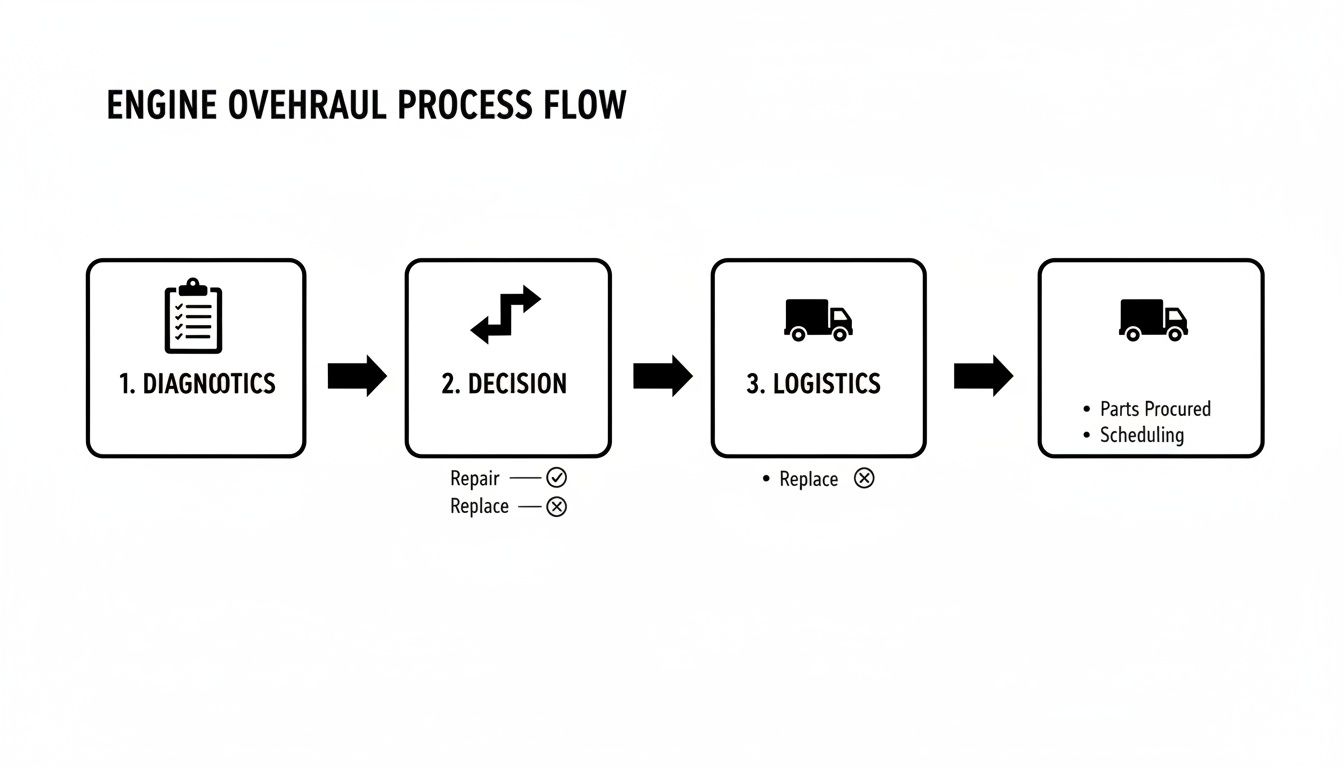
As you can see, a successful overhaul isn't just about the hands-on work. It’s about the critical thinking and meticulous planning that happen long before a single wrench is turned.
The Art of Forensic Inspection
Once the engine is carefully disassembled, the real investigation begins. This is where a factory-certified technician’s expertise truly shines. We aren't just looking for obviously broken parts; we're reading the story the engine is telling us through its wear patterns, heat signatures, and even microscopic imperfections.
It’s a true forensic process. For instance, a technician might pull a piston and notice a slight "polishing" on one side of the skirt. To an untrained eye, it might look insignificant. But to a seasoned expert, that tiny clue could point to a bent connecting rod or a misaligned cylinder liner—a deep-seated problem that, if missed, would cause the newly rebuilt engine to fail all over again.
The most critical part of any overhaul is the inspection. It's the difference between simply replacing parts and truly understanding and correcting the root cause of the engine’s failure. This is where years of hands-on experience with specific brands like MTU, MAN, and CAT become invaluable.
This meticulous approach is exactly why overhauling is a globally recognized strategy. The diesel engine remanufacturing market is a massive, multi-billion dollar industry for a reason—it flat-out works. It's projected to grow from USD 37.79 billion in 2024 to over USD 70.09 billion by 2032, a trend fueled by savvy owners who know that rebuilding can save 30–50% over buying a new engine while being far more sustainable. For South Florida yacht owners, this means access to a competitive market of skilled technicians ready to extend the life of their high-value assets. You can see more on this growing global trend on 360iResearch.com.
Key Components Under the Microscope
During the inspection, several key components get put under intense scrutiny. Our technicians use precision measuring tools like micrometers and bore gauges to check every tolerance against the manufacturer's strict specifications. In this world, a thousandth of an inch can mean the difference between a reliable engine and a recurring nightmare.
Here are some of the critical checkpoints we never skip:
- Cylinder Liners: We're measuring for out-of-roundness and taper wear. A visible "ridge" at the top of the liner is a classic, undeniable sign that it's at the end of its service life and must be replaced.
- Crankshaft Journals: These are the surfaces where the connecting rods and main bearings ride. We inspect them for any scoring, pitting, or signs of overheating and use plastigauge to verify bearing clearances with extreme accuracy.
- Pistons and Rings: We check piston crowns for cracks or erosion, which are often caused by faulty injectors. The ring grooves are measured for wear to ensure new rings will seal perfectly and restore compression.
- Fuel Injectors: While these are often sent out for specialized bench testing, a visual inspection can reveal carbon buildup or tip damage. Addressing injector health is non-negotiable, as a single bad injector can destroy a brand-new piston in short order. If you're seeing these issues, you can learn more about our specialized approach to diesel fuel injector rebuilds.
- Bearings: The old main and rod bearings are laid out in order and "read" like a book. Uneven wear patterns can point directly to oil pressure problems, crankshaft issues, or even block distortion.
This detailed, evidence-based inspection ensures that when we rebuild your engine, it’s not just put back together—it’s re-engineered for reliability. We use the insights gained from its past life to guarantee it a much stronger future.
Putting It All Back Together: The Rebuild
With the engine torn down and every part inspected, we get to the best part of the job: the rebuild. An **overhaul engine diesel** service is more than just putting pieces back where they came from. This is our chance to build your engine back stronger, more efficient, and far more reliable than it has been in years.
This is where true craftsmanship shines. We’re not just swapping old parts for new ones; we’re looking for smart upgrades. Modern components can deliver real-world gains in fuel economy, punch up the power output, and add years of service life. It’s a painstaking process, but it’s how a tired old workhorse is reborn into a powerhouse you can count on for thousands of hours.
From the tiniest seal to the beefiest piston, every single component is critical to its new lease on life.
The Heart of the Matter: Core Components in a Rebuild
During any proper overhaul, there are a few key components that are almost always on the replacement list. These parts take the most abuse and are the foundation of your engine’s performance. Understanding what they do and why they fail helps you see the real value in doing the job right.
Pistons and Liners: These are ground zero for combustion, constantly fighting extreme heat and pressure. Liners eventually wear thin, and pistons can develop tiny stress cracks. Installing a fresh, perfectly matched set restores compression to factory specs. You'll feel that as regained horsepower and see it as a cleaner, more efficient fuel burn.
Bearings: Main and rod bearings are the quiet heroes, letting the crankshaft spin at thousands of RPMs on a paper-thin cushion of oil. A bit of grit in the oil or an overheating event can chew them up in no time. New bearings guarantee the right oil clearances and pressure, which is your best defense against catastrophic failure.
Fuel Injectors: Today's common-rail injectors are incredible pieces of engineering, but they don't last forever. A professionally rebuilt or brand-new set ensures a perfect fuel spray pattern, which is the key to complete combustion. This doesn't just give you more power; it cuts down on black smoke and nasty emissions.
Turbochargers: You can always tell a worn-out turbo. It whines, leaks oil, and just can't deliver the boost you need. A remanufactured or new turbo brings back that lost power, helping the engine breathe easy and give you instant throttle response when you ask for it.
Getting these core components right is the backbone of a successful, long-lasting rebuild.
The Great Parts Debate: OEM vs. Aftermarket
One of the biggest conversations we’ll have during an overhaul is about parts: Original Equipment Manufacturer (OEM), high-quality aftermarket, or remanufactured. There’s a time and a place for each, and the right call usually comes down to the specific part and your budget.
OEM parts are the same ones your engine was built with at the factory. You get a guaranteed fit and the manufacturer’s seal of approval, but that peace of mind comes at a premium price. For the guts of a high-performance engine like an MTU or MAN, I almost always recommend sticking with OEM.
Aftermarket parts are made by third-party companies, and quality can be all over the map. Some are junk, but many top-tier brands make parts that meet or even beat OEM standards, often for less money. This is where experience counts—a good technician knows which brands to trust.
An experienced technician's knowledge of the parts market is invaluable. They know which aftermarket seals are superior to the original, which remanufactured turbo offers the best value, and when only an OEM piston will do the job right.
Finally, remanufactured parts are used components that have been completely rebuilt to factory specs with all new wear items. This is a fantastic, reliable option for complex assemblies like turbochargers, alternators, and even entire long blocks.
Even as engine manufacturers focus on new sales, the marine overhaul market remains incredibly strong. The global marine diesel engine market was valued at around USD 12.02 billion in 2024 and is expected to settle around USD 11.75 billion by 2032. This slight shift highlights the massive number of yachts and commercial vessels already on the water that need to be maintained, not replaced. This is good news for owners, as it ensures a steady supply of parts and expertise for popular engines. You can dig deeper into these market trends over at IntelMarketResearch.com.
At the end of the day, the goal is to build an engine you never have to worry about. That’s why the "small stuff"—the seals, gaskets, and O-rings—are so important. We always use a complete, high-quality gasket set, no exceptions. A single leaky seal can sabotage thousands of dollars in precision work, making that final attention to detail the most critical step of all.
Putting It All to the Test: Commissioning and Sea Trials

The rebuild is done. Every last bolt is torqued to spec, and the engine room is finally looking sharp again. But don't pop the champagne just yet—the job isn’t over. A successful overhaul engine diesel project is only truly complete once that engine proves itself under real-world conditions, first at the dock and then out on the open water.
This is the moment of truth. All that meticulous work comes down to this final phase of commissioning and sea trials, which serves as our ultimate quality control check. Honestly, this is what separates a professional overhaul from a simple parts-swapping job. Rushing this stage is a huge gamble, as it's our only real chance to catch a minor drip or a slight hesitation before it can turn into a major headache offshore.
First Fire-Up: Dockside Checks
Before we even dream of casting off the lines, we run a series of critical tests right at the pier. Firing up a newly rebuilt engine for the first time isn’t just a turn of the key; it’s a carefully orchestrated event. We're watching, listening, and feeling for the engine to roar to life exactly as it should.
Our immediate priorities are simple: safety and fluid integrity. We go over every single connection with a fine-tooth comb—fuel lines, coolant hoses, oil fittings—looking for the slightest sign of a weep or leak. On a freshly cleaned engine, even a single drop of diesel is a red flag that we address immediately.
A successful overhaul isn't just about what you replace; it's about what you verify. The sea trial is the final exam, and only a perfect score gives you the confidence to head offshore.
Once we’re dead certain everything is sealed tight, we let the engine come up to full operating temperature at idle. This "heat soak" is crucial. It lets all the new components settle in, and we monitor key vitals to make sure they're playing nicely together.
What We're Watching for at the Dock
During this initial run-in, our eyes are glued to the gauges and our diagnostic laptop is plugged in, tracking every data point. This isn't just passive observation; it’s an active analysis of the engine’s health at its most vulnerable moment.
- Oil Pressure: We need to see strong, stable oil pressure from the instant the engine fires. Any hesitation or fluctuation could point to an issue with the pump, a problem with bearing clearances, or an internal leak.
- Coolant Temperature: We watch the temp gauge like a hawk. It should climb steadily and then hold firm as the thermostat opens. Any sudden spikes or "hot spots" could mean an airlock is trapped in the cooling system.
- Exhaust Condition: A little white steam on a cold start is perfectly normal, but we’re looking for anything else. The slightest hint of blue smoke (burning oil) or black smoke (excess fuel) at idle tells us something isn't quite right inside.
- Vibration and Noise: A freshly rebuilt engine should be noticeably smoother and quieter. We’re listening for any abnormal sounds—a new tick, a knock, or a whine—that simply shouldn't be there.
The Ultimate Test: Hitting the Water
With all the dockside checks passed with flying colors, it’s time for the main event. A sea trial is the only way to confirm the engine performs perfectly under a real load, something you can never truly simulate when tied to a dock. We’ll systematically run the vessel through its entire RPM range, from a dead-slow crawl all the way up to wide-open throttle.
But this is no joyride. We are actively collecting data and validating every single aspect of the engine’s performance. We're looking for smooth, linear power delivery with zero hesitation. Turbo boost levels have to hit the manufacturer's targets, proving the system is spooling correctly and there are no pesky air leaks.
Most importantly, we hold the engine at various load settings, especially at your typical cruising RPMs, to ensure all temperatures and pressures remain rock-solid. The engine has to prove it can run all day without breaking a sweat. Only after it passes this demanding on-the-water validation will we sign off on the job, giving you absolute peace of mind that your engine is ready for anything you can throw at it.
Got Questions About Your Marine Diesel Overhaul? We've Got Answers.
Walking into a major marine diesel overhaul can feel overwhelming. As a yacht owner, captain, or fleet manager, you're bound to have questions, and you deserve straight answers from people who've spent their careers in the engine room. We've heard it all, so let's tackle the biggest concerns right here.
Deciding to rebuild your engine is a major financial and operational commitment. Getting the facts straight from the start is the key to making sure the project hits all its marks—performance, budget, and getting you back on the water on schedule.
Is an Overhaul Really Worth the Investment?
This is the big one, isn't it? In almost every case where the engine block is in good shape, the answer is an emphatic yes. A proper overhaul isn't just a repair; it's a strategic move that can save you a staggering 30-50% over the cost of a full engine replacement. It's the smartest way to breathe new life into your most important piece of machinery.
Think about it. A professional rebuild brings your engine back to its original factory specs. Often, it ends up running even better and more efficiently than it has in years. For premier engine brands like MTU or MAN, overhauling isn't a last-ditch effort—it's standard operating procedure for a long and reliable service life.
The true win with an overhaul isn't just the money saved. It's about turning a tired, unpredictable engine into a rock-solid powerhouse you can depend on for thousands more hours. You're preserving your vessel's value and, most importantly, ensuring your safety at sea.
How Long Is My Boat Going to Be Laid Up?
Downtime is always a top concern. The timeline really boils down to two things: how deep we need to go and if we can do the work right where she’s docked. A straightforward, in-frame top-end overhaul on a common engine model where parts are easy to get? We could be looking at one to two weeks.
But if it's a full "out-of-frame" overhaul where the engine has to be pulled out of the boat, that’s a different story. That kind of project can easily stretch to four to six weeks, sometimes longer, once you account for crane logistics, potential machine shop delays, and the complex reinstallation. Our goal is always to perform the overhaul dockside to keep your downtime to an absolute minimum.
What’s the Number One Reason a Rebuilt Engine Fails?
When a freshly overhauled engine gives up the ghost prematurely, it’s almost never the fault of the new parts. The most common culprit, by a long shot, is a rushed or incomplete diagnostic and inspection phase before the work even started.
We see it happen: a technician replaces the obvious culprits like pistons and liners but completely misses the subtle signs of a failing oil pump or a partially clogged heat exchanger. That's why a painstaking, forensic-level inspection is the foundation of every successful overhaul we do. You have to find and fix the root cause of the original problem. Anything less is just putting a band-aid on a bigger issue, and it's a recipe for another failure down the line.
Can I Use Aftermarket Parts to Save Money?
You can, but you have to know what you're doing. For the mission-critical internal components, sticking with OEM (Original Equipment Manufacturer) parts is always the safest and recommended path.
However, for things like gaskets, seals, and some external hardware, there are fantastic aftermarket brands that offer incredible value. An experienced technician knows which suppliers produce parts that meet—or even beat—OEM quality and, just as importantly, which ones to steer clear of. Using a smart mix of OEM and trusted aftermarket parts is a great way to manage the overhaul engine diesel budget without cutting corners on reliability.
At GTM International, we don't just fix engines; we provide the expert answers and certified service you need for a successful marine diesel overhaul. Our mobile technicians come directly to you, ready to manage everything from deep diagnostics to the final sea trial. Contact us today to get a clear, no-nonsense plan for restoring your engine's power and dependability.
