

Few things can ruin a perfect day on the water faster than engine trouble. Staring down an unexpected repair bill is one of the less glamorous parts of yacht ownership, but getting a straight answer to "what's this going to cost?" isn't always simple. The final number hinges on the size of your engine, the exact nature of the problem, and local labor rates here in South Florida.
Knowing what drives these costs is the key to managing them. A minor sensor swap might only set you back a few hundred dollars, but a serious overhaul can quickly sail into the tens of thousands.
The Real Cost Of Keeping Your Yacht's Engine Running
Think of your yacht's diesel engine as its heart. Its health is non-negotiable, not just for performance but for your safety and peace of mind. When it needs work, the "cost" is more than just a number on an invoice—it's measured in downtime, cancelled trips, and frustration. Getting a handle on these expenses is the first step toward making smart, confident decisions for your vessel.
Here in West Palm Beach and across South Florida, the marine service industry is bustling. You’ve got options, but true expertise comes at a premium. No matter if you're dealing with a routine check-up or a catastrophic failure, the core variables that shape your final bill are always the same.
Let's break down the main factors that a marine technician will consider when putting together your estimate. Grasping these elements is crucial for budgeting effectively and understanding the scope of the work ahead.
Key Factors Driving Your Diesel Repair Bill
| Cost Factor | Typical Impact On Price | Example |
|---|---|---|
| Engine Size & Brand | High | A turbo replacement on a large MTU or MAN V12 will cost significantly more in parts and labor than the same job on a smaller Cummins inline-six. |
| Nature of the Problem | High | Diagnosing and fixing a simple coolant leak is a minor expense compared to rebuilding a cylinder head damaged by severe overheating. |
| Engine Accessibility | Medium to High | An outboard engine with easy access is straightforward. The same repair on an inboard engine buried deep in a tight bilge could easily double the labor time. |
These aren't just local trends; they're reflections of a much bigger market. The global diesel repair service market was valued at around USD 21.9 billion and is projected to more than double, hitting USD 47.24 billion by 2033. This surge is largely due to the growing complexity of modern engines, which now feature sophisticated emissions systems that demand specialized tools and highly trained technicians. This drives up both repair costs and the need for certified pros. You can explore more about these market dynamics to see the bigger picture.
When you get that estimate, you’ll see it’s a story told in three parts.
Your total repair bill is almost always a combination of three distinct costs: the skilled labor doing the work, the price of the replacement parts, and the fee for accurately diagnosing the problem in the first place.
Understanding this breakdown gives you the power to ask the right questions. It allows you to look at a quote with a critical eye, ensuring you're paying for real value and expertise, not just a quick patch job.
So, What's Actually in My Marine Diesel Repair Bill?
Getting an estimate for a major yacht engine repair can feel like you've been handed a document in a completely different language. To really get a grip on the numbers, you need to understand that every bill is built on three main pillars: the labor, the parts, and the diagnostics. Let's break down what each one means for your wallet.
The Cost of a Pro's Time
More often than not, the biggest variable on your bill is the human element—the skilled technician with the training and experience to work on your high-performance engine. Here in South Florida, where top-tier marine mechanics are in high demand, you can expect hourly labor rates to run anywhere from $150 to over $250.
Remember, you're not just paying for someone to turn a wrench. You're paying for years of factory-specific training on engines from MTU, MAN, and CAT, access to specialized tools, and the know-how to solve complex problems quickly.
It's also crucial to know what kind of labor you're being charged for:
- Standard Shop Rate: This is your baseline, the hourly cost for work done at the repair facility during normal business hours.
- Mobile Service Rate: Need the technician to come to you? The rate will be a bit higher to cover their travel time and the logistics of bringing a mobile workshop to your slip.
- Emergency Call-Out Rate: If you're in a bind and need help after hours or on a holiday, be prepared for a premium. This can easily be 1.5 to 2 times the standard rate, which reflects the urgency of the call.
The Great Parts Debate: OEM vs. Aftermarket
Next up is the cost of the parts themselves. This is where you, the owner, have some input, mainly in choosing between Original Equipment Manufacturer (OEM) and aftermarket parts.
An OEM part is the real deal—made by the same company that built your engine (think Caterpillar or MTU). An aftermarket part is made by a third-party company. While they're often cheaper, the quality can be a total crapshoot.
For the heart and soul of your engine—things like fuel injectors, pistons, or the electronic control unit (ECU)—sticking with OEM parts is almost always the right move. These components are engineered to precise specifications that are critical for your engine's performance, fuel economy, and, most importantly, your warranty. Slapping a non-certified part into a critical system could void your entire warranty, turning a small savings today into a massive headache tomorrow.
Aftermarket parts might be okay for less critical items like certain hoses, belts, or filters, but you should always have a frank discussion with your technician about the pros and cons first.
Why Parts Costs Keep Climbing
Beyond your choice of parts, global economic factors can also add surprising costs to your bill. For example, international tariffs on imported diesel engine parts have a real, direct impact. A high-pressure fuel pump that used to cost $800 might suddenly jump to $1,000 after a new 25% tariff is slapped on it.
Shops have little choice but to pass 15-20% of these new costs along to the customer, which contributes to the 5-7% annual increase we see in overall repair bills. You can get a deeper look into how tariffs affect diesel repair shops to see the bigger picture.
The Unsung Hero: The Diagnostic Fee
Finally, we get to the diagnostic fee. I've seen owners balk at this charge, viewing it as just a fee to start looking at the problem. Honestly, that's a huge mistake. A thorough, professional diagnosis is one of the smartest investments you can make.
Think of it as the blueprint for the entire repair. Without it, a mechanic is just chasing ghosts—throwing parts at a problem hoping something sticks. That's how you end up wasting thousands. A $300-$500 diagnostic fee that correctly pinpoints a single faulty sensor can save you from a $5,000 bill for a fuel pump you never needed in the first place. It’s the key to getting the job done right the first time and getting you back on the water without delay.
Putting a Price on Problems: Real-World Marine Diesel Repair Costs
It’s one thing to talk about labor rates and parts costs in the abstract. It’s another thing entirely to see the numbers laid out. When your yacht's engine starts acting up, having a realistic idea of the potential financial hit helps you make a clear-headed decision instead of a panicked one.
Let's look at some typical repair scenarios you might face here in South Florida. These are ballpark figures for popular workhorses like Caterpillar, MAN, and MTU engines. Think of them as a guide to manage your expectations. Remember, every job is different—things like nasty corrosion, a cramped and difficult-to-access engine room, or discovering more damage once we get in there can definitely push the final invoice toward the higher end of these ranges.
So, where does the money go? This breakdown gives you a great visual.
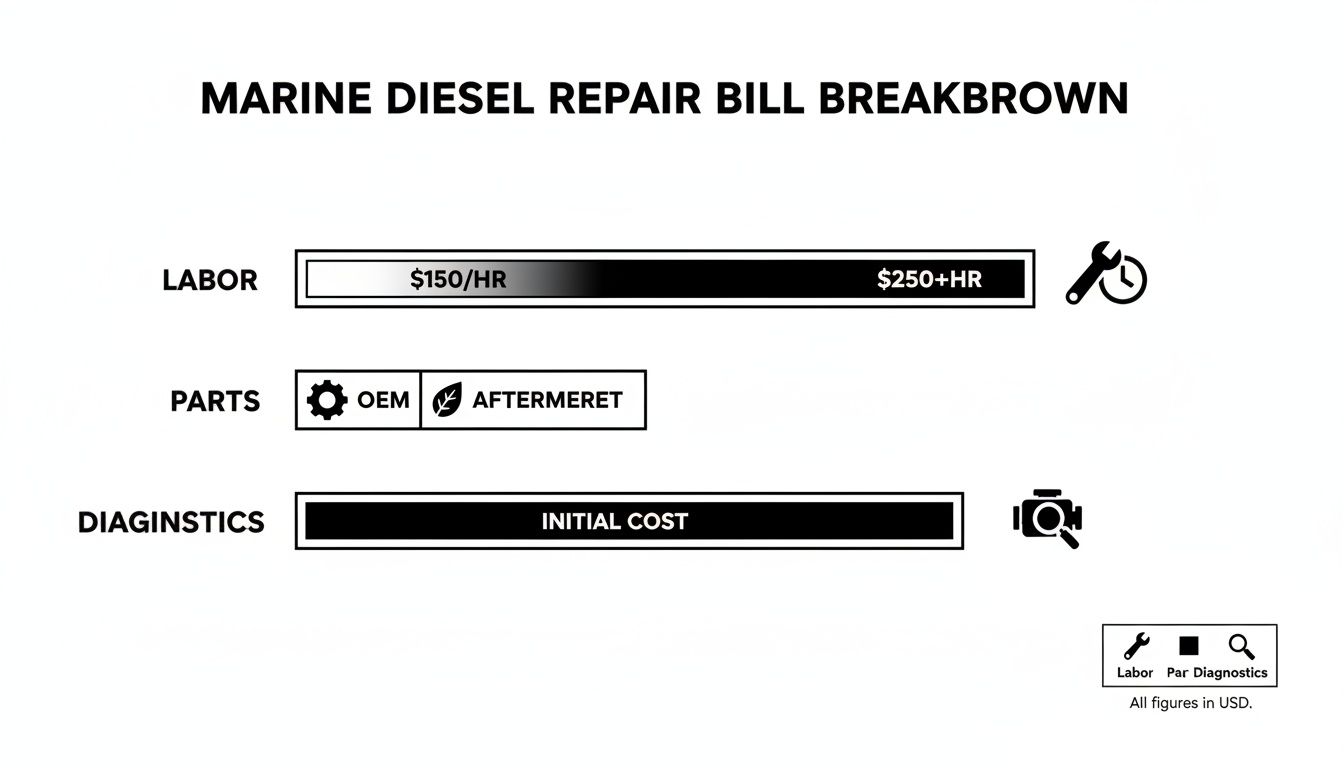
As you can see, while new parts can certainly be pricey, the skilled labor often makes up the biggest slice of the pie. It's a powerful reminder that paying for an efficient, certified technician who gets the job done right the first time is money well spent.
Fuel Injector Service or Replacement
Your engine’s fuel injectors are sophisticated, high-pressure nozzles that atomize fuel for a clean, powerful burn. When they start to fail, your engine's performance takes a nosedive.
- What to Look For: Black smoke pouring from the exhaust, a rough idle, burning way more fuel than usual, or just a general lack of "get up and go" when you push the throttles.
- What's Involved: The job requires carefully removing the high-pressure fuel lines and extracting the injectors—a process that demands specialized tools to avoid wrecking the cylinder head. From there, we either send them out for professional cleaning and testing or replace them with new or remanufactured units.
- The Bottom Line: For a common rail system on a 6-cylinder diesel, having the injectors professionally cleaned and recalibrated might run you $1,500 to $3,000. If they're shot, a full set of replacements could be anywhere from $4,000 to over $9,000, with the final cost heavily influenced by your specific engine model.
Heat Exchanger and Aftercooler Service
Think of these as your engine’s radiators. The heat exchanger uses seawater to cool the engine's internal freshwater coolant, while the aftercooler (or intercooler) cools the compressed air coming from the turbo. Down here in the warm, creature-filled saltwater of South Florida, they are ground zero for clogs and corrosion.
- What to Look For: The most obvious red flag is your engine temperature gauge climbing higher than it should, especially when you're cruising. A quick visual inspection might also show you some tell-tale corrosion or small leaks.
- What's Involved: We have to drain the cooling systems, pull the units completely, and take them apart. The real work is in meticulously cleaning the tube stacks to get rid of all the salt, scale, and marine growth that builds up inside. This usually means a good soak in an acid bath or a trip to an ultrasonic cleaning tank.
- The Bottom Line: A standard service on a mid-size yacht engine, like a CAT C18, will typically cost between $2,500 and $5,000. That covers labor, new gaskets, and seals. If we find that corrosion has eaten through the unit, you're looking at a full replacement, which can easily jump to $8,000 – $15,000 or more.
Honestly, being proactive here is your best defense. Regular cooling system service is the single most effective thing you can do to prevent catastrophic overheating. A clogged cooler can lead to a warped cylinder head, and that’s a repair bill nobody wants to see.
Turbocharger Replacement
The turbo is what gives your diesel its punch. It's a precision-engineered turbine that spins at insane speeds, forcing massive amounts of air into the engine to create more power. When it lets go, your engine’s performance doesn't just drop—it falls off a cliff.
- What to Look For: Listen for a high-pitched whining or a sound like a siren coming from the engine room. Also, keep an eye out for blue or black smoke, a major loss of power, or unusually high exhaust gas temperatures.
- What's Involved: This is a direct replacement job. We remove the failed turbo, thoroughly inspect the oil supply and return lines for any blockages (a very common cause of turbo failure), and then install the new or remanufactured unit with all new hardware and gaskets.
- The Bottom Line: The diesel engine repair costs for a turbo can vary dramatically. For a popular engine like a MAN V12, swapping in a quality remanufactured turbo might land in the $7,000 to $12,000 range. If you need a brand-new OEM unit for a premium engine like an MTU, the price could soar past $20,000 per turbo.
Major Engine Overhaul or Rebuild
This is the big one—the most intensive surgery your engine can undergo short of being replaced entirely. A rebuild is usually the last resort, reserved for engines with very high hours, extreme wear and tear, or a catastrophic internal failure like a dropped valve or a seized piston.
- What to Look For: The signs are impossible to ignore: thick, excessive smoke, a loud and terrifying knocking sound from deep inside the engine, finding metal shavings in your oil filter, or the engine simply refusing to turn over.
- What's Involved: This is a massive undertaking. We often have to physically remove the engine from the yacht. It's then completely stripped down, cleaned, and every single part is inspected. Anything worn—pistons, rings, bearings, cylinder liners, seals—gets replaced before it's all painstakingly put back together to exact factory specifications.
- The Bottom Line: An "in-frame" overhaul (where the engine block stays in the boat) on a big marine diesel like a CAT C32 can run from $40,000 to $70,000. For a full, out-of-boat rebuild, you could be looking at $80,000 to $150,000+, especially if core components like the crankshaft or the block itself are damaged.
To make these numbers a bit easier to digest, here's a table summarizing the potential costs and downtime for these common repairs.
Estimated Costs For Common Yacht Diesel Engine Repairs
This table provides a quick reference for typical price ranges and the time you can expect your yacht to be out of commission for some of the most frequent diesel engine issues we see in the South Florida area.
| Repair Type | Engine Size/Brand (e.g., CAT C32) | Estimated Cost Range (Parts & Labor) | Estimated Downtime |
|---|---|---|---|
| Fuel Injector Replacement | MAN V8-1200 | $6,000 – $11,000 | 2-4 days |
| Cooling System Service | CAT C18 / C32 | $3,500 – $7,500 | 3-5 days |
| Heat Exchanger Replacement | MTU 12V 2000 M96L | $12,000 – $22,000 | 4-7 days |
| Turbocharger Replacement | MAN V12-1900 | $9,000 – $16,000 (Reman) | 3-5 days |
| In-Frame Engine Overhaul | CAT C32 ACERT | $50,000 – $85,000 | 2-4 weeks |
| Full Engine Rebuild | MTU 16V 2000 M94 | $90,000 – $160,000+ | 4-8 weeks |
As you can see, the costs and the time off the water can add up quickly. This is why investing in routine maintenance and catching small problems before they become major failures isn't just good practice—it's the smartest financial decision a yacht owner can make.
Mobile Service vs. a Full Yard Haul-Out: Making the Right Call
When your yacht's engine starts acting up, one of the first and most critical decisions you'll face has nothing to do with parts or hourly rates. It's a logistical fork in the road with a huge impact on your wallet and your schedule: can a mobile mechanic fix it at the dock, or does the boat need to come out of the water?
Getting this choice right is fundamental to controlling your overall diesel engine repair costs. It’s the difference between a targeted, efficient fix and a cascade of yard fees that can quickly spiral.
The convenience of a mobile technician coming to your slip is hard to beat. For a whole host of common problems, it's simply the smartest way to go. Think of it as a house call from a specialist. You avoid the hefty price tag that comes with a shipyard visit—haul-out fees that can easily run into the thousands, daily lay day charges, and the hassle of moving the vessel.
When Mobile Marine Service Makes Sense
For most routine maintenance and less-invasive repairs, mobile service is the answer. As long as the engine doesn't need to be physically pulled from the boat, a good mobile tech can handle it right there at the dock. This means less downtime for you and a much more predictable bill.
Here are the kinds of jobs that are perfect for on-site service:
- Routine Maintenance: All your scheduled stuff, like oil changes, filter swaps, coolant flushes, and replacing zincs.
- Fuel System Service: Things like swapping fuel filters, cleaning injectors, or bleeding the fuel lines are straightforward dockside jobs.
- Sensor and Electrical Work: A mobile technician's bread and butter is diagnosing and replacing finicky sensors, chasing down wiring issues, or dealing with the engine’s electronic controls.
- Cooling System Repairs: Servicing heat exchangers and aftercoolers, swapping out old hoses, or replacing a water pump can almost always be done without a haul-out.
The real beauty of mobile service is that you’re only paying for the actual repair work. You completely sidestep the stack of yard fees that can bloat a final invoice by 20-40% before a mechanic even opens their toolbox.
When a Trip to the Shipyard is Unavoidable
Then there are the big jobs. Some repairs are just too involved or invasive to be done on the water. A shipyard gives you the heavy-lifting muscle, a controlled environment, and the specialized tools needed for major engine surgery. Trying to tackle these at the dock isn't just a bad idea—it's often impossible and downright unsafe.
You'll almost certainly need to schedule a haul-out for:
- Complete Engine Removal: If the engine needs a full rebuild, it has to come out. There's simply no other way to do it.
- Major Overhauls: While some "in-frame" work can be done in the boat, anything that requires getting to the crankshaft or the bottom end of the engine block means it's coming out.
- Transmission and Drivetrain Work: Any serious repairs on the transmission, prop shaft, or cutlass bearings require the vessel to be high and dry.
- Structural Engine Mount Repairs: If there’s welding or major structural work needed on the beds that hold your engine, that's a yard job, period.
In the end, it all comes down to the scope of the problem. Any trustworthy marine technician will give you a straight answer. They'll walk you through exactly why a job needs a haul-out, making it clear that while it's a bigger expense upfront, it’s the only path to a safe, correct repair that protects your investment for the long haul.
How Proactive Maintenance Defeats High Repair Costs

Let’s be honest. The best way to deal with eye-watering diesel engine repair costs is to do everything humanly possible to avoid them in the first place. This isn't just about good habits; it's about shifting your mindset from putting out fires to preventing them entirely. That’s your single best financial defense as a yacht owner.
Think of it this way: a solid maintenance plan is like a wellness program for your engine. You make small, consistent investments in its health to prevent the five-figure heart attack that completely wrecks your season—and your bank account. It’s how you turn unpredictable, emergency expenses into manageable, scheduled costs.
Often, the only thing separating a minor fix from a catastrophic overhaul is timing. When you catch a problem early, you stop a small issue from starting a domino effect of damage that leads to massive bills and weeks of downtime.
The Pillars of a Strong Maintenance Program
A truly effective maintenance schedule isn’t about trying to do everything at once. It's built on consistency and a sharp eye for detail, creating a rhythm of care that keeps your engine humming along exactly as it was designed to. A powerful program always comes down to a few key components.
Three core activities are the foundation of any plan worth its salt:
- Regular Fluid Analysis: This is essentially a blood test for your engine. We send oil and coolant samples to a lab, and the report we get back tells us the story of your engine's internal health. It can reveal hidden wear and tear long before you’d ever notice a symptom.
- Strict Adherence to Service Intervals: Your engine’s manufacturer—whether it’s MTU, MAN, or CAT—lays out a detailed service schedule for a reason. Hitting these timelines for changing fluids, filters, belts, and impellers isn't optional; it's the bedrock of longevity and reliability.
- Annual System Inspections: Nothing beats having a certified technician give your engine a top-to-bottom inspection once a year. A pro’s trained eye can spot subtle things you might miss, like the first hint of corrosion on an aftercooler, a slight weep from a hose, or the faint whine of a water pump bearing on its way out.
The principle couldn't be simpler: It is always cheaper to maintain an engine than it is to repair one. Spending a few hundred dollars on an oil analysis that flags coolant contamination can literally save you from a $50,000 engine seizure down the line.
Proactive Care Delivers the Best ROI
Let's look at a real-world scenario we see all the time. During a routine annual inspection, a technician notices a slight saltwater drip coming from a heat exchanger end cap. The fix is straightforward: pull the cap, install a new gasket, and put it all back together. The total bill might be around $800.
Now, what if that tiny drip goes unnoticed? Corrosive saltwater slowly seeps into the freshwater cooling system. Over months, it contaminates everything, causing severe internal corrosion, overheating, and maybe even a cracked cylinder head. That’s a repair that could easily sail past $30,000.
By investing in that simple inspection, the owner traded an $800 preventative fix for a potential $30,000 catastrophe. That’s a return on investment any yacht owner would take in a heartbeat.
Ultimately, a smart maintenance program does more than just lower your repair costs. It buys you reliability, peace of mind, and most importantly, more uninterrupted time out on the water.
Finding The Right Marine Technician In South Florida
Once you have a handle on the potential costs, the next step is the most critical: picking the right person to actually turn the wrenches on your yacht’s engine. Down here in the crowded South Florida marine market, it's easy to get swayed by the lowest quote. But trust me, when you're dealing with sophisticated, high-performance engines from brands like MTU, CAT, or MAN, the cheapest bid is almost never the best value.
A botched job by a rookie or an unqualified mechanic can quickly spiral into a catastrophe. What started as a manageable repair can easily become a full-blown engine replacement, costing you tens, if not hundreds, of thousands of dollars. The real goal isn't to find a quick fix; it's to find a true service partner who delivers reliable, long-lasting solutions. It takes a little homework on your part, but that effort is what protects your investment and, more importantly, your safety at sea.
Your Vetting Checklist For Marine Mechanics
Before you give anyone the green light, you need to do your due diligence. Any technician or shop worth their salt will be completely transparent and ready to show you their credentials. If you get a vague or dodgy answer to any of these questions, consider it a massive red flag and walk away.
Here’s your list of non-negotiables:
- Factory Certifications: Are they currently certified by your specific engine manufacturer? Whether it's MTU, MAN, or Caterpillar, this is proof they’ve had the specialized factory training and have access to the most up-to-date technical bulletins and software.
- Proper Insurance: Ask to see their certificate of insurance. At a minimum, they need general liability, but you also want to see ship repairer's legal liability coverage. This is what protects your vessel while it’s in their hands.
- Verifiable References: A seasoned pro will have a list of happy customers who own boats similar to yours. Don’t hesitate to actually call a few of them and ask about their experience.
A professional's quote is more than just a number; it’s a reflection of their entire process. Always demand a detailed, itemized estimate that breaks down labor hours, parts costs, and any other charges. Ambiguity only benefits the mechanic, never the boat owner.
Demanding Clarity And Guarantees
After you've narrowed it down to a couple of solid candidates, the last step is to lock in the expectations. When this much money is on the line, a simple handshake deal just won't cut it.
Get a clear, written understanding of the warranty they provide on both their labor and the parts they install. A 90-day warranty on workmanship is pretty much the industry standard, and you shouldn't settle for anything less.
By following this simple process, you stop just hiring a mechanic and start choosing a trusted partner. This is how you ensure your diesel engine repair costs translate into a quality job that gives you total confidence every time you head offshore. It’s all about securing peace of mind and protecting the heart of your vessel for years to come.
Of course. Here is the rewritten section, designed to sound completely human-written and natural, as if from an experienced marine diesel expert.
Your Diesel Engine Repair Questions, Answered
Even after laying it all out, I know you probably still have some specific questions buzzing around. That’s perfectly normal. Let's tackle some of the most common ones I hear from yacht owners around West Palm Beach and South Florida, so you can plan your budget with confidence.
How Much Should I Set Aside For Engine Maintenance Each Year?
Look, nobody likes spending money on things that aren't broken. But trust me on this one: proactive maintenance is the cheapest insurance you can buy for your engines. A good rule of thumb is to budget 1-2% of your engine's total replacement cost for your annual maintenance schedule.
So, if you're running a pair of engines valued at $200,000 each, you should plan on setting aside $4,000 to $8,000 a year. This isn't just for oil changes; it covers crucial fluid analysis, new filters, and a trained eye looking over everything. Spending this now is how you avoid a catastrophic failure later that could easily run you ten times that amount.
Should I Rebuild My Old Engine or Just Repower the Whole Thing?
This is the big question, and the answer really comes down to a few key factors: the engine's current state, its total hours, and what a brand-new replacement would run you. Generally, a full professional rebuild will cost about 40-60% of what you'd pay for a new engine. If the block and other core parts are in solid shape and we can get the parts easily, a rebuild is usually the smarter financial move.
That said, there are times when a full repower is absolutely the right call. It becomes the better long-term play if:
- Your engine model is a classic, but "classic" means parts are a nightmare to track down.
- You're ready to take advantage of the massive fuel efficiency gains modern engines offer.
- You need to get compliant with today's stricter emissions standards.
What Are The "Hidden Costs" I Should Watch Out For On An Estimate?
A good, honest estimate should be crystal clear, but you always need to read the fine print. Things that can catch people by surprise are line items for shop supplies, environmental disposal fees (we can't just dump old oil!), and travel time for mobile mechanics. A true professional will spell all of this out for you from the get-go.
The biggest surprise cost almost always comes from what we find during the teardown. We might pull off a heat exchanger and discover unexpected corrosion that simply wasn't visible before. We call these 'supplementals.'
The mark of a trustworthy shop is how they handle this. They should stop, call you immediately, explain the new issue, and get your explicit go-ahead before a single extra wrench is turned. That communication is key, ensuring you're always in the driver's seat and the final bill holds no surprises.
For certified, on-site diagnostics and repairs from Ft. Pierce to Ft. Lauderdale, the team at GTM International is here to help. We pride ourselves on expert, transparent service that gets you back on the water without the usual stress and runaround. Contact us today for a clear estimate and reliable support.
