
There's nothing quite like a faulty marine air conditioner to ruin a perfect day on the water. This guide will get you straight to a solution, starting with some simple checks you can safely do yourself. The idea is to give you the confidence to spot common problems, get a feel for potential repair costs, and know exactly when it’s time to call in a certified pro for marine air conditioner repair.
Why Your Marine AC Needs a Specialist
A marine air conditioner is a different beast entirely from the unit cooling your home. It’s a specialized system built to survive in a harsh, corrosive saltwater environment. While your home AC uses air to cool its condenser, a marine unit uses a constant flow of raw seawater—and that changes everything.
This core difference introduces a unique set of challenges. From day one, your system is fighting a battle against saltwater corrosion, relentless humidity, and the constant vibration of the vessel. All these factors mean components are far more likely to fail than on a land-based unit.
The Growing Need for Expert Repair
The demand for marine AC systems is booming, with the global market projected to grow by USD 3.99 billion between 2025 and 2029. A huge slice of that pie is repairs and maintenance, simply because the tough marine environment causes more frequent breakdowns. In a major market like North America, shipyards have noted that service contracts can make up 40% of the operational costs for AC units on larger yachts, which really drives home how critical proper upkeep is. You can discover more about these market trends and their impact on marine technology.
Consider this guide your first line of defense. We'll walk you through what's going on inside your AC, so you can handle the small stuff yourself or make a smart, informed call for professional help when you need it.
Think of this as your practical playbook for handling any AC hiccup, from a minor annoyance to a major meltdown. It's all about giving you the confidence to manage your yacht's climate control and keep every trip comfortable.
By getting a handle on the basics, you can take control of the situation. We're going to cover:
- How your yacht's AC system actually works, explained in simple terms.
- The most common symptoms of failure and what they likely mean.
- A safe, step-by-step troubleshooting checklist you can follow.
- Clear, no-nonsense advice on when to call in a certified technician.
How Your Yacht's Air Conditioner Really Works
It’s tempting to think of your yacht’s air conditioner as a magic box that creates cold air out of thin air. But the reality is much cleverer. A marine AC unit doesn't actually make cold; it moves heat. Think of it as a highly efficient heat sponge, soaking up the warmth from inside your cabin and wringing it out into the sea.
This is a continuous cycle of heat removal, and knowing how it works is the first step to figuring out what’s wrong when it stops. Your system isn't just one big unit—it's actually three distinct circuits working together in harmony. If any one of them has a problem, the whole system can grind to a halt. This is why a targeted approach to marine air conditioner repair is so important.
This map gives you a bird's-eye view of how everything fits together, from diagnosing the problem to getting it fixed and keeping it from happening again.
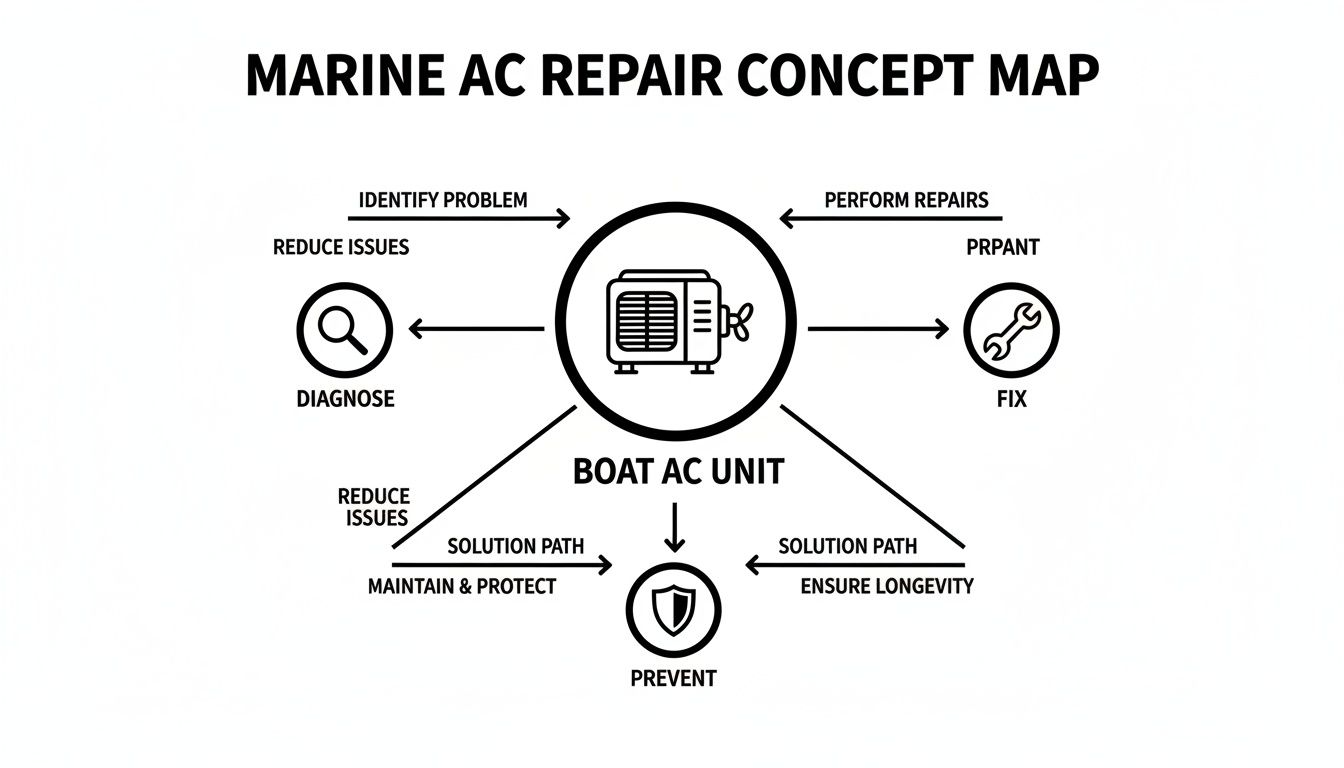
As you can see, a good repair is built on a solid diagnosis. But it doesn't end there. Smart preventive maintenance is what keeps you cool all season long.
The Seawater Cooling Circuit
The first and most unique part of a marine system is the seawater circuit. A dedicated raw water pump pulls in seawater through a thru-hull fitting and a sea strainer. You can think of this constant flow of cool water as the lifeblood for the whole cooling process.
This water gets pumped through the system's condenser, where it does the heavy lifting of absorbing the heat that was collected from your cabin. Once it’s done its job, the now-warmer water is simply discharged overboard. A steady stream of water spitting out the side of your hull is the number one sign this circuit is happy and healthy.
The Refrigerant Circuit Heartbeat
At the very core of your AC is the sealed refrigerant circuit. This is the cardiovascular system of your unit, and the compressor is its heart. The compressor's job is to pressurize a special gas—the refrigerant—and keep it flowing through a closed loop of copper tubing.
As this refrigerant circulates, it constantly changes from a liquid to a gas and back again. This phase change is the secret sauce; it’s what allows the refrigerant to absorb heat from your cabin air and then release that heat into the seawater circuit. All the real magic of heat exchange happens right here.
Key Takeaway: The refrigerant is the stuff that physically moves the heat. A leak in this sealed circuit is a showstopper that always requires a certified technician to fix.
This whole dance involves a few key players working in sync:
- Compressor: Puts the refrigerant under pressure to get the cycle moving.
- Condenser: This is where the hot refrigerant gas dumps its heat into the seawater and turns back into a liquid.
- Expansion Valve: As the liquid refrigerant passes through here, the pressure drops, causing it to become intensely cold.
- Evaporator: The ice-cold refrigerant absorbs heat from the cabin air blowing across its coils, turning it back into a gas to start the journey all over again.
The Cabin Air Circuit
Finally, we have the air circuit, which is the part you actually feel. A blower fan sucks in the warm, humid air from your cabin and pulls it across the frigid coils of the evaporator.
As the air tumbles over these coils, the heat is literally pulled out of it and absorbed by the refrigerant inside. What comes out the other side is the cool, dehumidified air that blows from your vents, making the cabin comfortable. This process just keeps repeating, slowly but surely dropping the temperature to whatever you’ve set on the thermostat.
Once you understand how these three systems depend on each other, you’re in a much better position to pinpoint where a problem might be.
Decoding Common Marine AC Problems
Your boat’s air conditioner rarely just dies without warning. Instead, it sends out distress signals—a strange noise from the engine room, a weak trickle of air from the vents, or that dreaded blast of warm, humid air on a hot day. Learning to read these signs is the first, most critical step in figuring out what’s wrong and getting it fixed fast.
Think of yourself as a detective onboard. Every symptom is a clue, and each clue points back to one of the three core circuits we talked about earlier: seawater, refrigerant, or air. By identifying the right symptom, you can zero in on the problem area and make a smart call on what to do next.
This is a skill every captain needs. The marine HVAC market is expected to hit USD 5.7 billion by 2035, and a big chunk of that is driven by repairs. Onboard systems fail at a rate of 12-15% annually, and the constant exposure to saltwater means components like condensers get clogged with biofouling up to 25% faster than land-based units. The challenges are real, as you can see if you read the full research on marine HVAC market trends.
Let’s break down the most common clues your AC will give you.
Symptom 1: The AC Blows Warm or Tepid Air
This one is as frustrating as it gets. The fan is blowing, but the air coming out is just… air. This almost always points to an issue with either the seawater circuit or the refrigerant circuit. Your AC is failing to shed the heat it pulled from the cabin.
The most common culprit is a lack of good water flow. The system can't transfer heat out to the ocean if water isn't moving through it effectively. This could be something as simple as a sea strainer packed with grass, a failing seawater pump, or marine growth blocking the through-hull intake.
If the water side checks out, the problem likely lies in the sealed refrigerant circuit. A slow refrigerant leak is a common cause, gradually reducing the system's cooling power until it's useless. This is a serious issue that absolutely requires a certified professional to diagnose and repair.
Symptom 2: Weak or Nonexistent Airflow from Vents
You can hear the unit humming away, but you can barely feel anything coming out of the vents. This tells you the problem is squarely in the air circuit. The system is probably making cold air just fine, but that air isn't getting into your living space.
The prime suspects here are usually simple:
- A Clogged Air Filter: Just like the one at home, a dirty filter will suffocate your AC, choking off the airflow. This should always be your first check.
- A Failing Blower Motor: The fan motor could be on its last legs or have an electrical problem, causing it to spin too slowly or not at all.
- Blocked or Crushed Ducting: Somewhere between the unit and the vent, the flexible ductwork could be kinked, crushed, or obstructed.
Pro Tip: Always check the air filter first when you have weak airflow. It’s the number one cause and the easiest fix. A clean filter can save you an unnecessary service call.
Symptom 3: The Unit Does Not Turn On at All
When the system is completely dead—no lights on the control panel, no clicks, no hums—you’re dealing with an electrical issue. Before you assume the worst, start with the basics. Did a circuit breaker trip? Is your shore power pedestal working and the cord securely connected?
If the main power supply is solid, the fault is likely inside the unit itself. It could be a bad thermostat, a fried control board, or a loose wire preventing the system from getting the signal to start. While anyone can flip a breaker, diagnosing these internal electrical faults is a job for a technician with the right tools and expertise.
Marine AC Symptom and Cause Quick Reference
To help you connect the dots faster, we've put together a quick-reference table. Use it to match what you're seeing and hearing with the most probable cause and decide whether it's something you can tackle yourself or if it's time to call in a pro.
| Symptom | Most Likely Cause | Potential Fix Level (DIY or Pro) |
|---|---|---|
| AC Blows Warm Air | Clogged sea strainer, low refrigerant | DIY (strainer), Pro (refrigerant) |
| Weak Airflow | Dirty air filter, failing blower | DIY (filter), Pro (blower) |
| Unit Won't Turn On | Tripped breaker, faulty thermostat | DIY (breaker), Pro (thermostat) |
| Water Leaking in Cabin | Clogged condensate drain line | DIY |
| System Trips Breaker | Failing compressor or pump | Pro |
Having this framework helps you move from a vague sense that "the AC is broken" to a focused, actionable plan. With this knowledge, you’re ready for the next section, where we’ll walk through a step-by-step troubleshooting checklist to run before you make the call for professional help.
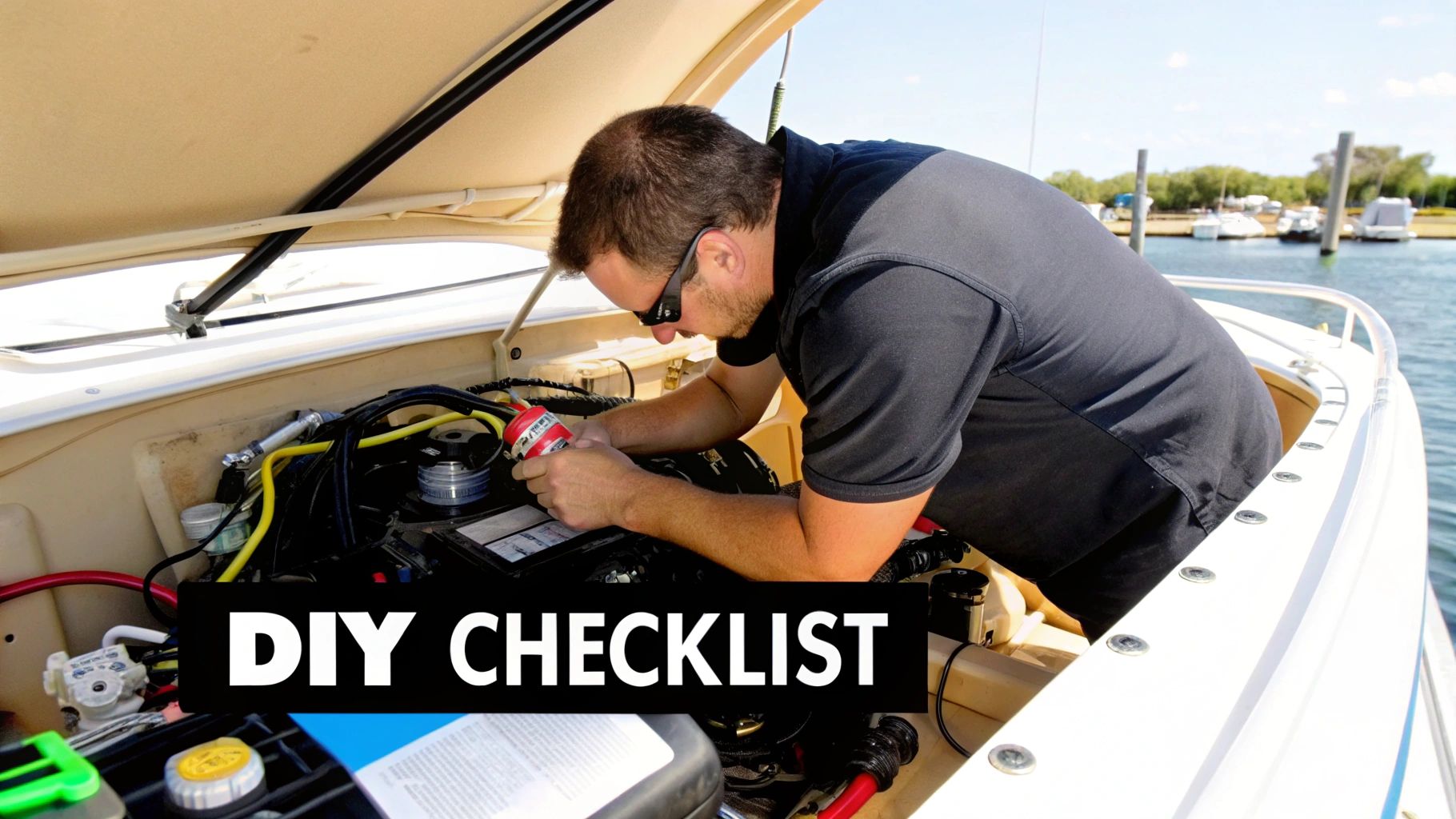
Your DIY Troubleshooting Checklist Before Calling for Help
Before you reach for the phone to book a marine air conditioner repair service, take a moment. So many of the most common AC meltdowns can be traced back to incredibly simple issues—the kind you can often spot and fix yourself in just a few minutes.
Running through this quick checklist could easily save you the time and expense of a service call. We’ll start with the dead-simple stuff and work our way up. Just remember, your safety comes first. If you ever feel out of your depth, especially around electrical panels, stop what you’re doing and call a pro.
Step 1: Start With the Obvious Electrical and Thermostat Checks
I know it sounds almost too basic, but you wouldn't believe how many "broken" AC units are just the result of a flipped switch or a dead battery. It’s always the first place to look.
Head over to your yacht’s main electrical panel. Find the breaker for your air conditioner and check if it’s tripped. If it is, go ahead and reset it once. If it trips again right away, don’t touch it again. That's a clear sign of a bigger electrical problem that needs a professional eye.
Next, glance at the thermostat. Is it actually set to "cool"? Is the temperature dialed down well below what it feels like in the cabin? If it’s a battery-powered model, weak or dead batteries can make the whole system seem dead, so pop in a fresh set if it’s been a while.
Step 2: Inspect the Airflow Path
If the unit seems to be running but you’re getting a weak, sad little puff of air from the vents, you’ve likely got an airflow problem. This is probably the single most common cause of poor cooling performance, and luckily, it's usually an easy fix.
Find the return air grille for your system and slide out the air filter. A quick visual check tells you everything: hold it up to a light. If you can’t see much light coming through, it’s choked with dust and needs a good cleaning or a new replacement.
Think of a clogged filter like trying to breathe through a pillow. It forces the blower to work way too hard for way too little air, killing its cooling power. Cleaning this filter once a month is the best preventive maintenance you can do.
With the filter out, take a quick peek to make sure nothing is blocking the grille itself. Duffel bags, loose cushions, or any other gear piled in front of it will starve the system of the air it needs to work.
Step 3: Verify the Seawater Flow
This one is absolutely crucial. Your marine AC is cooled by seawater, and without a steady flow, it will overheat and shut itself down in a heartbeat to prevent damage.
First, a simple visual check. With the AC running, look over the side of the boat for the water discharge outlet. You should see a strong, steady stream of water pumping out. If all you’re getting is a pathetic trickle—or nothing at all—you’ve found your problem. The seawater circuit is blocked.
Now, let's find the blockage. Start by turning off the AC breaker. Then, close the seacock that feeds your AC’s raw water pump and open up the sea strainer. That little basket is designed to catch all the seaweed, grass, and other gunk from the water. Clean out any debris you find, make sure the rubber O-ring is seated properly, and screw the top back on securely.
Once that’s done, open the seacock back up, fire up the AC, and check that water discharge again. If you’ve got a healthy stream of water now, you’ve probably just fixed it. Still nothing? Then the problem is likely a bad seawater pump or a deeper clog in the line, and that’s a job for a technician.
If you’ve gone through these three steps and your AC is still on the fritz, you can call for help with confidence. You’ve already ruled out all the common culprits and can tell the technician exactly what you’ve already tried.
Knowing When to Call a Professional AC Technician
While our troubleshooting checklist can help you knock out a lot of common hiccups, some problems are a clear signal to put down the tools and call for marine air conditioner repair. Let’s be honest: trying to tackle complex repairs without the right training isn't just a gamble with your equipment—it can be downright dangerous. Knowing when to call it quits protects you, your crew, and your investment.
Think of your AC's sealed refrigerant system like the high-pressure fuel lines on an engine. It’s a no-go zone for amateurs. The refrigerant is under immense pressure and requires specialized gauges, a vacuum pump, and an EPA license to handle safely and legally. Trying to "top off" the refrigerant yourself is not only against the law but is a surefire way to destroy your compressor.
The same goes for major electrical faults. Resetting a breaker is one thing, but digging into the system with multimeters or swapping out capacitors and control boards is a different ball game. A wrong move here can lead to fried electronics, a potential fire, or serious personal injury. It's just not worth the risk.
Red Flags That Demand an Expert
Some symptoms are non-negotiable. If you see, hear, or even suspect any of the following, your first move should be to kill the power at the breaker. Your second should be to call a pro.
- Hissing or Bubbling Noises: That's the tell-tale sound of a refrigerant leak. Gas is escaping the sealed system, which not only stops the cooling but also releases harmful greenhouse gases.
- Loud Grinding or Squealing: A happy compressor has a steady hum. A loud, mechanical grinding noise is a scream for help, usually signaling a critical internal failure that needs immediate attention.
- A Puddle of Oily Residue: The refrigerant in your system is mixed with a special oil to keep the compressor lubricated. If you spot an oily patch on or underneath the unit, you’ve found the source of a significant leak.
- Constantly Tripping Breaker: You reset it, and it immediately pops again. This points to a serious electrical short or a seized motor in either the compressor or one of the pumps. Stop trying to reset it.
A professional technician isn't just a parts-swapper; they are a diagnostician. They use specialized tools like electronic leak detectors and thermal imaging cameras to pinpoint the exact cause of a problem with an accuracy you just can't get from a visual inspection.
The Value of Factory-Certified Technicians
Bringing in a professional is about more than just a quick fix. Marine HVAC is a specialized field, and it’s a big one—the market is projected to hit USD 1,170.77 million by 2032. In harsh environments like the Gulf of Mexico, AC repairs recently jumped by 20%, often due to corrosion, with some repair bills climbing as high as $15,000 per vessel. This trend makes it clear why getting expert service is so important, and you can learn more about the critical marine HVAC repair market if you're interested.
Hiring a factory-certified technician who truly knows brands like Dometic or Webasto inside and out means the job gets done right the first time. They have direct access to genuine parts, they understand the specific quirks of your model’s wiring and plumbing, and they follow manufacturer-approved procedures that keep your warranty intact. That level of expertise prevents costly mistakes down the road and ensures your system runs safely and efficiently for years to come.
Simple Maintenance to Prevent Future AC Breakdowns
When it comes to marine air conditioner repair, the best fix is the one you never have to make. Think of your AC system like your boat's engine—it needs a little consistent attention to run reliably. Spending just a few minutes each month can make a huge difference, extending its life, boosting its efficiency, and stopping most of those frustrating, trip-ending failures before they start.
That old saying, "an ounce of prevention is worth a pound of cure," couldn't be more true out on the water. A simple schedule of weekly, monthly, and yearly checks keeps the three vital circuits—seawater, air, and refrigerant—working as they should. This isn't about becoming a mechanic; it's just smart, proactive care.
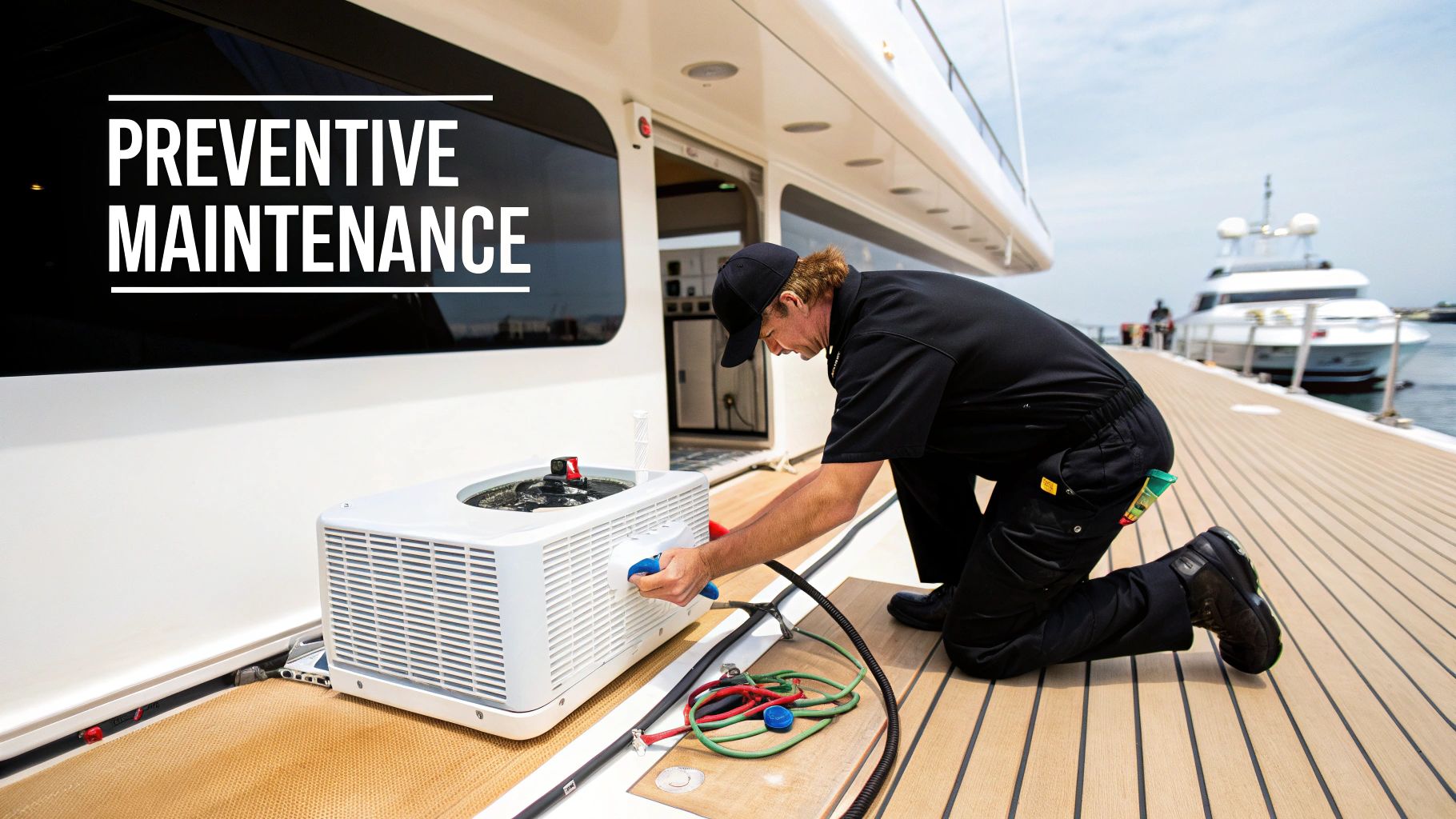
Your Routine Maintenance Checklist
Consider this checklist your system's health plan. Each step is quick, simple, and designed to spot little issues before they spiral into big, expensive headaches.
Weekly Checks:
- Inspect the Sea Strainer: This is your AC’s first line of defense. Just take a look at the clear bowl. Is it filling up with seaweed, grass, or other gunk? A clean strainer guarantees your system gets the steady supply of cool seawater it needs to run properly.
Monthly Tasks:
- Clean or Replace the Air Filter: A dirty air filter is like trying to breathe through a pillow—it chokes the system, kills the airflow, and makes the unit work way harder than it should. Pull it out, hold it up to the light, and if you can't see through it, give it a good cleaning or just pop in a new one.
- Check Electrical Connections: Flip the breaker off first! Then, take a peek at the wiring terminals. You’re looking for any tell-tale signs of corrosion, like that fuzzy green or white buildup that can mess with the power supply.
- Clear the Condensate Drain: Make sure the little drain line that carries moisture away isn't clogged. Keeping it clear prevents water from backing up and ending up in your bilge or, even worse, on your cabin floor.
Proactive maintenance isn’t just about dodging repairs; it’s about having a system you can count on. A well-kept unit delivers cool, efficient air, giving you comfort and peace of mind on every trip.
The Annual Professional Service
While your own checks are crucial, there's no replacement for a professional tune-up once a year, ideally before boating season kicks into high gear. A certified technician can handle the important jobs that go beyond the basics. They’ll do a deep clean of the evaporator and condenser coils, make sure the seawater pump is putting out full pressure, and check the refrigerant levels with precision gauges.
Think of this annual service as your best insurance policy against a major system failure. It ensures your marine air conditioner is primed and ready for the hottest days of summer.
Got Questions? We've Got Answers
Even with a solid grasp of your system, you probably still have a few questions floating around. Let's tackle some of the most common ones we hear from yacht owners and captains to help you feel more confident about handling your marine AC.
What's This Going to Cost Me?
That's the big question, isn't it? The truth is, repair costs can be all over the map. A simple fix, like clearing out a clogged sea strainer or a backed-up condensate drain, might just set you back a few hundred dollars for a service call.
But when things get more serious, the numbers can climb. For instance, replacing a seized seawater pump could run you anywhere from $800 to $1,500. If the compressor—the heart of the whole system—has given up, you could be looking at a bill from $2,500 to over $5,000. The final price really hinges on your unit's size, its brand, and how much of a puzzle it is for a tech to get to. Our advice? Always get a detailed, written estimate before giving the green light for any major work.
Can I Just Call a Regular HVAC Guy?
We get this one a lot, and the answer is a hard no. While your home's HVAC tech is great at what they do, the marine world is a completely different beast. Marine ACs are water-cooled and built tough to survive the constant assault of salt, moisture, and vibration.
Think of it this way: you wouldn't ask a car mechanic to work on an airplane engine. A certified marine technician has the specific know-how for water-cooled systems, the right diagnostic tools for a boat, and access to the correct marine-grade parts. Hiring anyone else is a gamble that could lead to bigger problems and even void your warranty.
How Often Do I Need a Pro to Look at My AC?
We're big believers in preventative care. We strongly recommend a professional service for your marine AC system at least once a year. The best time to get this done is in the spring, right before you start spending serious time on the water.
This annual check-up is your best shot at avoiding a mid-season meltdown. During the service, a technician will:
- Give the coils and fins a deep cleaning.
- Check the seawater pump's pressure and electrical draw.
- Inspect every electrical connection for signs of corrosion.
- Make sure refrigerant levels are topped off for max performance.
A little proactive maintenance goes a long way in catching small issues before they turn into trip-ending, wallet-draining disasters.
What's the Number One Killer of Marine ACs?
Hands down, the most common reason a marine AC unit quits is restricted raw water flow. Without a constant supply of cool seawater, the system just can't shed heat and will shut itself down to prevent damage.
Nine times out of ten, the problem comes down to one of three things: a sea strainer packed with seaweed, a failing seawater pump, or marine growth blocking the thru-hull intake. If you do just one thing, make it this: check and clean your sea strainer regularly. It's the simplest and most effective way to keep your cool and avoid a service call.
When you need reliable, on-site diagnostics and expert marine air conditioner repair, trust the factory-certified technicians at GTM International. We come to your vessel, saving you the time and hassle of a trip to the yard. Get fast, professional service today.
