
When something goes wrong with your engine, "diesel repair" is the first thing that comes to mind. But what does that really mean? Too often, it’s a reactive fix for a single, glaring problem—the engine won’t turn over, there’s a strange rattle you can’t ignore, or you’ve lost power just when you need it most.
That's just putting out fires. Total diesel repair is a completely different philosophy. It’s a proactive, all-in strategy designed to keep you on the water, not just get you back to the dock. It’s about treating your engine like the heart of your vessel—a complex, vital system that needs comprehensive care to perform at its peak.
What Total Diesel Repair Really Means for Your Vessel
For a yacht owner in South Florida, an engine problem isn't just an inconvenience; it can ruin a weekend, derail a trip to the Bahamas, or even create a serious safety issue offshore. A "total diesel repair" approach understands this reality. It goes far beyond simply fixing what's broken today.
Think of it as having a dedicated chief engineer who knows your vessel inside and out. This isn't about one-off service calls. It's about building a partnership focused on the entire life of your engine, from routine oil changes to major overhauls. It's the deep understanding that your main engines, generators, cooling systems, and electrical grids are all interconnected pieces of a single, powerful puzzle.
A Holistic Approach to Marine Power
A genuine total diesel repair program looks at the bigger picture. It’s built on a foundation of reliability, ensuring that every time you leave the dock, you can do so with complete confidence. This means covering every single aspect of your vessel's powertrain, not just the engine block.
The goal is to move from a reactive "break-fix" cycle to a proactive strategy of prevention and performance optimization. It's a mindset that is absolutely essential in the marine world, where even a small mechanical issue can escalate quickly. This commitment to expert care is why the global diesel repair service market, valued at USD 21.9 billion, is expected to skyrocket to USD 47.24 billion by 2033. As you can see in the full market projections on Business Research Insights, dependability is big business.
By adopting a total repair mindset, you shift from simply fixing breakdowns to actively preventing them. This not only saves money on costly emergency repairs but also protects your most valuable asset: your time and peace of mind on the water.
To give you a clearer picture of what this looks like in practice, here are the essential services that form a truly comprehensive marine diesel program.
Key Pillars of a Total Marine Diesel Repair Program
| Service Category | What It Involves | Primary Goal |
|---|---|---|
| Predictive Diagnostics | Advanced computer analysis, fluid testing (oil/coolant), and thermal imaging to spot wear before it becomes a failure. | Catch problems while they're small, cheap, and easy to fix, preventing catastrophic breakdowns at sea. |
| System-Wide Maintenance | Servicing not just the main engines, but also generators, gearboxes, cooling systems, fuel systems, and steering controls. | Ensure all supporting systems are as reliable as the engine itself, creating a completely sea-ready vessel. |
| Emergency & Mobile Response | A certified team ready to deploy 24/7, whether you're at a marina in West Palm Beach or anchored offshore. | Minimize downtime and resolve critical issues quickly and professionally, wherever you are. |
| Lifecycle Management | Expert guidance on everything from routine servicing schedules to complete engine overhauls or repowers. | Maximize the performance, efficiency, and lifespan of your engines, protecting your investment. |
Ultimately, this all-encompassing approach ensures every component works in perfect harmony. It's the crucial difference between having a boat that merely runs and a vessel that is truly, dependably ready for anything.
What's Really Included in a Total Diesel Repair Plan?
Think of "total diesel repair" less as a single service and more as a complete support system for your yacht. It goes way beyond just fixing what breaks. It's about having a team in your corner that understands every nut, bolt, and wire, ensuring you have total confidence every time you push off the dock.
This is a comprehensive approach that looks at the big picture—from the heart of the engine block to all the critical systems that keep it running smoothly. Let's pull back the curtain on the core services that make up a real-deal vessel care plan.
Advanced Diagnostics: Seeing Trouble Before It Starts
Gone are the days of waiting for a strange clatter or a plume of black smoke to tell you something's wrong. Modern marine diagnostics are like a crystal ball for your engine. We're not just guessing; we're plugging manufacturer-specific software directly into your engine’s brain—the Electronic Control Module (ECM)—and pulling thousands of data points on performance, stress, and wear.
This data tells a story. It can reveal a tiny shift in injector timing, a slight flutter in fuel pressure, or a minor temperature change that you'd never notice. By catching these patterns early, a seasoned technician can flag a potential failure weeks, or even months, before it leaves you stranded. This means you can schedule a convenient repair at the dock instead of dealing with a crisis offshore.
The infographic below shows how these pillars work together, starting with deep analysis and sustained by consistent care.
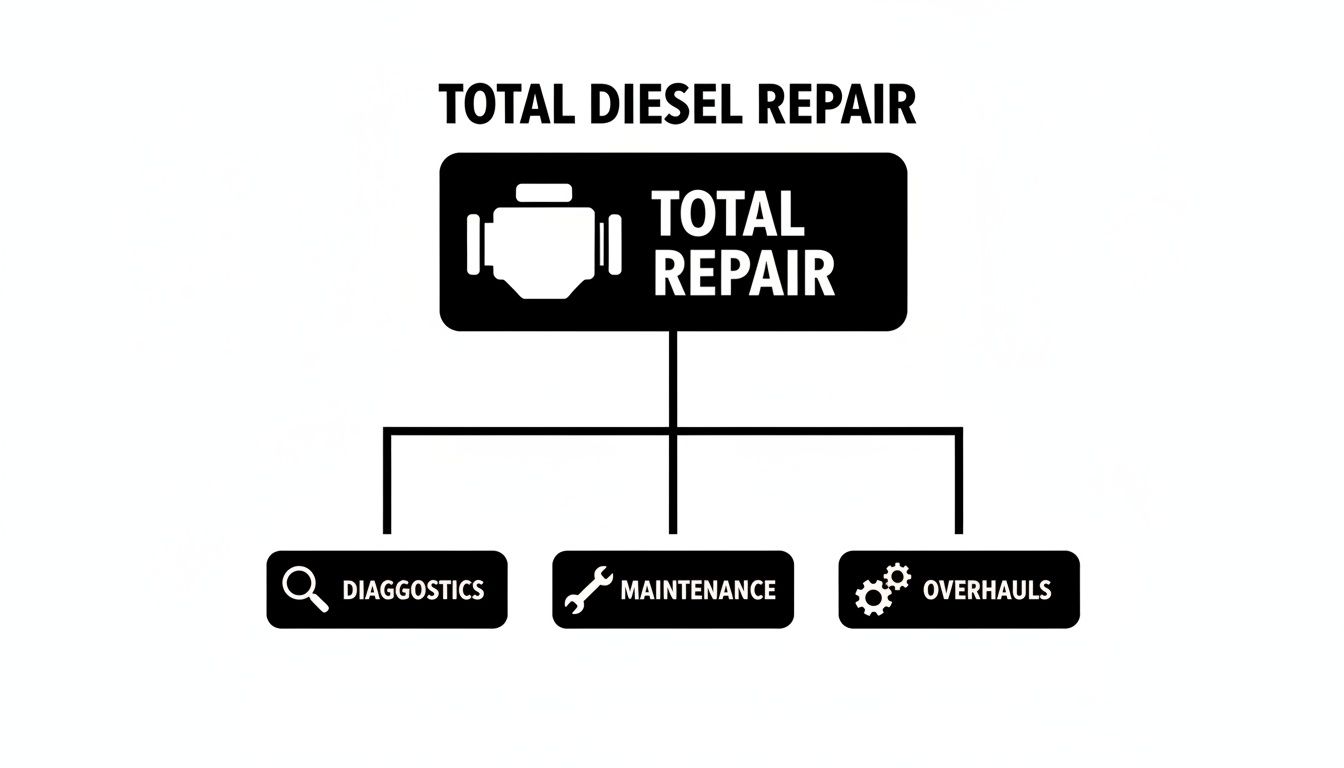
As you can see, a solid plan starts with diagnostics, is kept strong with routine maintenance, and uses major overhauls strategically to give an engine a whole new life.
The Lifeline: Mobile and Emergency Repairs
For any yacht owner in West Palm Beach or anywhere in South Florida, accessibility is king. Let's be honest, an engine problem rarely happens when you're tied up at a full-service boatyard. A true total diesel repair partner gets this and builds their entire operation around a rapid-response mobile team.
Whether you're at a private dock, a busy marina, or anchored out, a fully-stocked mobile unit brings the workshop right to your stern. This is absolutely critical for crushing downtime and avoiding the logistical nightmare of a tow. A great mobile team can handle a huge percentage of repairs right on-site—from bleeding a fuel system to swapping out a starter—getting you back on the water fast.
A mobile repair service isn't just a convenience; it's a strategic advantage. It reduces downtime from days or weeks to mere hours, preserving your valuable time on the water.
Engine Overhauls and Repowers: The Rebuild vs. Replace Dilemma
Sooner or later, even the most bulletproof engine hits its limit. When that day comes, you’re facing a big decision: overhaul or repower? A trusted repair partner isn’t just there to turn wrenches; they’re there to provide the expert guidance you need to make the right call for your boat and your budget.
An engine overhaul is a meticulous, top-to-bottom rebuild. The engine is completely disassembled, every part is cleaned and inspected, and it's reassembled to factory specs with new or re-machined components. It’s like hitting the reset button on your engine’s life, and it's often the smartest move for engines with good bones but tired internals.
A repower, on the other hand, means pulling the old engine out and dropping a brand new one in. This is usually the best path when:
- The old engine has suffered catastrophic damage, like a cracked block.
- Parts for your older model are becoming impossible to find.
- You're ready to upgrade to a more modern, efficient, or powerful engine.
The Supporting Cast: Generators, Cooling, and Steering
Your main engines are the stars of the show, but they can't perform without a solid supporting cast. A complete repair plan recognizes that all these interconnected systems are just as important. A failure in any one of them can sideline you just as fast as a main engine problem.
- Generators: Your onboard power plant is non-negotiable. Services should cover everything from diagnostics and load bank testing to full maintenance, ensuring you have dependable power for nav systems, comms, and A/C.
- Cooling Systems: Overheating is the arch-nemesis of a marine diesel. A total service plan includes cleaning heat exchangers and charge air coolers, flushing coolant, and inspecting pumps to keep temperatures exactly where they need to be.
- Steering & Electrical: From the hydraulic steering lines to the complex web of wiring that ties everything together, you need 100% confidence in these systems for safe and reliable voyages.
By looking after the entire powertrain and its support network, a total diesel repair program delivers the one thing every yacht owner really wants: unwavering peace of mind on the water.
Decoding Your Engine's Warning Signs
Your marine diesel engine is always talking to you. It uses a language of vibrations, sounds, and sights to tell you exactly how it's feeling. Learning to understand this language is one of the most valuable skills you can have as a boat owner. It's the difference between being a passenger and being the true captain of your vessel.
Ignoring these little messages is like hearing a faint smoke alarm chirp and just rolling over. At first, it's just a nuisance, but it's almost always a sign that a much bigger fire is on the way. A genuine total diesel repair approach isn't just about fixing what’s broken; it's about catching the early whispers before they become a deafening roar.

What Your Eyes Are Telling You
Often, the most glaring signs that something is wrong are right in front of your face. A quick look around your engine room and at the water behind your yacht can give you critical clues. Don't ever write these things off as "normal"—they are direct messages that demand your immediate attention.
Keep a sharp eye out for these visual alerts:
- Exhaust Smoke Color: Think of your exhaust smoke as a real-time report from inside the combustion chamber. White smoke often means water or coolant is getting into a cylinder. Black smoke usually points to unburnt fuel, maybe from a bad injector or clogged air filter. And blue smoke? That almost always means you're burning oil.
- Sheen on the Water: Seeing a rainbow sheen trailing your boat is an immediate red flag. This can be anything from a tiny fuel drip to a serious internal oil leak caused by failing seals, gaskets, or even a cracked block.
- Changes in Fluid Levels: If you constantly have to top off your coolant or oil, that’s not just a routine chore—it's a symptom. Those fluids are going somewhere, and finding the leak is absolutely critical to preventing overheating or catastrophic engine failure.
Sounds and Sensations That Signal Trouble
Beyond what you can see, you have to learn to trust your ears and your gut. Every engine has a baseline rhythm—a normal hum and vibration that you get used to over time. Any change, no matter how small, is your engine trying to tell you something is wrong.
A seasoned mechanic can hear tiny changes that come long before a major breakdown. It’s like a doctor listening to a heartbeat; the rhythm tells the whole story.
A sudden change in your engine's sound or an unfamiliar vibration is never normal. It's the mechanical equivalent of a cry for help, and addressing it immediately can be the difference between a simple adjustment and a full-scale emergency repair.
The need for technicians who can interpret these signs is exploding. With the global market for diesel repair services valued at around USD 150 billion in 2025, it’s clear how much the world relies on these workhorses. As detailed in recent market analysis, this growth highlights the urgent need for expert diagnostic skills. You can discover more insights about the global diesel repair service market and its projected growth.
Translating Common Engine Noises
- Knocking or Pinging: That sharp, metallic sound is often "diesel knock," caused by fuel igniting too early. This could be anything from bad injectors or incorrect timing to simply poor-quality fuel.
- Squealing or Whining: A high-pitched squeal that gets louder as you increase RPMs usually points to a failing belt or a bad bearing in your alternator, water pump, or another accessory.
- Grinding Noises: This is a bad one. A harsh grinding sound, especially when you start up or shut down, is a serious warning. It could be a problem with the starter, but more often it signals that internal engine parts are starting to make contact.
By learning to decode these signs, you give yourself the power to act fast. Catching a problem early means you can call in a mobile repair expert for a targeted fix, stopping a minor issue from turning into a trip-ending disaster. That proactive mindset is the real foundation of a total diesel repair strategy.
Understanding the Real Costs of Marine Diesel Repair
Let's have a frank conversation about what it really costs to keep your yacht's diesel engines running. When a problem pops up, the final bill is never just one number. It’s a mix of a few key things that all add up, and knowing what they are is the secret to budgeting smartly and avoiding any nasty surprises at the end of the job.
There’s no such thing as a one-size-fits-all price for total diesel repair. The engine brand plays a huge role—working on a newer, high-tech MTU is a different ballgame than servicing a classic Caterpillar workhorse, and the parts and labor costs reflect that. The job itself is a big factor, too. Swapping out a fuel injector is a quick fix, but a full in-frame overhaul is a massive undertaking that can take days of careful, intensive work.
And then there's the biggest variable of all: access. If your engine room is cramped and poorly laid out, a simple job can turn into a nightmare. Technicians have to become contortionists to get to a bolt, and those extra hours on the clock add up fast.
Budgeting for Common Repair Scenarios
Every boat and every engine is different, but I can give you some ballpark figures to help you get a sense of the costs. Think of these as realistic ranges for what we see here in the South Florida market, not hard quotes.
- Routine Maintenance (per engine): For a standard service—oil, filters, zincs, and a good look-over—you're typically looking at anywhere from a few hundred to over a thousand dollars. It really depends on the size of your engine and what the manufacturer calls for.
- Injector Replacement: This one can vary a lot. On a modern common rail system, you should expect to be in the thousands once you factor in the cost of the parts and the specialized labor needed to do it right.
- Cooler Service: Servicing your heat exchangers and aftercoolers is non-negotiable preventative maintenance. It involves pulling them off the engine, giving them a thorough cleaning, and reinstalling them. This will usually run into the thousands, especially on bigger engines.
- Engine Overhaul: This is the big one, short of a complete repower. A proper overhaul can cost anywhere from $20,000 to well over $100,000. The final price depends on the engine's size, the brand, and just how much internal surgery is needed.
The Hidden Costs Beyond the Invoice
The single biggest cost in any major diesel repair often doesn't even show up on your mechanic's invoice: downtime.
Every day your boat is tied to the dock is a day you're not out on the water. If you run a charter operation, that's lost income, plain and simple. For a private owner, it’s a lost weekend, a canceled trip with the family, and a whole lot of frustration.
This is exactly why having a proactive maintenance plan with a mobile team you trust is so valuable. The global diesel engine service market, which is worth around USD 121 billion in 2024, is built on keeping vessels like yours operational. Engine rebuilding, in particular, is a growing part of that market because it's a smart way to get like-new reliability without the cost of a full repower. You can dive deeper into the numbers in this detailed market analysis of diesel engine services.
Proactive maintenance isn't a cost; it's an investment in availability. Spending a fraction on prevention now saves you a fortune in emergency repairs and lost time later.
At the end of the day, picking the right mobile repair partner in West Palm Beach is about more than just shopping for the best price. It's about finding a team that respects your time and is committed to maximizing your vessel's performance. When you invest in regular, expert care, you stop reacting to problems and start strategically ensuring your yacht is always ready for your next adventure.
How to Choose a Trusted Mobile Repair Partner
In the sun-drenched, bustling marine world of South Florida, a good mobile diesel mechanic isn’t just a convenience—they're worth their weight in gold. But let's be honest. When an alarm is blaring and you're stuck at the dock, it’s all too easy to make a panicked call to the first name that pops up on Google. That’s a roll of the dice. You might get lucky, or you could end up with a half-finished job, a bigger problem, and a much lighter wallet.
Choosing the right team for your yacht's total diesel repair is about more than just finding someone who can turn a wrench. It’s about forging a partnership with an expert you can trust to protect your investment and your time on the water. Let’s walk through how to find that perfect fit.
Look for Real Manufacturer Certifications, Not Just Claims
First things first: expertise matters. A lot. Marine diesel engines are incredibly complex machines, and a mechanic who’s a genius with older Caterpillar engines might be totally lost when faced with a modern, computer-controlled MTU. This is non-negotiable—always start by asking about factory certifications.
These aren't just fancy pieces of paper. A factory certification proves a technician has been trained directly by the manufacturer. They know the specific diagnostic software, the exact torque specs, and the common gremlins of your particular engine. Hiring an uncertified mechanic for a high-performance engine is like asking a general family doctor to perform heart surgery. You need a specialist.
Don't be shy; ask directly:
- Are your technicians factory-certified for my specific engine brand, like MTU or MAN?
- How many years have you been working hands-on with this particular model series?
How Good is Their Mobile and Emergency Response, Really?
A brilliant mechanic who can't get to you when you need them is no help at all. In the yachting world, a top-tier mobile response isn't a luxury; it's the bare minimum. You need a crew that can reach you whether you're at a private dock in Palm Beach or a busy marina down in Fort Lauderdale.
This is where you need to dig into the details. Don't just accept a "yes" when you ask if they're mobile. Find out what that really means.
A truly reliable mobile partner gets it: downtime is the real enemy. Their entire operation is built around getting to you fast, with the right tools and parts in the truck to solve the problem on the spot.
When you're interviewing a potential partner, you're setting expectations. Their answer about response time and preparedness will tell you everything you need to know about their professionalism and whether they're truly client-focused.
Your Checklist for Vetting a Marine Diesel Mechanic
Before you hand over the keys to your engine room, take a moment to run any potential mechanic through this simple checklist. Getting straight answers here will quickly separate the seasoned professionals from the rest of the pack.
This simple vetting process can save you a world of headaches down the road.
| Evaluation Criteria | Key Questions to Ask | Why This Matters |
|---|---|---|
| Experience & Certification | "Are you factory-certified for my MTU/MAN/CAT engines?" | This confirms they have specialized training and access to the correct diagnostic tools and manufacturer bulletins. It's the difference between guessing and knowing. |
| Insurance & Licensing | "Can you send over proof of your current liability insurance and business licenses?" | This is crucial. It protects you from any liability for accidents or damages that happen while they’re working on your vessel. No insurance, no deal. |
| Emergency Availability | "What's your realistic response time for an emergency call in the West Palm Beach area?" | You need to know they can be there when things go wrong, not just between 9 and 5 on a weekday. This defines their level of service. |
| Parts Sourcing | "Do you have established accounts with parts suppliers for my engine brand?" | A great network means faster access to genuine, high-quality parts at fair prices. This dramatically cuts down on your repair time. |
| Local Reputation | "Could you provide a few references from other yacht owners or captains right here in the area?" | A solid local reputation is earned one job at a time. It’s the single best indicator of the quality and reliability you can expect. |
Remember, choosing a repair partner is a commitment. By doing your homework upfront, you’re not just hiring for a one-off fix. You’re investing in a relationship that will keep your vessel sea-ready, protect its value, and give you peace of mind for years to come.
Got Questions About Marine Diesel Repair? We’ve Got Answers.
Even after laying it all out, you probably still have a few specific questions about what "total diesel repair" really means for your boat. That’s perfectly normal. Here are some of the most common things we hear from yacht owners around West Palm Beach and all over South Florida, answered straight up to help you make the right call.
How Often Should I Really Be Servicing My Marine Diesel Engines?
You've probably heard the old "every 100 hours" rule, but modern engines have changed the game. The honest-to-goodness best answer? Stick to what your manufacturer recommends. They design those service intervals based on a ton of testing, and it's usually a mix of engine hours and time—like "every 250 hours or once a year, whichever comes first."
Now, let's talk about where we live. Here in South Florida, the combination of intense heat, high humidity, and constant saltwater exposure is brutal on machinery. Because of that, leaning on the side of caution is always a smart move. We tell our clients that a comprehensive service at least once a year is a solid baseline, even if you haven't put a lot of hours on the clock. It gives us a chance to inspect zincs, hunt for hidden corrosion, and get a good look at your fluids before the environment turns a small issue into a big one.
Does All This Preventative Maintenance Actually Save Me Money?
Without a doubt. It’s not even close. The cost of a proactive maintenance plan is a tiny fraction of what you’ll spend on an emergency repair, not to mention the headache of unexpected downtime.
Think of it this way: a scheduled heat exchanger and aftercooler service might run you a few thousand dollars. But if that cooler gets clogged and your engine overheats while you're offshore? You're suddenly looking at a catastrophic failure and a tow, which can easily spiral into a tens-of-thousands-of-dollars overhaul. And that doesn't even touch on the safety risk.
Preventative maintenance isn’t just another bill. It's a direct investment in your vessel’s reliability and your own peace of mind. It is, by far, the most effective way to protect your boat's value and keep you out on the water.
This approach is all about catching problems when they're small and cheap to fix. A simple oil analysis, for example, can spot a trace of coolant in the oil long before you’d ever notice it. That discovery turns a potential catastrophic bearing failure—and a full rebuild—into a much simpler and less expensive head gasket job.
Rebuild vs. Repower: What’s The Difference, and Which One Is for Me?
Deciding whether to rebuild your current engine or repower with a new one is a major crossroads. The right choice really hinges on your engine's current health, its age, and what you want for the future of your vessel. Knowing the difference is the first step.
Engine Rebuild (Overhaul): Think of this as a complete restoration of your existing engine. We take it apart, piece by piece. Every single component—from the block to the pistons—gets cleaned, inspected, and measured against the original factory specs. Anything that's worn out (pistons, liners, bearings, seals) gets replaced with new parts, and we reassemble it to perform like it just came off the assembly line. A rebuild is perfect for bringing a tired but solid engine back to life, often for much less than buying new.
Engine Repower: This is exactly what it sounds like: we pull the old engine out entirely and install a brand-new one. A repower makes the most sense when the original engine has suffered a catastrophic failure (like a cracked block), parts are no longer available, or you're ready to upgrade to a more modern, fuel-efficient, or powerful engine.
A good technician won't just sell you one or the other. They'll give you a straight-up assessment of your engine's condition and help you weigh the costs and long-term benefits of each path, so you can make a smart, informed decision for your boat.
For certified, on-site diagnostics and a partner committed to your vessel’s reliability, trust the experts at GTM International. Schedule your marine diesel service in South Florida today.
