

A yacht engine almost never dies without whispering a few warnings first. Learning to hear those whispers is what separates a routine maintenance call from a catastrophic failure miles from shore. For any captain or owner, spotting trouble early isn't just a skill—it's your first line of defense. A little prompt attention now can be the difference between a simple fix at the dock and a long, expensive haul-out.
Is Your Engine Sending an SOS
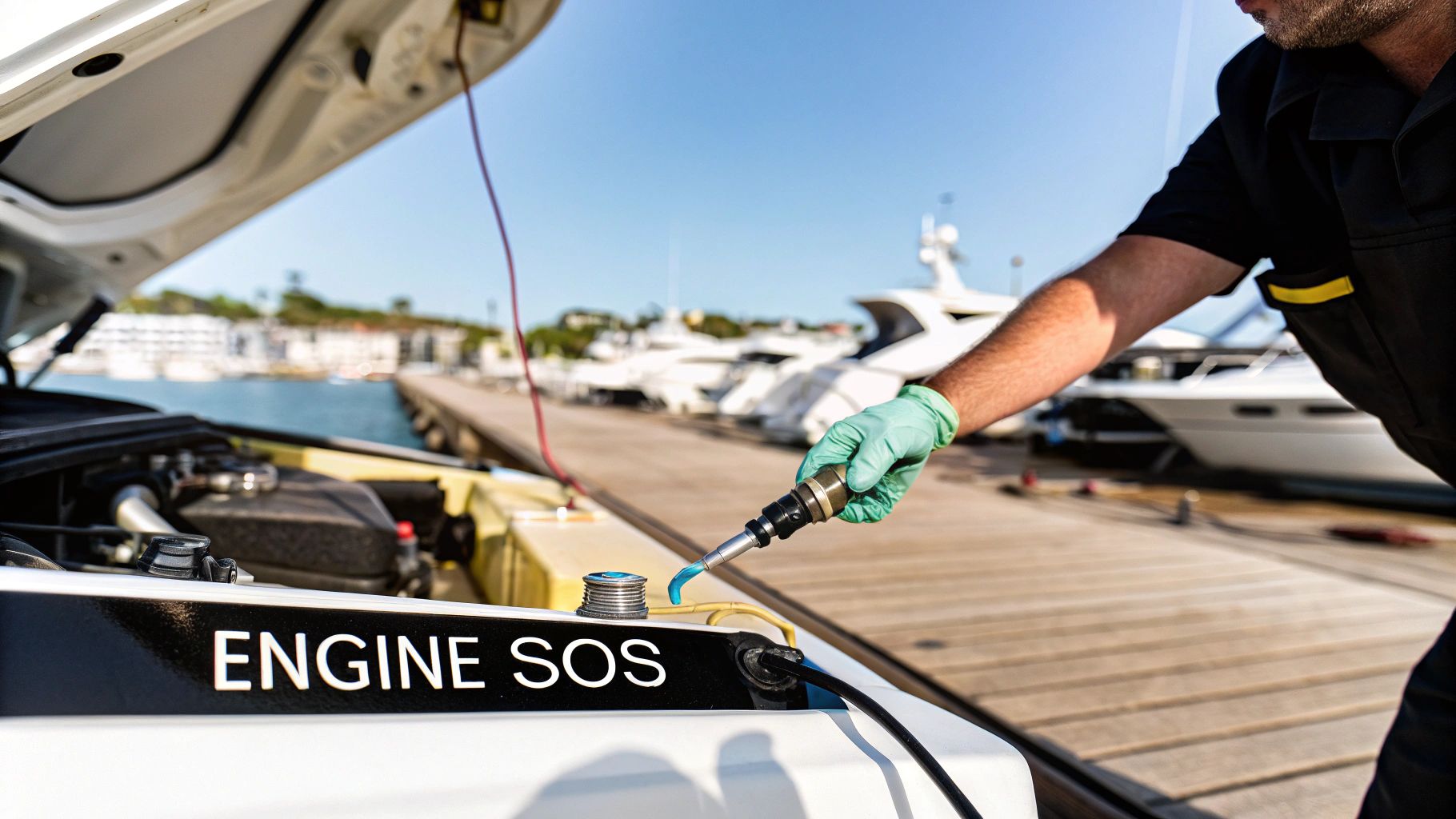
Think of your diesel injectors as the heart of your engine, each one delivering a perfectly timed, precise pulse of fuel. When that rhythm is steady and strong, your engine purrs. It’s powerful, it’s efficient, it’s reliable. But the moment one injector falters, that perfect rhythm stumbles, and the engine’s performance immediately takes a nosedive. It's sending up a flare, an SOS, and you need to know how to read the signal.
Ignoring these warnings is like ignoring the smell of smoke in the galley. What starts as a small, manageable problem can quickly spiral into serious engine damage, leaving you dead in the water with a staggering repair bill. Learning to spot these early signs puts you back in command, letting you call in a professional before things get out of hand.
Translating the Warning Signs
Your engine doesn't speak in riddles. It tells you exactly what’s wrong through clear changes in its behavior. These aren't just minor quirks; they're direct messages that a critical component, like a diesel injector, is in trouble. The most common signals are often the easiest to dismiss, but they're the ones that matter most.
Whether you're tied up at the marina or cruising offshore, keep an ear and eye out for these tell-tale signs:
- Rough Idling: Does your engine sound more like it's sputtering and shaking at the dock instead of humming along smoothly? That rough idle is a classic sign of an injector sending in the wrong amount of fuel, throwing the whole system off balance.
- Visible Black Smoke: Seeing a puff of black smoke when you accelerate? That's not just ugly—it's unburnt fuel. It means too much diesel is being dumped into the cylinders, wasting power and creating carbon buildup that can choke your engine.
- Noticeable Power Loss: When you open up the throttle, does the yacht feel sluggish? Do you struggle to hit speeds that used to be easy? A failing injector can’t deliver the fuel your engine needs to perform, leaving you with a frustrating—and potentially dangerous—lack of power when you need it.
- Increased Fuel Consumption: Finding yourself at the fuel dock more often than you used to? A bad injector wastes fuel, either through a poor spray pattern or a constant leak. That hits you directly in the wallet and shortens your range.
A malfunctioning diesel injector doesn't just reduce performance; it actively harms your engine. The unburnt fuel can wash lubricating oil off cylinder walls, leading to increased friction, wear, and potentially a complete engine seizure if left unchecked.
The Urgency Behind the Smoke
These symptoms are far more than just performance hiccups; they are active threats to your engine's life. A leaky injector, for example, can cause a dangerous condition called "wet stacking," where raw fuel pools in the exhaust system, creating a serious fire hazard. At the same time, an injector with a bad spray pattern can create hot spots on a piston head, eventually causing it to crack or even melt.
This is exactly why getting a fast, accurate diagnosis is so critical. When you understand what your engine is telling you, you can take control of the situation. Instead of waiting for a total breakdown to ruin a trip and force an emergency tow, you can have a mobile service come to repair diesel injectors right in your slip, on your schedule. That proactive mindset doesn't just save you time and money; it protects the most valuable asset on your vessel. The next step is knowing how a seasoned pro will pinpoint the exact cause of the problem.
How a Marine Technician Gets to the Bottom of Injector Problems
When your engine starts acting up, you need a professional who can get to the root of the problem, and fast. Think of a skilled marine technician as a detective arriving at the scene. They aren't just there to look at the obvious; they're there to follow the clues, use their experience, and employ sophisticated tools to uncover precisely what's wrong. It’s a methodical hunt, not a guessing game. This ensures we can tell a simple clog from a deep-seated electronic failure, making sure the fix is the right one, the first time.
The moment a certified technician steps on board, the diagnostic process begins—often before a single wrench is turned. A seasoned pro starts by simply using their eyes and ears, gathering critical first impressions about the engine's condition that can immediately point them in the right direction.
The Initial On-Dock Assessment
This is the engine's physical exam. It's a non-invasive but absolutely crucial first step that often tells us most of what we need to know. The goal here is to quickly spot the obvious red flags and narrow down the possibilities before we plug in the computers.
Here's what that looks like:
- A Good Look Around: We meticulously check for any tell-tale signs of fuel leaks. Is there a weep around an injector line? A damp spot on the engine block near the common rail? These are dead giveaways that you're losing pressure somewhere in the system.
- Listening to the Engine's Heartbeat: A healthy injector has a very distinct, sharp "click" as it fires. We'll use a mechanic's stethoscope to listen to each injector one by one. If we hear a dull thud, a muffled sound, or an erratic tick, we know we're likely dealing with a mechanical or electrical issue in that specific injector.
This hands-on, sensory approach is invaluable. It gives us immediate feedback and sets the stage for the entire diagnostic process. From here, we move from what we can see and hear to what the data tells us.
Diving Deeper with Advanced Diagnostic Tools
After the initial look-see, it's time to connect our advanced diagnostic gear directly to your engine's brain—the Electronic Control Unit (ECU). This lets us speak the engine's digital language and uncover problems that are completely invisible to the naked eye. This is where modern expertise really shines, backing up our initial instincts with cold, hard data.
Some of the key tests we run include:
- Reading the Tea Leaves (Fault Codes): Your ECU is constantly monitoring the engine. When something operates outside of its normal range, it logs a Diagnostic Trouble Code (DTC). A code pointing to low fuel rail pressure or an injector circuit malfunction gives us a huge head start.
- Watching the Engine in Real-Time: We can monitor live data streams from the engine, tracking things like individual cylinder performance, injector pulse width, and fuel delivery rates. This is how we spot an injector that's starting to fail but isn't quite bad enough to throw a permanent code yet.
- The Injector Cutout Test: This is a classic. While the engine is idling, we can electronically shut off one injector at a time. If we disable an injector and the engine's idle doesn't change one bit, we’ve found our culprit. That cylinder wasn't contributing any power to begin with.
Modern common rail systems—the heart of engines from MAN to CAT—are incredibly complex. In fact, a 2023 industry survey showed that injector issues are responsible for a staggering 35% of all diesel engine failures. Down here in South Florida, we see them fail even faster thanks to the tropical humidity and variable fuel quality.
The Ultimate Proof: Flow and Spray Pattern Testing
Sometimes, the only way to be 100% certain is to get the injectors out and put them on a test bench. This is the definitive test of an injector's health, especially when we suspect a clog or internal wear. It shows us exactly how an injector is behaving—or misbehaving—under real-world pressure.
- Flow Rate Test: This measures the precise volume of fuel an injector delivers over a set period. Too little fuel, and you lose power. Too much, and you're just blowing black smoke and wasting money.
- Spray Pattern Analysis: This test is all about visualizing the fuel atomization. What we want to see is a perfect, cone-shaped mist. What we don't want to see are drips or solid streams of fuel, which lead to terrible combustion and can cause serious engine damage over time.
This thorough, step-by-step process is exactly why a professional mobile service is such a game-changer. We bring all of this diagnostic power right to your slip, saving you the immense headache and cost of hauling your yacht out of the water. We get you an accurate plan to repair your diesel injectors quickly, so you can get back out on the water with total confidence and minimal downtime.
The Smart Choice: Repairing vs. Replacing Injectors
When a diesel injector starts acting up, every captain and owner faces the same critical question: do we repair it or replace it? There's no single right answer. The best path forward really depends on what’s gone wrong inside that injector. Making the right call is a balancing act between cost, downtime, and the long-term health of your engine.
Think of it like this: a clogged injector is like a high-end spray gun with a bit of dried paint in the nozzle. The pressure is fine, but the spray is weak and uneven. You wouldn't toss the whole gun—you'd clean the nozzle. It's the same principle here. Many common injector problems are straightforward fixes, offering a fast and budget-friendly way to get you back out on the water.
When to Repair Your Diesel Injectors
Opting to repair diesel injectors is frequently the most sensible financial decision, especially when the main body of the injector is in good shape. A repair targets the specific point of failure without the hefty price tag of a brand-new component. Best of all, our technicians can often get this done right on your vessel, which slashes your downtime.
A repair is usually your best bet for issues like:
- Clogged Nozzles: Carbon buildup and fuel gunk are the usual suspects here, blocking the tiny orifices in the nozzle and messing up the fuel spray. A professional ultrasonic cleaning can make it perform like new again.
- Worn Seals and O-Rings: These are the gaskets that keep high-pressure fuel where it belongs. They wear out over time. Swapping them is a quick, inexpensive fix that stops leaks and restores pressure.
- Incorrect Calibration: Sometimes, an injector is mechanically sound but has just fallen out of sync electronically. It might be firing at the wrong time or delivering the wrong amount of fuel. A simple recalibration can get it back in perfect rhythm with the rest of the engine.
This flowchart lays out the diagnostic journey clearly, showing how a technician moves from the first signs of trouble to a definitive conclusion.
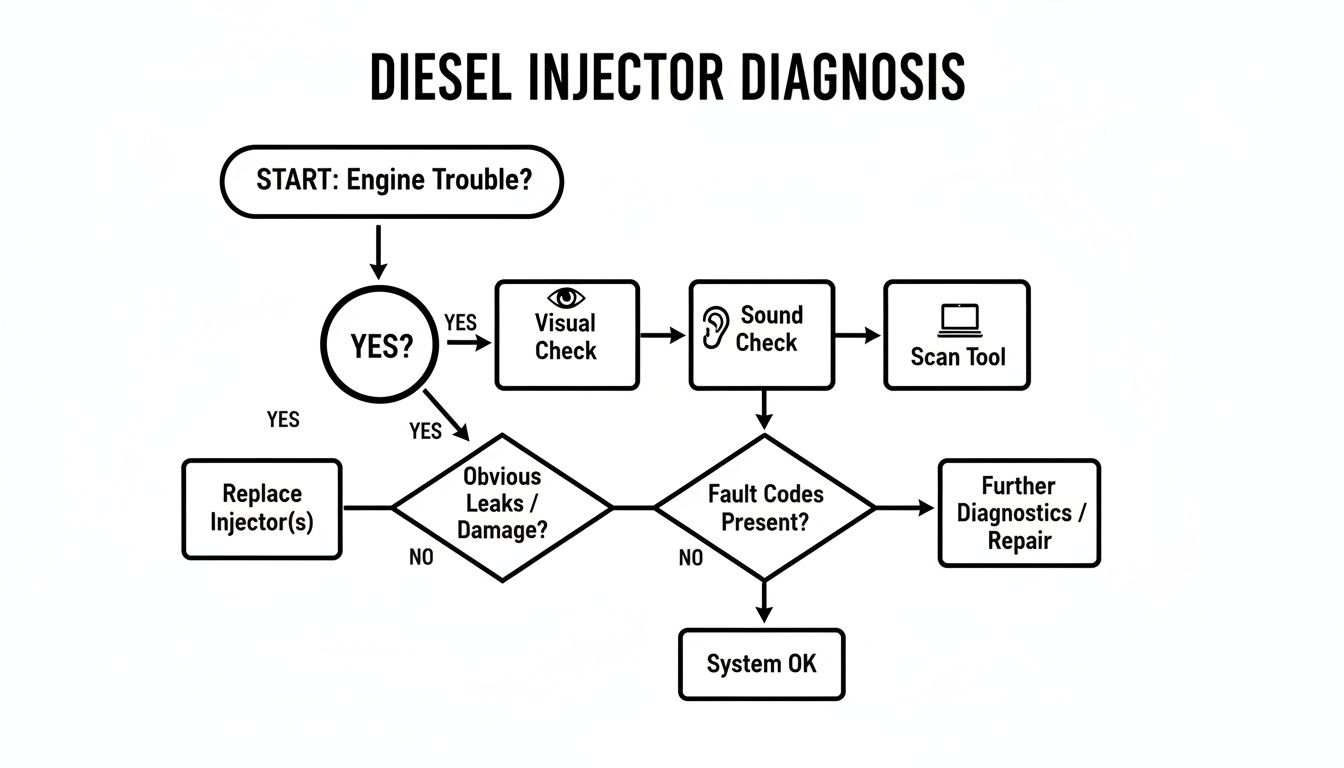
Following this kind of logical process allows a skilled tech to quickly figure out if you're dealing with a simple problem perfect for a repair, or something more serious that demands a replacement.
When Replacement Is the Only Safe Option
While we love the efficiency of a good repair, some problems are just too deep to patch up reliably. Trying to fix a fatally flawed injector is just kicking the can down the road. In these situations, a full replacement isn't just a repair—it's an essential investment in your engine's safety and reliability.
You absolutely must replace an injector if it has:
- Internal Cracks or Body Damage: Even a hairline crack in the injector body, often invisible to the naked eye, is a ticking time bomb. It can lead to a catastrophic high-pressure fuel leak, creating a massive fire hazard that simply cannot be repaired safely.
- Solenoid or Piezo Actuator Failure: These are the sophisticated electronic brains of the injector, telling it when to fire. When these internal electronics give up, the whole unit is a goner.
- Severe Internal Wear: After thousands of hours at sea, crucial moving parts like the needle and nozzle assembly simply wear out. They've reached the end of their service life, and a new injector is the only way to guarantee another long run of reliable performance.
The decision isn't just about the initial invoice. It's about long-term value and your peace of mind. A proper repair on the right problem can save you 40-60% compared to a new part, but a necessary replacement is what protects your entire engine from catastrophic failure.
Repair vs. Replace Diesel Injectors At a Glance
To help you see the trade-offs more clearly, we’ve put together this quick comparison. It breaks down the key factors—cost, downtime, and long-term results—to help you weigh your options when discussing the next steps with your technician.
| Factor | Repairing Injectors | Replacing Injectors |
|---|---|---|
| Average Cost | Lower. You can expect to pay 40-60% less than the cost of a new part. | Higher. You're paying for a brand-new component plus installation labor. |
| Downtime | Minimal. With mobile service, often just 24-48 hours. | Longer. Can range from a few days to a couple of weeks, depending on part availability. |
| Best For | Clogs, worn seals, and minor calibration issues. | Cracked bodies, electronic failures, and severe internal wear. |
| Long-Term Result | Extends the life of the existing injector. | Resets the injector’s service life back to zero hours. |
Ultimately, a thorough and honest diagnosis from an experienced technician is what empowers you to make a confident choice.
For a deeper dive into what a comprehensive overhaul involves, take a look at our guide on the diesel fuel injector rebuild process. Understanding what goes into a quality repair will help you see the value and make the best decision for your vessel and your budget.
Understanding Your Service Costs and Timelines
When your yacht's performance is on the line, the last thing you want are surprises on your invoice. Let's tackle the bottom-line questions about costs and timelines head-on. Knowing the real financial and time commitment for injector service on premier marine engines like MTU, MAN, and CAT is the key to making smart decisions for your vessel.
The cost to repair diesel injectors isn't a single, fixed number; it's a mix of diagnostics, labor, and parts. But honestly, the biggest factor that will drive your final bill is often where the work gets done. A traditional boat yard introduces a whole cascade of extra expenses that can inflate the cost far beyond the repair itself.
The True Cost of a Yard Stay
Hauling your vessel out of the water is a massive undertaking, both logistically and financially. Before a technician even lays a hand on your engine, you're already racking up big costs that have nothing to do with the actual problem. This is where the value of a top-tier mobile service becomes crystal clear.
- Haul-Out Fees: These can easily run into the thousands of dollars, depending on the size of your yacht.
- Yard Labor Rates: Boat yards often charge a premium for their technicians' time, and those hours add up fast.
- Extended Downtime: What should be a straightforward injector job can drag on for weeks at a busy yard. That’s lost cruising time or, even worse, cancelled charters.
We eliminate all those secondary costs by bringing our certified technicians and advanced diagnostic tools right to your slip. You pay for the expert work your engine actually needs, not the overhead of a brick-and-mortar facility.
Think about this real-world scenario: We got a call about a 70-foot sportfish in Fort Lauderdale showing all the classic signs of injector failure. A local yard quoted them a two-week stay with costs creeping toward $20,000 after you factor in the haul-out and all the associated labor. Our mobile team was on-site the very next day, finished the entire job in 48 hours, and saved the owner over $8,000.
Breaking Down Mobile Service Costs
Our pricing is designed to be completely straightforward. We give you a clear, detailed breakdown of what to expect so you understand every single line item. While every job has its own unique wrinkles, most mobile injector services will include charges for diagnostics, labor for the repair or replacement, and the cost of any parts. For a deeper dive into what goes into a service bill, check out our comprehensive guide on diesel engine repair costs.
It's a fact: the global market for diesel fuel injectors is exploding and projected to nearly double to USD 13.2 billion by 2032. Here in South Florida's tough marine environment, injectors on yachts fail 25-30% more frequently than their cousins in cars and trucks, thanks to constant saltwater exposure and high operational loads. This is exactly why mobile repair is such a game-changer. On-site service completely sidesteps the staggering $5,000-$15,000 haul-out costs per incident and avoids weeks of expensive downtime. You can discover more insights about the growing diesel fuel injector market on dataintelo.com.
Time is Your Most Valuable Asset
Beyond the major financial savings, the most critical advantage of our mobile service is time. We get it. Every single day your yacht is out of commission is a missed opportunity. Our entire operation is built from the ground up for speed and efficiency to get you back on the water as fast as humanly possible.
A Typical Mobile Service Timeline:
- Initial Call & Scheduling: We can often schedule same-day or next-day service.
- On-Site Diagnostics: Our techs can usually pinpoint the issue within a few hours of arrival.
- Repair or Replacement: Most jobs are wrapped up within 24-48 hours, depending on the scope and parts availability.
This rapid turnaround is a world away from the weeks you might spend waiting for a slot at a traditional yard. We bring the expertise, the tools, and the parts directly to you, delivering unmatched value and getting you back to cruising faster.
Proactive Maintenance to Protect Your Engine
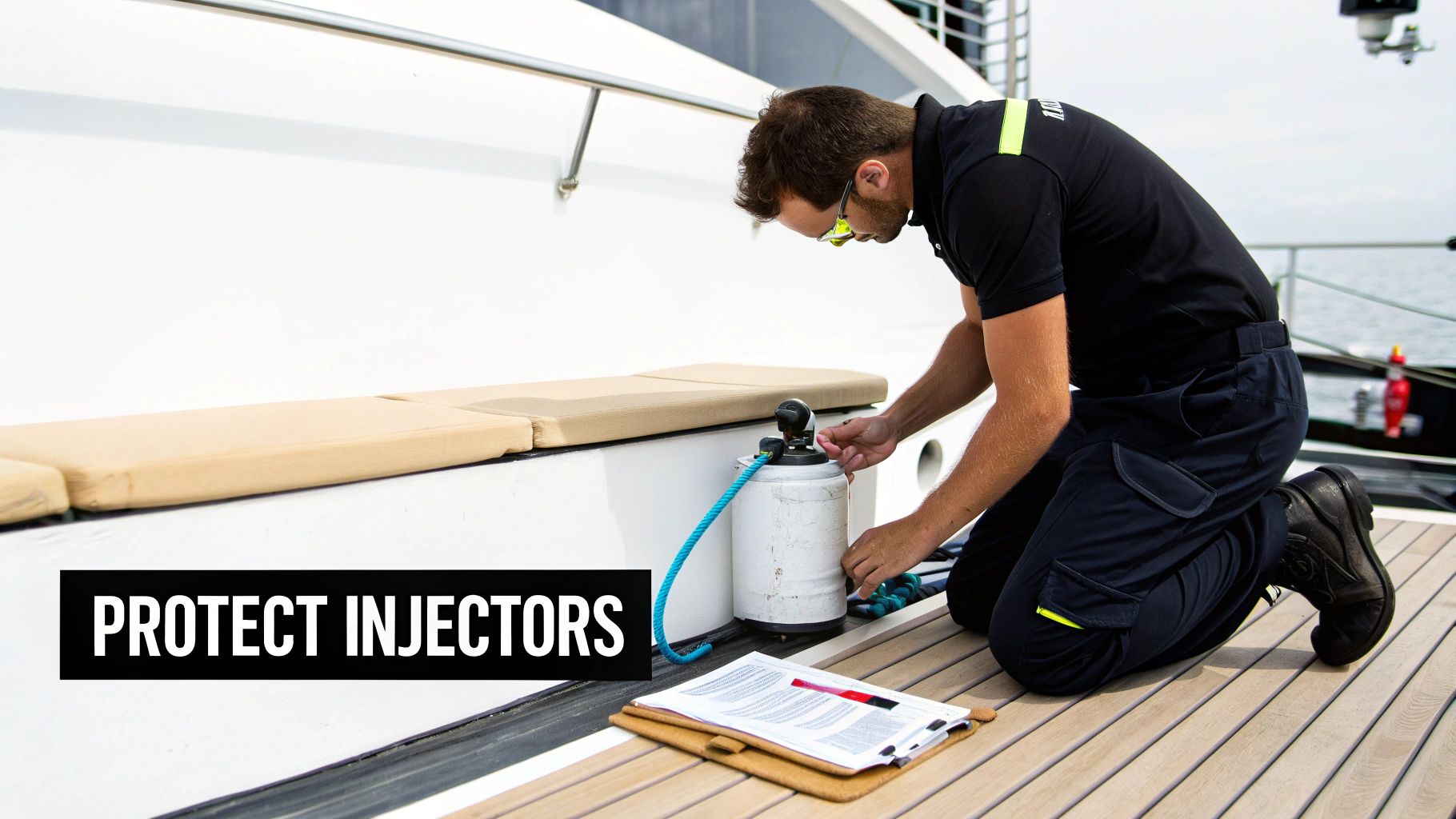
As any seasoned captain knows, the best way to handle a costly repair is to make sure it never happens in the first place. Knowing the signs of a bad injector is one thing, but true peace of mind comes from a maintenance strategy that keeps them from failing. Making that shift from reactive repairs to preventative care is the single most important thing you can do to protect your engine.
Think of it as the difference between a frantic emergency call and a routine check-up. Proactive maintenance is your engine’s long-term health plan. It’s a series of simple, vital steps that ensure your yacht is always ready for open water, not stuck at the dock. This is especially true here in South Florida, where the demanding marine environment is constantly working against your engine.
Your Essential Maintenance Checklist
The health of your injectors really boils down to what you feed them. Fuel, filters, and additives—these are the three pillars of a solid maintenance routine. If you neglect any one of them, you're essentially leaving the door wide open for contaminants to walk right in and wreak havoc.
Sticking to these fundamentals will dramatically cut the odds of you needing to repair diesel injectors ahead of schedule.
- Prioritize High-Quality Fuel: Let's be honest, diesel quality can be a mixed bag from one marina to the next. Always, and I mean always, get your fuel from reputable suppliers. This is your best shot at minimizing the water, dirt, and other gunk that can score or clog delicate injector nozzles.
- Adhere to a Strict Filter Schedule: Your fuel filters are the security guards for your injectors. Change them out every 10,000 to 25,000 miles (or the marine equivalent in operating hours) based on what the engine manufacturer recommends. No excuses.
- Use the Right Additives: In Florida's humidity, that nasty "diesel algae" is a constant threat inside fuel tanks. A good biocide is non-negotiable. Throw in a cetane booster, and you’ll not only stop microbial growth but also improve combustion and keep the injector internals clean.
Your engine's fuel injectors operate under immense pressure, often pushing past 25,000 PSI. At those forces, even a microscopic piece of debris in bad fuel acts like sandpaper, destroying the precision-engineered nozzle and ruining the spray pattern that gives you power.
The Logic Behind the Routine
When you understand why you're doing something, you're more likely to do it. Each of these steps directly counters a specific threat. Bad fuel doesn’t just cause a bit of smoke; it physically erodes the microscopic holes in your injector tips, which leads to poor atomization, unburnt fuel, and wasted power.
Likewise, water in the fuel isn't just a minor issue. It's a leading cause of corrosion on the injector's internal parts, which can make it stick open or shut—both of which are bad news. A strict filter schedule is your best insurance policy against both water and debris ever reaching these critical components.
Partnering for Long-Term Reliability
For busy owners and captains, juggling a detailed maintenance schedule is just one more thing on an already full plate. This is where a planned maintenance program becomes your most valuable asset. We work with our clients to build a simple, effective plan that removes all the guesswork from engine care.
Our technicians can handle the scheduling, the filter changes, the fuel sampling, and the system checks. We log everything, giving you a complete service history and the confidence of knowing your yacht isn't just ready for the next trip, but is protected for years to come. It's the smartest way to ensure reliability and maximize your time on the water.
Why Go With a Certified Mobile Service?
When your yacht’s engine starts acting up, you have a big decision to make. It’s not just about the repair itself, but how and where you get it done. You could go the traditional boatyard route, but for today's yacht owner, a certified mobile service brings an unbeatable mix of efficiency, expertise, and pure convenience. It’s a modern approach built to protect your most valuable assets: your time and your vessel.
Choosing a mobile expert to repair diesel injectors completely transforms the entire service experience. Forget the logistical headache of hauling out, fighting for a spot in a busy yard, and then waiting days or even weeks for an update. We bring the solution directly to you. Our certified technicians show up at your slip—whether you're in West Palm Beach, Miami, or anywhere in between—with everything they need to diagnose the problem and get it fixed.
The Clear Advantages of On-Site Expertise
The benefits of mobile service are about more than just convenience; it’s a smarter way to manage your yacht’s maintenance. You immediately sidestep all the hidden costs and frustrating delays that are practically baked into the traditional yard model. No more haul-out fees, inflated yard labor rates, or watching your boat sit idle while you could be on the water.
This model is also far more personal. Our technicians are focused on your engine, working around your schedule. You get transparent communication and clear, upfront pricing every step of the way. We see ourselves as partners in keeping your vessel in top shape, not just another work order number on a long list.
Your time is the one asset you can never get back. By bringing world-class diagnostics and repair services directly to your yacht, we don’t just fix your engine—we give you back your cruising schedule, eliminate logistical headaches, and protect your bottom line from unnecessary expenses.
Protecting Your Investment with Certified Pros
At the end of the day, a repair is only as good as the technician doing the work. Our team is made up of licensed, insured, and factory-certified professionals who live and breathe marine diesel systems. This is our craft. We have firsthand experience with the unique demands that South Florida’s environment puts on engines from MAN, MTU, and CAT.
When you combine that deep expertise with the efficiency of on-site service, you simply get a better result. We're committed to the highest standard of care, ensuring every repair is done right the first time. To see what else we can do, check out our full range of diesel marine repair services.
Don’t let a straightforward injector problem spiral into a long, expensive saga. Go with the modern, efficient, and expert solution. Contact GTM International today to book your on-site service and see for yourself why a certified mobile team is the smarter choice. We're ready to get you back on the water, fast.
Common Questions We Hear About Injector Repair
When you're dealing with marine diesel engines, a lot of questions come up. It's only natural. Here are the straight-up answers to the most common ones we get from captains and yacht owners trying to get to the bottom of injector issues.
How Often Should I Get My Marine Diesel Injectors Serviced?
In the tough marine environment of South Florida, we've found that a professional check-up every 1,500 to 2,000 operating hours is the sweet spot. Think of it as preventative medicine for your engine. This allows a good technician to catch things like early-stage clogs or calibration issues before they turn into a real headache out on the water.
But don't get too hung up on the hours alone. Your engine will tell you when it needs help. If you notice any of these red flags, it's time to call for a diagnostic, regardless of how long it's been since the last service.
- More black smoke than usual billowing from the exhaust.
- The engine is running rough or sputtering at the dock.
- You feel a definite loss of power or the throttle just feels "spongy."
- You're burning through fuel faster than you used to.
These are classic signs that an injector is crying out for attention. Ignoring them only leads to bigger, more expensive problems down the line.
Can't I Just Dump in a Fuel Injector Cleaner?
Look, a quality fuel additive is a fantastic part of a good maintenance routine. But it’s not a magic fix for an injector that’s already failing. It's like brushing your teeth to prevent cavities—it's essential, but it won't fix a tooth that's already broken.
Additives are great for keeping minor deposits at bay, but they have their limits.
An additive simply can't repair a physically worn-out nozzle, a dead solenoid, or a spray pattern that's gone haywire from internal damage. Once you're seeing real symptoms, the problem has almost always gone beyond what a bottle of cleaner can solve. You need a proper diagnosis to find out what's really going on.
What’s the Real Turnaround Time for Mobile Injector Repair?
This is where mobile service truly shines. We bring the entire workshop to your slip, which means you're not stuck waiting in a yard queue.
A typical diagnostic visit takes just a few hours. If we're looking at an on-site repair—like cleaning, a recalibration, or swapping out seals—we can usually have you ready to go within 24 to 48 hours. If it's a full replacement and we have the parts on hand, it's often a same-day job. Compare that to the 7-14 day average you might be looking at in a traditional boat yard, and the difference is night and day.
When you need clear answers and expert service right at your vessel, the certified pros at GTM International are the ones to call. We bring the solution to you, so you spend less time worrying and more time on the water. Contact us today to schedule your service.
