

When your yacht’s diesel engine acts up, the last thing you want is a logistical nightmare. The old way meant haul-outs, shipyard queues, and watching your time on the water slip away. But diesel marine repair has evolved. Now, the expertise comes directly to your dock.
The Modern Solution to Yacht Engine Problems
We’ve all been there—or heard the horror stories. You’re miles from shore, or maybe just gearing up for a weekend cruise, when you notice a problem. The traditional response was a painful process: find a shipyard with an open slot, coordinate the haul-out, and then wait. And wait. Your vessel could be sidelined for days, sometimes weeks, turning a simple repair into a frustrating, expensive ordeal.
Thankfully, there’s a much smarter approach. Think of it as a house call for your high-performance yacht. Instead of taking the boat to the shop, a certified technician travels to you, fully equipped with the specialized diagnostic tools needed to solve the problem right where you're berthed in South Florida. This isn't just a convenience; for today's yacht owner, it's a necessity.
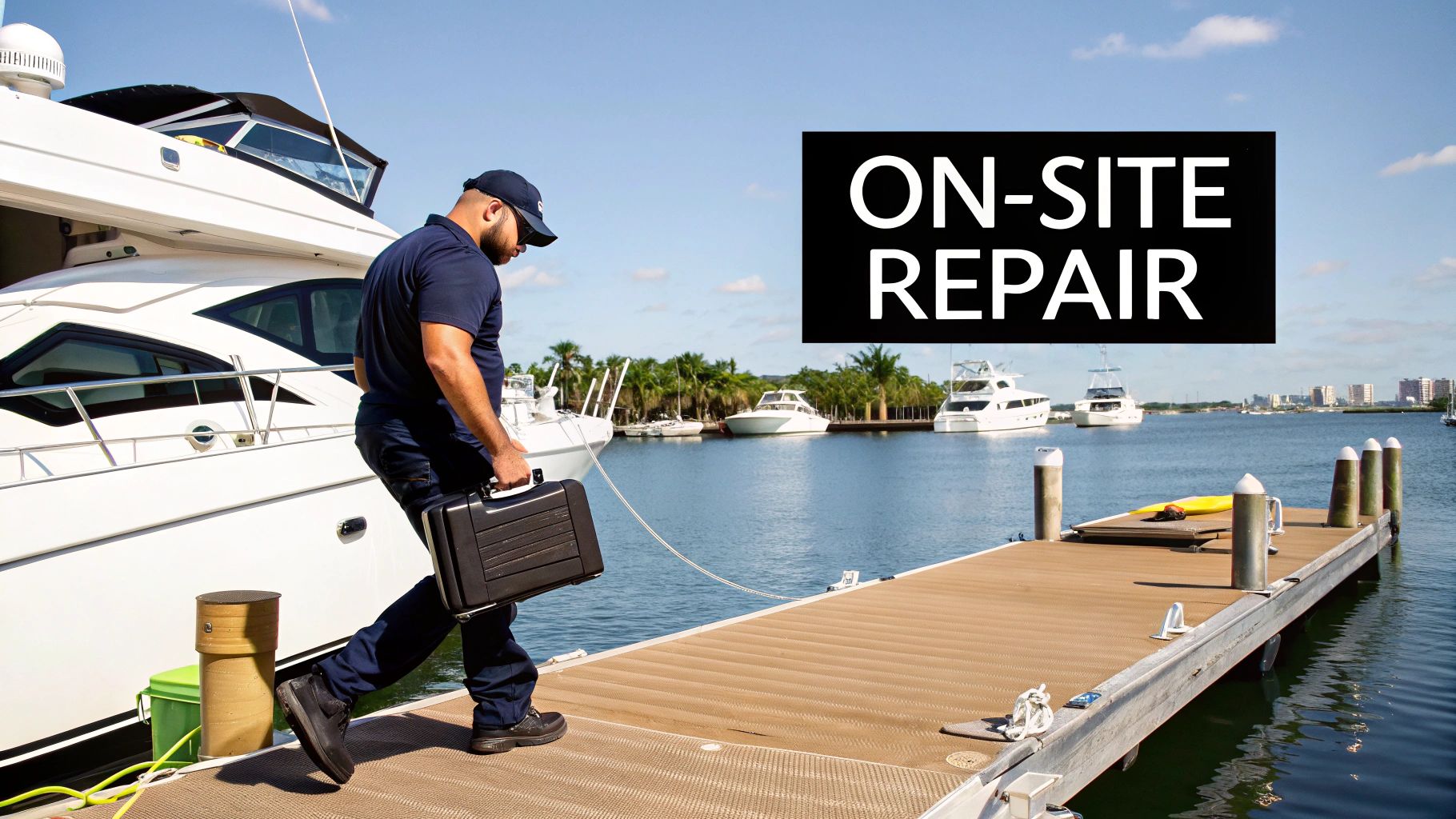
Why On-Site Service is the Superior Choice
The benefits of mobile diesel repair go well beyond just skipping a trip to the yard. By bringing the technician to the vessel for most issues, you gain a massive advantage in protecting both your investment and your valuable time.
- Minimized Downtime: We get to work right away. Diagnostics and repairs start immediately, dramatically reducing the time your yacht is out of service.
- Cost Savings: Forget the hefty fees for haul-outs, shipyard labor, and transport. You avoid all of them.
- Unmatched Convenience: We come to you, wherever you are docked from West Palm Beach to Ft. Lauderdale. The service works around your schedule, not the other way around.
This is a fundamental shift in how yacht maintenance is handled. It puts you, the owner, back in control. What was once a reactive, stressful process becomes a streamlined solution that keeps you where you belong—on the water.
At the end of the day, choosing on-site repair is choosing efficiency. It’s about getting problems solved quickly and professionally with the least possible disruption, making sure your yacht is always ready for its next adventure.
Spotting Trouble Before It Starts: Early Warning Signs from Your Diesel Engine
Your marine diesel engine is the heart of your yacht. It's an incredible piece of engineering built for relentless power and reliability. But like any powerful machine, it has its own way of communicating. The real trick to keeping it healthy isn’t waiting for an alarm to go off—it’s learning to understand the subtle whispers it sends out long before it ever starts shouting.
Ignoring those little signs—a slight change in sound, a puff of smoke, a minor shudder—is the fastest way to turn a small, fixable issue into a vacation-ruining breakdown miles from shore. Catching problems early is the difference between a simple on-site fix and a catastrophic failure. It puts you in control.
This isn’t just good practice; it’s a necessity. Diesel engines are the undisputed workhorses of the sea, powering vessels that consume over 50% of all fuel in global shipping. That constant, heavy-duty work takes its toll. In fact, unplanned downtime costs the maritime industry over $10 billion every year, often from problems that started as minor, overlooked symptoms. You can dig deeper into the dominant role of marine diesel engines by exploring the full research on techsciresearch.com.
Learning to Speak "Engine"
Think of your engine as constantly giving you a health report. Odd smells, weird noises, and dips in performance aren't just minor annoyances; they're data points telling you something needs attention. Getting familiar with these signs is the first and most critical step in smart diesel marine repair.
- Smoke Signals: The color of your exhaust is a dead giveaway. Is it black? That often points to injector issues or a turbo problem—basically, too much fuel or not enough air.
- Feeling the Vibrations: A healthy engine purrs. If you suddenly feel a new or worsening vibration, that's a clear warning. It could be a misfiring cylinder, a serious engine misalignment, or even propeller damage sending shudders through the vessel.
- Power Loss: Does your yacht feel sluggish? Is it struggling to get up to its usual RPMs? That’s a massive red flag. The cause could be as simple as a clogged fuel filter or as serious as a failing turbo or a loss of compression in a cylinder.
A clogged fuel filter is like a pinched straw. You can suck as hard as you want, but you're just not going to get enough to drink. For your engine, that "drink" is diesel fuel. Restricting the flow starves it of power and, if ignored, can lead to serious damage to the fuel pump—a much bigger headache than a simple filter swap.
Before we get into the sounds, here's a quick cheat sheet to help you connect what you're seeing or feeling with what might be going on inside your engine.
Quick Diagnostic Guide: Common Diesel Engine Symptoms and Potential Causes
This table isn't a substitute for a professional diagnosis, but it can give you a solid head start. When you call a technician, being able to describe the symptom accurately helps them narrow down the possibilities and get to the root of the problem faster.
| Symptom You Notice | What It Could Mean | Recommended Action |
|---|---|---|
| Black Smoke from Exhaust | Too much fuel or not enough air. Could be a faulty injector, turbocharger issue, or a clogged air filter. | Schedule a diagnostic check, focusing on the fuel and air intake systems. Avoid running at high RPMs. |
| White or Blue Smoke | White smoke can be unburnt fuel or coolant leaking. Blue smoke is almost always burning oil. | Immediate professional inspection. This could indicate a serious internal issue like a blown head gasket or worn piston rings. |
| Engine Overheating | Low coolant, a failing water pump, a clogged heat exchanger, or a thermostat stuck closed. | Reduce engine load immediately. Check coolant levels (when cool). If the problem persists, shut down and call for service. |
| Sudden Loss of Power | Clogged fuel filters, a failing fuel pump, air in the fuel lines, or a turbocharger problem. | Check fuel filters first. If that doesn't solve it, a technician needs to investigate the fuel delivery system. |
| Unusual Vibrations | Misfiring cylinder, engine misalignment, damaged engine mounts, or a fouled/damaged propeller. | Have a mechanic check engine mounts and alignment. If vibrations are new, a diver may need to inspect the prop. |
| Difficulty Starting | Weak batteries, starter motor issues, fuel delivery problems (air leaks), or failing glow plugs. | Check battery voltage first. If batteries are good, the issue is likely in the fuel or electrical starter system. |
Remember, the more details you can provide—when the symptom started, under what conditions it happens (at idle, under load, etc.), and any accompanying noises—the more efficiently we can diagnose and fix the issue.
Listen for Trouble
Beyond what you can see or feel, your ears are one of your best diagnostic tools. An engine’s rhythm tells a story, and any change in that rhythm is a clue.
The best thing you can do is establish a mental baseline. Know exactly what your engine sounds like when it’s running perfectly. That way, the moment a new noise appears, it will stick out like a sore thumb.
- Knocking or Pinging: Sharp, metallic clanking is a sound you never want to hear. It often points to fuel detonation (timing issues) or, worse, worn internal bearings. This is a "call for help immediately" kind of noise.
- Whining or Whistling: A high-pitched sound that rises and falls with your engine's RPM is a classic sign of a failing turbocharger or an air leak in the intake system.
- Grinding Noises: If you hear grinding, shut the engine down as soon as it's safe. That's the sound of metal-on-metal destruction, and it means severe mechanical damage is happening in real-time.
By paying close attention to these clues, you become an active partner in your vessel's maintenance. When you can tell our technicians exactly what you saw, felt, and heard, you give us a huge head start. That collaborative approach is the key to a fast, accurate diesel marine repair that gets you back on the water with total confidence.
What To Expect When You Call For Mobile Marine Repair
When you're dealing with a dead engine, the last thing you need is more uncertainty. You're probably wondering what happens after you make that urgent call. A professional diesel marine repair service should turn that anxiety into a clear, straightforward plan to get you running again. It’s all about getting you back on the water fast, and a good service keeps you in the loop every step of the way.
From the moment you pick up the phone, the diagnostic process is already underway. That first call is more than just scheduling a visit; it’s a critical triage session. A seasoned technician will ask specific questions about what you're seeing, hearing, and feeling from the engine. This conversation is key—it helps them show up with the right tools and a good idea of what parts might be needed, saving valuable time.
Arrival And On-Site Safety Check
Whether your yacht is docked at a bustling Ft. Lauderdale marina or a quiet private slip in West Palm Beach, the technician comes to you. But the first thing they’ll do isn't pop open the engine hatch. It's all about safety. They'll conduct a thorough safety sweep of the engine room and the surrounding space to make sure it's secure before a single tool comes out.
This means checking for any signs of fuel leaks, ensuring the ventilation is adequate, and properly securing the boat’s power systems. Only when the area is declared 100% safe will the hands-on work begin. This safety-first protocol is a non-negotiable sign of a true professional.
The troubleshooting process itself is methodical. It's a logical flow from symptom to solution, as shown below.
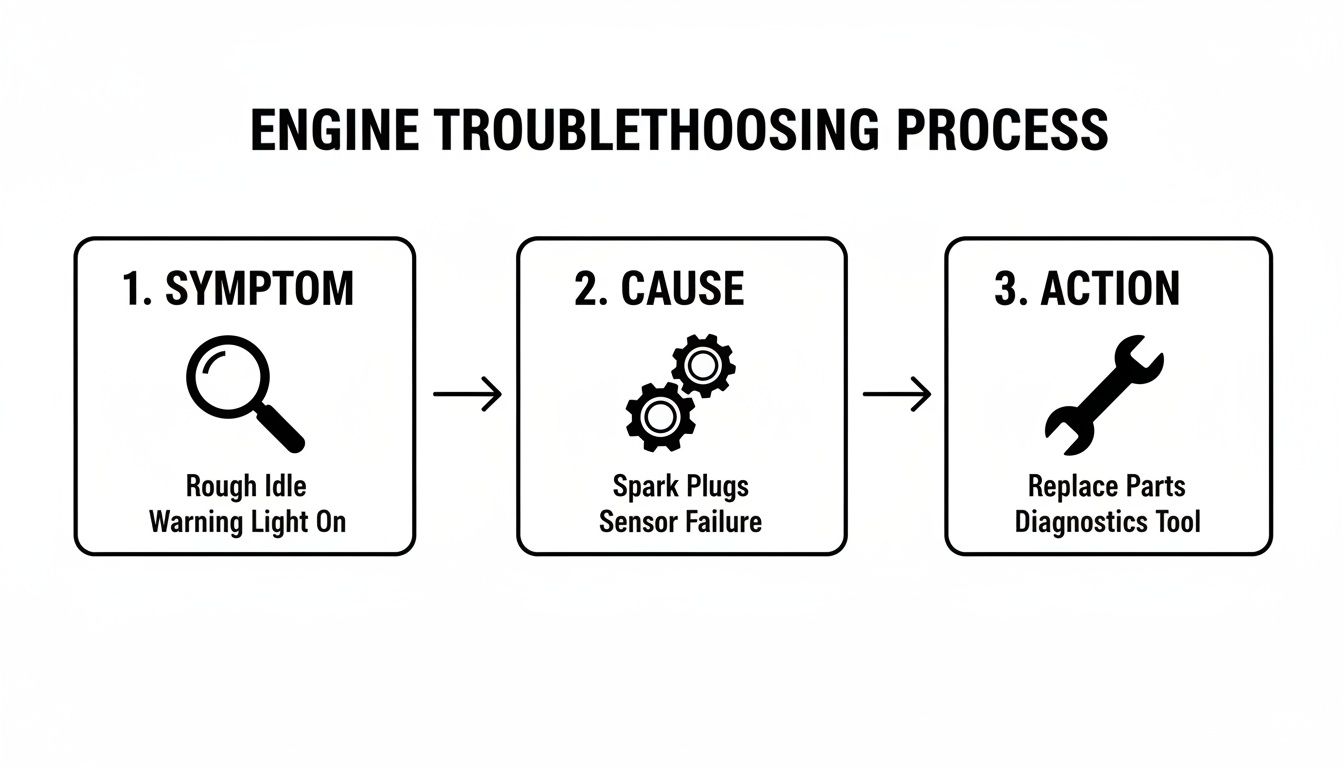
This simple, powerful approach means we're fixing the real problem based on evidence, not just taking a guess. It leads to more accurate, reliable repairs that last.
Diagnostics And Building Your Repair Plan
Once the area is secure, the real deep dive begins. The technician will plug advanced diagnostic computers right into your engine’s electronic control unit (ECU). Think of it like a full-body scan for your engine. It pulls a massive amount of data—performance history, hidden fault codes, and operational quirks that are impossible to spot with the naked eye. For today's complex marine diesels, this step is absolutely essential.
After combining the computer diagnostics with a hands-on mechanical inspection, the technician will sit down with you and explain everything in plain English. No jargon, no runaround.
You'll get a complete rundown of the issue, a clear explanation of the proposed fix, and a transparent cost estimate. We believe you should understand exactly what needs to be done and why, so you can approve the repair plan with total confidence.
As soon as you give the okay, the work starts. If a new part is required, a well-connected mobile service uses its network to get high-quality OEM or equivalent parts delivered quickly, keeping downtime to a minimum. To get a better idea of what to budget for, take a look at our guide to diesel engine repair costs and see how on-site service can often save you money.
The Final Steps: Sea Trial and Sign-Off
Getting the engine running again is just one part of the job. The most important phase is making sure the fix actually worked. Once the repair is complete, the technician will fire up the engine and run it at the dock to monitor all its systems.
If everything looks good and the conditions are right, the final test is a sea trial. Taking the vessel out on the water is the only way to ensure the engine performs perfectly under a real-world load. This confirms the repair was 100% successful.
The job isn't done until you are completely satisfied. This methodical process—from the first call to the final sea trial—is what sets a superior mobile marine service apart. It's about delivering not just a repair, but complete peace of mind.
Why Brand-Specific Expertise on MTU, MAN, and CAT Matters
When you’re dealing with high-performance marine engines, "a mechanic is a mechanic" just doesn't hold water. Think of it this way: you wouldn't have your family doctor perform heart surgery. The same specialized logic applies directly to your yacht's powerplant. Handing over a complex MTU, MAN, or CAT engine to a general mechanic is a gamble that often leads to misdiagnoses, temporary fixes, and ultimately, more downtime and higher costs.
True expertise in diesel marine repair isn’t generic; it's brand-specific. Certified technicians aren't just familiar with diesel engines in general. They're fluent in the unique language of the brands they service—understanding their specific architecture, sophisticated electronics, and common quirks. This deep, specialized knowledge is what separates a wild guess from a precise, permanent solution.
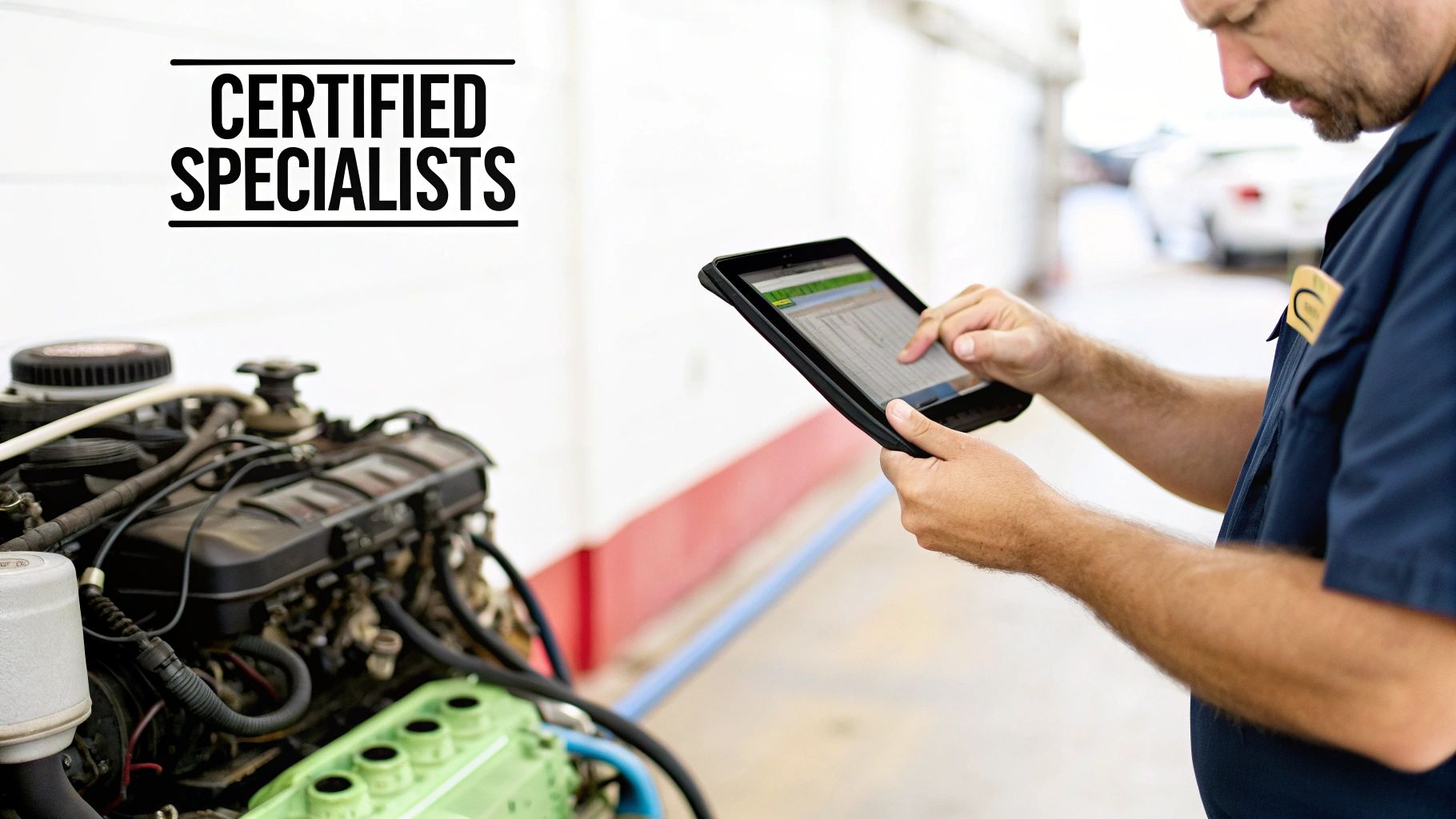
This level of skill isn't picked up on the job; it’s earned through direct, factory-level training and access to proprietary tools that general shops simply can't get.
- Proprietary Diagnostic Software: Manufacturers like MTU, MAN, and CAT have their own exclusive software that talks directly to their engines' electronic control units (ECUs). This gives a certified tech x-ray vision, allowing them to see past generic fault codes and analyze deep performance data to nail down the real root cause of a problem.
- Factory-Direct Training: Our specialists get ongoing training directly from the people who built the engines. They learn about engineering updates, new service bulletins, and advanced troubleshooting methods straight from the source.
- Genuine OEM Parts Access: As a certified partner, we have a direct pipeline to genuine Original Equipment Manufacturer (OEM) parts. This guarantees that every replacement component meets the precise tolerances and material specs your engine needs to perform at its peak.
Choosing a brand-certified technician is an investment in certainty. It ensures the person working on your multi-million dollar asset has the precise tools, training, and parts needed to do the job right the first time, protecting your engine’s performance and resale value.
The Nuances of MTU Engines
MTU engines are masterpieces of German engineering, known for their sophisticated electronic controls and incredible power-to-weight ratios. A classic issue we see is a derate condition where the engine limits its own power because a sensor is feeding the ECU bad information. A generalist might start swapping parts, hoping to get lucky. An MTU specialist, however, plugs right in with the diagnostic software, isolates the faulty sensor, checks its live data stream, and confirms the problem before ever picking up a wrench. This targeted approach saves a huge amount of time and money.
For a deeper look, you can learn more about the specifics of servicing MTU diesel marine engines and see just how critical this expertise is.
The Demands of MAN Powerplants
MAN engines are absolute workhorses, famous for their rugged durability. But they have their own unique service needs, particularly with their fuel injection systems. An issue like injector timing drift can cause a subtle loss of power and more smoke than usual. A technician without MAN-specific training might chase a phantom turbo problem. A certified expert knows exactly how to calibrate the system and has the specialized tools to time the injectors perfectly, restoring full efficiency and preventing long-term cylinder damage.
The Robust World of CAT Engines
Caterpillar (CAT) engines are built to be bulletproof, but their cooling systems require an expert’s touch. A hidden killer in these engines is cavitation—tiny vapor bubbles in the coolant that implode with enough force to erode the cylinder liners from the inside out. A CAT specialist knows the exact supplemental coolant additives (SCAs) and testing schedules needed to prevent this. This is the kind of preventative knowledge, gained only through factory training, that protects the engine block from catastrophic internal damage that would be incredibly expensive to fix.
How Proactive Maintenance Protects Your Investment
It’s easy to look at maintenance as just another line item on the expense sheet, but that’s one of the biggest—and costliest—mistakes a yacht owner can make. The truth is, a proactive maintenance schedule is the single best financial strategy for your vessel. It’s not a cost; it’s an investment that pays you back over and over in reliability, performance, and the long-term value of your yacht.
Think of it like this: your engine's maintenance plan is like a retirement fund. You make small, consistent contributions on a regular schedule. They don't feel like much at the time, but over the years, they compound into a fortress of financial security. If you skip those contributions, you’re left with a massive shortfall right when you need the money most. The exact same principle applies to professional diesel marine repair and maintenance.
That minor coolant leak you put off fixing today? It can easily turn into a catastrophic engine overheat miles from shore tomorrow. Suddenly, a simple hose replacement has spiraled into a multi-thousand-dollar rescue and a nightmare of a repair bill. Proactive care is all about making sure that scenario never happens.
Building a Fortress of Reliability
A solid maintenance plan goes way beyond just changing oil and filters. It’s a complete health and wellness program for your yacht's most vital systems, designed specifically to catch small problems before they have a chance to become big, expensive ones. It's the difference between you controlling your schedule and a sudden breakdown controlling it for you.
An effective preventative schedule always includes these key checks:
- Routine Fluid Analysis: We send oil and coolant samples to a lab to get a detailed report on your engine's internal health. This can reveal microscopic metal fragments signaling bearing wear or catch coolant contamination long before it can cause serious damage.
- Heat Exchanger and Cooler Servicing: Your engine’s cooling system is its lifeline. Regular servicing clears out blockages and stops corrosion that lead to overheating—the number one killer of marine diesel engines.
- Generator Load Bank Testing: This test is like a stress test for your generator, making sure it can handle its maximum rated load. It’s the only way to be certain you'll have full power when you absolutely need it.
This systematic approach gives you real, tangible benefits that protect both your time on the water and your bank account.
The Financial Case for Preventative Care
The numbers don't lie. A well-maintained engine doesn't just run more reliably; it runs more efficiently, burning less fuel and lowering your operating costs every time you leave the dock. Even more importantly, it dramatically extends the engine’s lifespan, pushing the enormous expense of a complete rebuild or replacement far into the future.
The real beauty of proactive maintenance is that it flips your spending from unpredictable, high-cost emergency repairs to predictable, manageable service appointments. That financial stability gives you a peace of mind that’s truly priceless.
The market itself shows how valuable this expertise has become. The global marine diesel engine repair market is valued at $5 billion in 2025 and is expected to surge to $7.9 billion by 2033. This growth is being fueled by owners who understand that investing in expert on-site care from specialists like GTM International is the key to avoiding the crippling downtime and costs of yard-based repairs. You can dive deeper into these industry trends in this market research report on archivemarketresearch.com.
When it’s finally time to sell your yacht, a detailed service history from a certified provider is one of the most powerful assets you can have. It’s undeniable proof to any buyer that the vessel has been professionally cared for, which significantly boosts its resale value and makes it stand out in a crowded market. It’s an investment that truly pays for itself, multiple times over.
Choosing the Right Marine Repair Partner in South Florida
When your yacht needs work, the most critical decision you'll make is who you trust to do it. South Florida has plenty of options, but let's be honest—they aren't all created equal. The right choice is about more than just a quick fix; it’s about finding a team that gives you complete confidence on the water and protects your investment for the long haul.
Choosing a repair partner isn’t the time to look for the cheapest or closest shop. Your high-performance vessel demands a higher standard. A truly elite diesel marine repair partner is built on a few non-negotiable principles that set the real pros apart. This is the level of service you should expect, every single time.
What an Elite Service Partner Looks Like
When you're evaluating a company, your checklist should be straightforward. A top-tier provider won't make you guess about their qualifications; they'll be proud to show you what they can do. Here’s what really matters:
- Verifiable Factory Certifications: Your technicians must have factory-level training for major brands like MTU, MAN, and CAT. This isn't just a nice-to-have; it's your guarantee that they have the proprietary software, specialized tools, and insider knowledge to service your engine exactly as the manufacturer intended.
- A True 24/7 Mobile Response: Engine trouble rarely happens on a convenient 9-to-5 schedule. You need a team that offers 24/7 availability across a wide service area, ready to come to you from West Palm Beach to Ft. Lauderdale the moment you call.
- Comprehensive On-Site Capabilities: The best specialists handle everything, not just the engine itself. You want a team that can manage electrical diagnostics, steering systems, and generator repairs right at the dock. It saves you the headache of coordinating multiple vendors.
Choosing a licensed, insured, and certified partner gives you ultimate peace of mind. It means every repair is backed by accountability, protecting you from liability and guaranteeing the quality of work performed on your yacht.
Demand Excellence for Your Vessel
In the end, it all comes down to trust. You're handing over the keys to the heart of your yacht—a complex, powerful, and expensive piece of machinery. Don’t settle for a generalist when your investment deserves a specialist.
An elite partner doesn't just fix what's broken; they build a lasting relationship based on skill, transparency, and a genuine commitment to keeping you on the water, problem-free. This is the standard we live by at GTM International. Our team of certified diesel engine specialists delivers the factory-backed expertise and rapid mobile response that South Florida yacht owners deserve. We’re here to do more than just repair your vessel—we’re here to enhance its reliability and protect its value for years to come.
Your Diesel Marine Repair Questions, Answered
When you're out on the water, the last thing you want is engine trouble. And when it does happen, a million questions can race through your mind. We get it. We’ve heard them all from yacht owners and captains across South Florida, so we’ve put together some straightforward answers to the questions we hear most often.
How Quickly Can You Get a Technician to My Yacht?
When your engine is down, every minute feels like an hour. That’s why a top-tier mobile service operates on a 24/7 dispatch schedule. It doesn't matter if it's a Tuesday morning or the middle of the night on a holiday weekend—an expert technician is always on call.
For any urgent call in our main service areas like West Palm Beach or Ft. Lauderdale, our goal is to get a technician rolling almost immediately. Factoring in your location and traffic, we can often be on-site within just a few hours, tools in hand, ready to figure out what's wrong and make it right.
What’s Involved in a Mobile Diagnostic Call?
This is way more than just a quick peek under the hood. A professional mobile diagnostic is a systematic, tech-forward process designed to get straight to the root of the problem without any guesswork. Think of it as a house call from a specialist.
Here's what you can expect:
- The Initial Call: We’ll talk through the symptoms with you over the phone to get a clear picture of what’s happening.
- Safety First: Once on-site, we conduct a full safety check of the engine room before a single tool comes out.
- Plugging In: We connect specialized, manufacturer-specific software directly to your engine’s computer (ECU) to pull fault codes and analyze real-time performance data.
- Hands-On Confirmation: The computer tells us a lot, but nothing beats a physical inspection. We’ll manually check the fuel, air, cooling, and electrical systems to confirm the digital diagnosis.
After we’ve nailed down the issue, we’ll walk you through it in plain English and provide a clear, detailed estimate for the repair. No surprises, just solutions.
Is Your Work Approved for My Engine’s Warranty?
Absolutely, and this is a critical detail for anyone with a newer vessel. As a factory-certified service provider for premier brands like MTU, MAN, and CAT, all our work is performed to the exacting standards set by the manufacturers themselves.
Using a certified technician isn't just a good idea—it's essential for keeping your factory warranty intact. We use only genuine OEM parts and follow the book on every procedure, so you can be confident your investment is protected.
What Parts of South Florida Do You Cover?
Our mobile teams are strategically based to serve the entire South Florida coastline, from the Treasure Coast down to Broward County. We provide fast, on-site service to yachts docked in marinas and private slips from Ft. Pierce and Jupiter all the way down through West Palm Beach, Boca Raton, and Ft. Lauderdale. If you're docked in this region, we can get to you.
When you need an expert who comes to you, GTM International is always ready to take your call. Contact us 24/7 for immediate help and experience the confidence that comes with having a professional on your side.
