
Your Volvo Penta marine diesel engine isn't just a piece of machinery; it's the beating heart of your vessel. It’s what gets you out on the water and, more importantly, what gets you home safely. Think of it as the most critical crew member you have—one that demands a specific kind of understanding to keep it performing at its best.
The Heartbeat of Your Vessel
Whether you're planning a quiet cruise along the coast or a serious offshore passage, your Volvo Penta is the core of the entire experience. This isn't just any engine; it's the product of a long legacy of Swedish engineering, built for toughness and packed with smart technology.
This guide is designed to cut through the jargon of a dense technical manual. We're going to give you a real-world owner's perspective on what makes this powerhouse tick. Our goal is to help you get to know your engine, so you can unlock its full potential, trust its reliability, and protect the value of your boat for years to come.
Why This Knowledge Actually Matters
Look, you don't have to be a seasoned diesel mechanic to benefit from knowing your engine. Understanding the basics of your specific Volvo Penta marine diesel engine empowers you to make smarter decisions, whether you're doing a quick pre-departure check or talking through a service plan with a technician. A well-cared-for engine is simply the foundation of safe, stress-free time on the water.
Knowing your engine is the first step toward confident ownership. It turns a complex machine into a trusted partner, so you're ready for whatever the sea throws at you and can act decisively when it counts.
We'll take a deep dive into everything you need to know, from figuring out which engine family you have to mastering its maintenance schedule. We’ll even cover common hiccups and how to troubleshoot them, helping you tell the difference between a minor issue and a sign you need to call in an expert.
The Need for a Specialist's Touch
Let's be honest—these aren't the simple diesels of 30 years ago. Modern engines are a sophisticated blend of precision mechanics and complex electronics. This is where the line between a general mechanic and a factory-certified technician becomes crystal clear.
- The Right Tools: A certified expert uses proprietary Volvo Penta diagnostic software that talks directly to your engine’s brain (the ECU). It pulls data and fault codes that generic scanners can't even see.
- Up-to-Date Training: These technicians live and breathe Volvo Penta. They get continuous training on the newest systems, so they know the unique quirks and architecture of your specific model.
- Genuine Parts: There's no substitute for the real thing. Using authentic Volvo Penta parts ensures a perfect fit and function, keeping your engine running exactly as the engineers in Sweden designed it to.
In the end, this guide will give you the knowledge to be a better, more informed owner and help you work with the right professionals to keep your vessel's heart running flawlessly.
Getting to Know Your Volvo Penta Engine Model
Every Volvo Penta marine diesel engine has its own unique character, built for a specific job on the water. Figuring out which "family" your engine belongs to is a bit like knowing if your star athlete is a marathon runner, a powerful gymnast, or a lightning-fast sprinter. It’s the key to understanding its strengths, its limits, and how to talk intelligently about performance, maintenance, and potential upgrades.
Think of the huge D-series as the marathon runners of the marine world. These are the workhorses, engineered for thousands of hours of endurance, reliability, and steady power. They are the heart and soul of commercial fishing fleets, pilot boats, and long-range cruising yachts—places where absolute dependability is the only thing that matters.
Then you have the sprinters, which make up many of the leisure-focused engines. These are all about rapid acceleration and top-end speed, perfect for sportfishing boats and express cruisers that need to jump on plane and stay ahead of the pack. And finally, the gymnasts: the revolutionary Inboard Performance System (IPS) pods. They're incredibly powerful but also astonishingly agile, giving a skipper a level of maneuverability that traditional inboard systems just can't touch.
This is all driven by a core philosophy that balances three critical elements for any boat owner.
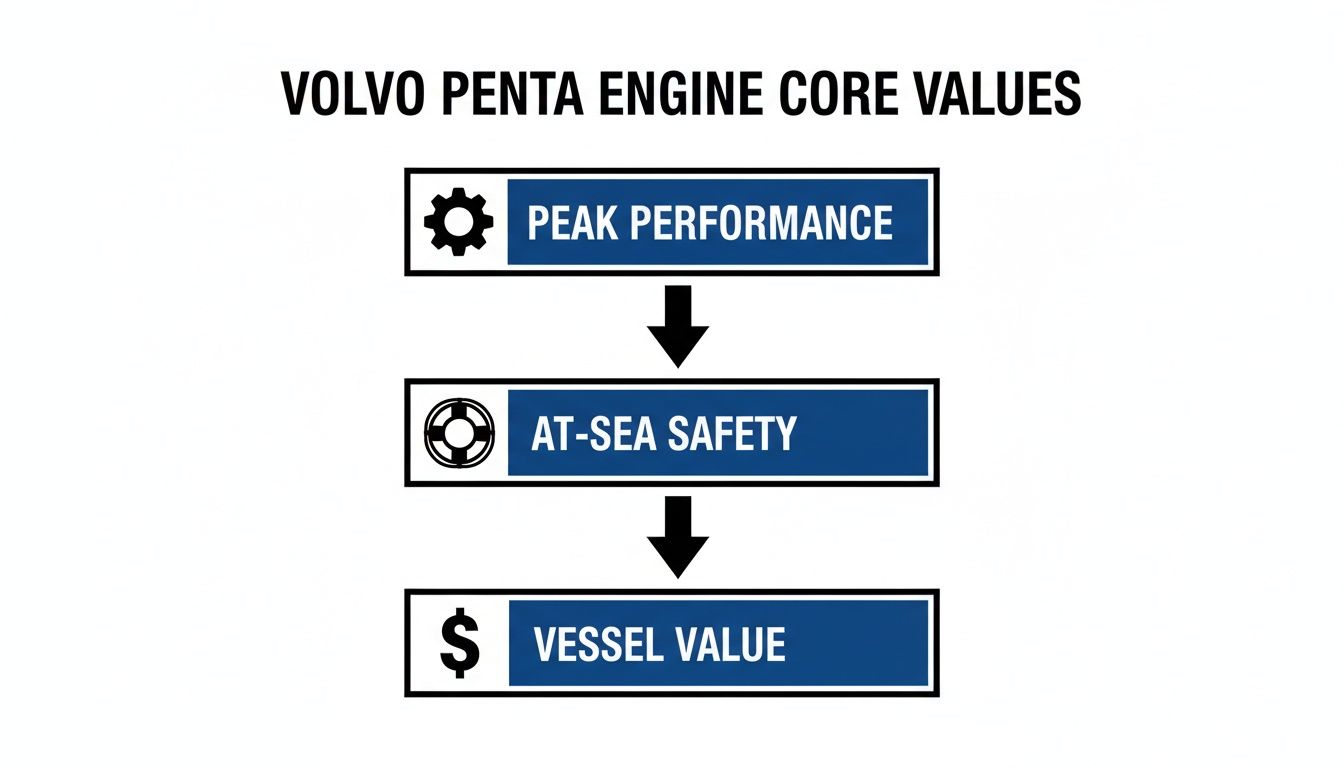
As you can see, Volvo Penta’s engineering is a constant balancing act. It's about delivering peak performance when you demand it, ensuring safety when you’re far from shore, and protecting the long-term value of your vessel.
What Do the D-Series Numbers Mean?
That "D" in your engine's model name is simple—it just stands for diesel. The numbers that come after it, though, tell the real story. They’re not random; they’re a roadmap to your engine's design, displacement, and power. For instance, a D4-300 is a 4-cylinder engine, while a D13-1000 is a much beefier 13-liter, 6-cylinder beast.
This naming system gives you a quick way to identify the basic architecture of your powerplant. It's the first clue you need to understand its capabilities and what kind of service it requires. After all, a small D1 or D2 engine humming away in a sailboat has completely different needs than a pair of thunderous D16s in a commercial workboat.
Volvo Penta's lineup is massive, a clear sign of their dominance in the marine industry. With a presence in over 130 countries and a network of roughly 3,500 dealers, their propulsion options are everywhere. The portfolio covers everything from about 10 to 900 horsepower, fitting everything from small recreational boats to large commercial craft. You can get a better sense of their market position from this insightful industry report on PowerMag.com.
Leisure vs. Commercial: More Than Just a Label
Here's something a lot of owners miss: while many engines share the same basic block, their internals and tuning can be wildly different depending on whether they were built for leisure or commercial use.
- Leisure Engines: These are typically tuned for higher power output relative to their size. They’re designed for intermittent use—think weekend trips and fishing runs—delivering big bursts of speed when you need it.
- Commercial Engines: These are often de-rated to produce lower, but continuous, power. They are built to run at a steady RPM for incredibly long hours, prioritizing longevity and fuel economy over raw top-end speed.
Understanding your engine’s duty cycle rating is absolutely critical. If you try to run a leisure-rated engine like a commercial one, you’re asking for premature wear and catastrophic failure. It simply wasn't designed for that kind of relentless workload.
To help you get your bearings, here's a quick look at the main engine series and where they fit into the Volvo Penta ecosystem.
Volvo Penta Marine Diesel Engine Series At a Glance
This table gives you a comparative overview of the primary Volvo Penta engine series, highlighting their common applications and key technological features to help you identify your model's strengths.
| Engine Series | Typical Application | Horsepower Range (Approx.) | Key Technology Feature |
|---|---|---|---|
| D1-D2 | Sailboats, small powerboats | 13-75 HP | Compact design and excellent fuel efficiency |
| D3-D6 | Sport cruisers, express yachts | 110-480 HP | Common-rail fuel injection for performance and quiet operation |
| D8-D16 | Motoryachts, commercial vessels | 550-1000+ HP | High torque-to-weight ratio and robust construction for heavy duty use |
| IPS Series | Modern planing hulls | 260-1000+ HP | Forward-facing props and joystick docking for superior maneuverability |
Each of these series represents a different approach to marine propulsion, but one stands out as a true paradigm shift in boating.
The Game-Changing IPS Technology
You can't really talk about modern Volvo Penta without bringing up the Inboard Performance System (IPS). When it was introduced in 2005, IPS fundamentally changed how boats handle and perform. Instead of a traditional shaft and rudder, IPS uses steerable pods under the hull with forward-facing, counter-rotating propellers.
This design isn't just a novelty; it delivers some serious advantages over old-school systems:
- Incredible Efficiency: By pulling the boat through the water instead of pushing it, IPS can slash fuel consumption by up to 30%.
- More Speed: The hydrodynamic efficiency of the pods often translates to a 15-20% faster top speed compared to a shaft-drive boat with the same engines.
- Unmatched Maneuverability: The famous joystick docking is what really turned heads. It lets even a novice skipper handle a large yacht with pinpoint precision—moving sideways, diagonally, or spinning the boat in its own length.
The IPS system is the perfect example of how Volvo Penta uses smart technology to improve the entire boating experience, making it safer, more efficient, and a whole lot more fun.
Mastering Your Maintenance Schedule
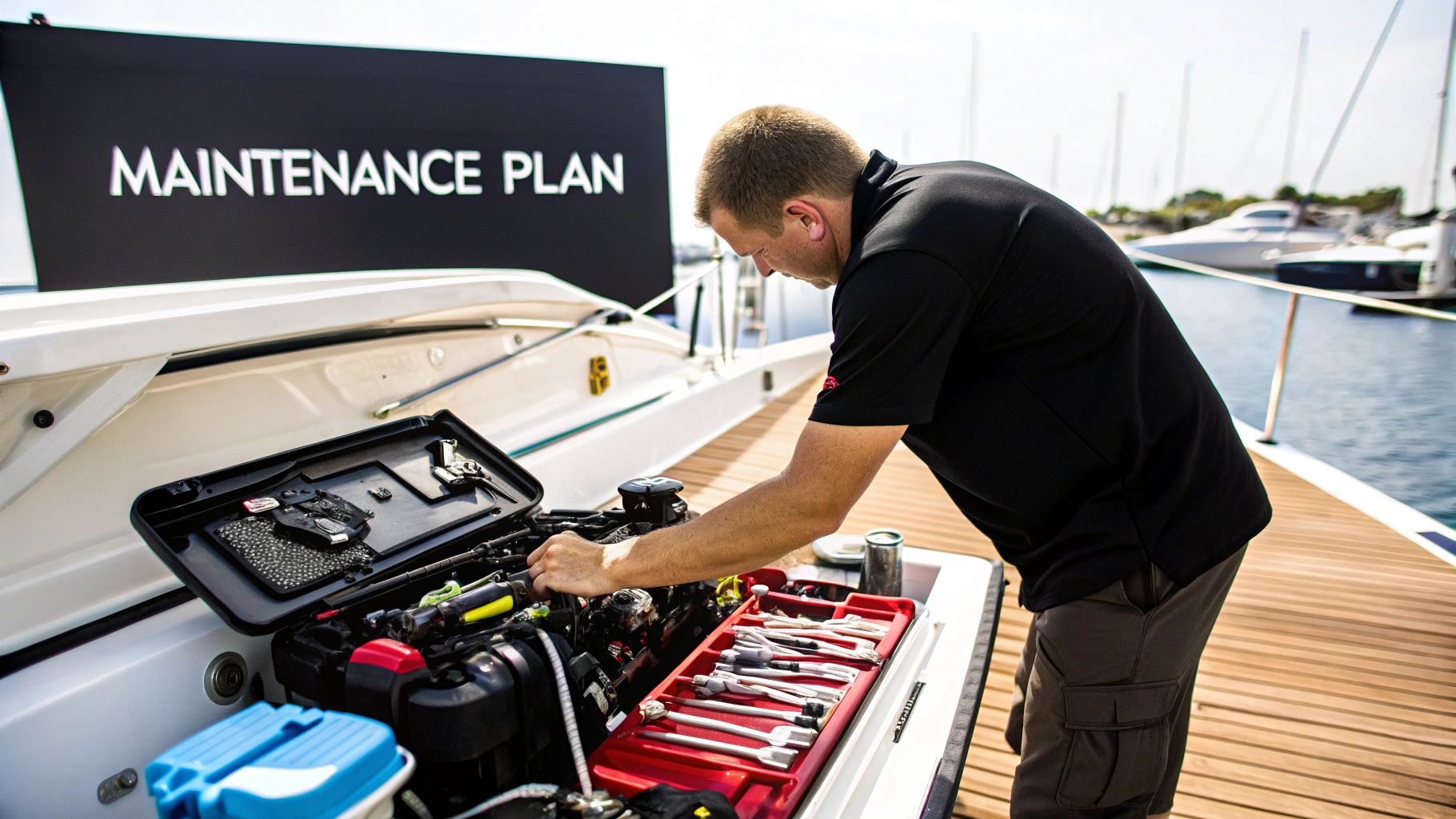
Think of your maintenance schedule less as a chore and more as a direct investment in your time on the water. A well-cared-for Volvo Penta marine diesel engine is what separates a perfect day offshore from a stressful, wallet-draining tow back to the marina. This isn’t about just ticking boxes on a checklist; it’s about understanding why each task is so critical.
Let’s look at it like a wellness plan for your engine. The simple oil and filter changes are your routine check-ups, keeping everything lubricated and running clean. Then you have things like impeller and heat exchanger services—that’s like essential cardiac care. It keeps the cooling system, the very heart of your engine, from causing a catastrophic meltdown.
Every step in your maintenance timeline, from the quick pre-departure look-over to the full-blown annual service, builds on the last. It’s this progressive, consistent care that delivers the rock-solid reliability and performance you expect from Volvo Penta.
Building a Bulletproof Maintenance Timeline
A smart maintenance schedule is layered. It starts with simple visual checks and builds up to more involved jobs based on engine hours or the calendar. In my experience, it's ignoring the small stuff that almost always leads to the big, expensive failures down the line.
While your engine's official manual is the bible, a solid framework breaks things down into daily, periodic, and annual service points. This approach ensures nothing falls through the cracks.
- Before Every Departure (The 5-Minute Walkthrough): This is non-negotiable. A quick look for any new leaks (oil, coolant, or fuel), a check of the fluid levels, and a glance to ensure sea strainers are clear can prevent 90% of the most common headaches.
- Periodic Service (Based on Hours): This is where you hit the core consumables. We're talking engine oil and filter changes, swapping out fuel filters, and giving the belts and hoses a good inspection. This typically happens every 100-200 hours.
- Annual Service (The Deep Dive): This one is crucial, regardless of how many hours you ran. An annual service covers items that degrade with time, not just use. This includes servicing the raw water pump impeller, cleaning the heat exchanger and aftercooler, and inspecting critical exhaust components.
"A documented service history is one of the most powerful assets you have when it comes time to sell your vessel. It provides concrete proof of meticulous care, instantly building trust with a potential buyer and commanding a higher resale value."
Following this rhythm turns maintenance from a reactive chore into a proactive strategy. You're catching wear and tear before it ever becomes real damage.
The Critical Components You Cannot Ignore
While every part of your Volvo Penta marine diesel engine matters, a few systems demand your full attention. If these fail, the consequences can be cascading and incredibly destructive. Think of these as the VIPs of your engine room.
1. The Cooling System
This is arguably the most vital system on any marine engine. It’s a dual-circuit setup where raw seawater cools a closed loop of freshwater and antifreeze that circulates through the engine block.
- Impellers: This little rubber star is the heart of your raw water pump. When it fails, all cooling stops, period. They need to be inspected annually and replaced proactively. Why? Because a single broken vane can get sucked into the system and completely clog your heat exchanger.
- Heat Exchangers & Aftercoolers: These are your engine's radiators. Over time, they get fouled with salt, scale, and marine growth, choking off water flow and causing the engine to run hot. A thorough cleaning every few years is absolutely essential.
2. The Fuel System
Clean fuel is everything. Modern common-rail injection systems are marvels of precision, but they are incredibly sensitive to any contamination.
- Filters: Water and debris are the enemy. Regularly changing your primary and secondary fuel filters is the cheapest insurance policy you can buy against catastrophic damage to your injectors and high-pressure fuel pump.
- Tanks: Try to keep your fuel tanks topped off. This simple habit reduces condensation inside the tank, which is a leading cause of algae growth (the dreaded "diesel bug") that clogs up filters.
3. The Exhaust System
This is an area that catches a lot of people by surprise because problems here are caused more by time than by engine hours. The hot, humid, and salty environment inside an exhaust system is the perfect recipe for corrosion. Exhaust risers and turbo housings can rust out from the inside, leading to a loss of power or, in a worst-case scenario, letting seawater flood right back into your engine. These parts often have a real-world service life of 5-7 years before they become a serious risk.
Using high-quality, authentic components for these jobs is non-negotiable for a perfect fit and long-term reliability. You can find a complete range of genuine Volvo Penta parts on our website to ensure your maintenance is done right the first time. Sticking to a proper schedule with certified parts not only prevents disaster but also builds a powerful service record that will significantly boost your vessel’s value.
Troubleshooting Common Engine Issues
Believe it or not, your Volvo Penta marine diesel engine is always talking to you. It's not using words, but it’s sending clear signals through its sounds, vibrations, and the way it runs. Learning to speak its language is the secret to catching small annoyances before they turn into trip-ending, wallet-draining disasters.
This isn’t about making you a certified diesel mechanic overnight. The goal is to give you the confidence to spot the early warning signs. Think of it like being the first responder for your own engine—knowing when you can handle it yourself versus when it's time to call in the professionals.
Catching these symptoms early is everything. A tiny drip of coolant or a weird puff of smoke might not seem like a big deal, but it could be the first domino in a chain reaction that leaves you dead in the water. Let's break down some of the most common messages your engine might be sending.
Interpreting Exhaust Smoke Signals
The color of your exhaust is probably the most honest and immediate diagnostic tool you have. Each color tells a different story about what’s happening inside the engine, giving you a surprisingly clear hint about where to start looking.
- Black Smoke: This is almost always a fuel-to-air mix-up. Either you're getting too much fuel or not enough air. The usual suspects are a choked-up air filter, a turbocharger that's not spooling up properly, or grimy fuel injectors. It's the classic sign of unburnt fuel.
- White Smoke: If it's a thick cloud with a sickly sweet smell, you're likely burning coolant. That points straight to a big problem, like a blown head gasket. Now, a thin, wispy vapor that vanishes quickly on a cold morning is just steam, and that's perfectly normal. But persistent, thick white smoke is a five-alarm fire.
- Blue Smoke: This is the tell-tale sign of burning oil. The cause could be anything from worn-out piston rings and tired valve seals to a problem with the crankcase ventilation system. If you see blue smoke, your first move should be to check the dipstick and figure out where that oil is going.
Common Causes of Engine Overheating
There are few alarms on a boat more urgent than an overheating engine. When you see that temperature gauge climbing into the red, you need to act fast to prevent catastrophic damage like a warped cylinder head.
Nine times out of ten, the problem lies somewhere in the raw water cooling circuit. The first and easiest place to look is your sea strainer. Is it clogged with seagrass or a stray plastic bag? If the strainer's clear, your next prime suspect is the raw water pump impeller.
A failed impeller is the number one cause of sudden overheating. These small rubber components wear out over time, and a single broken vane can get lodged in your heat exchanger, creating a blockage that starves the engine of cooling water. This is why annual replacement is non-negotiable.
If you've checked the strainer and the impeller looks good, the problem might be deeper—like a clogged heat exchanger or a thermostat that's stuck closed. Both of those are jobs best left to a professional to diagnose and fix properly.
Why Your Engine Wont Start or Loses Power
There's nothing quite like the feeling of turning the key and getting nothing, or having your engine suddenly feel weak and sluggish out on the water. These headaches usually trace back to one of two things: a problem with fuel, or a problem with air.
If the engine is cranking over but just won't catch, start simple. Is the primary fuel filter clogged? Did you forget to open the fuel shutoff valve? You might also have air in the fuel lines, which means you'll need to bleed the system. And don't forget the obvious—a weak battery might have enough juice to turn the engine slowly, but not enough fire it up.
A sudden loss of power while underway is often caused by something many people overlook: a restricted exhaust system. Over the years, the exhaust riser or turbo housing can corrode from the inside out, creating backpressure that literally chokes the engine. It's a sneaky problem that builds over years, not hours. In a saltwater environment, many marine exhaust components only have a realistic service life of 5–7 years. If you ignore it, you risk having exhaust bypass the turbine wheel or, even worse, getting saltwater pushed back into your engine.
Making Smart Repower and Purchase Decisions
Whether you're thinking about breathing new life into a trusted vessel or you're in the market for a pre-owned boat, the engine is the heart of the machine. These are big, expensive decisions. Get it right, and you're looking at years of reliable fun on the water. Get it wrong, and you could be facing a financial nightmare.
Considering a repower is about so much more than just swapping out old iron for new. It's a golden opportunity to fundamentally upgrade your boat's performance, efficiency, and frankly, how much you enjoy using it. Dropping in a new Volvo Penta marine diesel engine isn’t just about getting fresh horsepower; it’s about gaining quieter operation, lower emissions, and access to incredible technology like the Inboard Performance System (IPS).
The trick, of course, is matching the new power plant to your hull's original design. You can’t just shoehorn in the biggest engine you can find. Overpowering a hull can create seriously dangerous handling problems, while underpowering it leaves you with a sluggish, inefficient boat that feels like it's always struggling.
Repower Considerations and Modern Tech
When you start planning a repower, a few critical things need to be on your checklist. It's definitely not as simple as just dropping a new engine onto the old mounts.
- Horsepower and Weight: The new engine’s power and, just as importantly, its weight, must be a good match for what the naval architect originally intended. This is key to maintaining proper balance and performance.
- Emissions Standards: Modern diesels run incredibly clean and meet much stricter emissions regulations. This is a huge plus for the environment and for getting rid of that old-school "diesel smell."
- Fuel Efficiency: The jump to a newer common-rail fuel system can slash your fuel burn. We're talking about savings that can add up to a significant amount of money over a single season.
A repower is your chance to fix any of the boat's old shortcomings and set it up for the future. Investing in modern tech like IPS can completely change the personality of an older boat, giving it a level of maneuverability and efficiency that its original designers could only dream of.
One of the biggest questions is whether to go for a full replacement or a professional overhaul. A brand-new engine brings total peace of mind, but a high-quality overhaul can be a smart, cost-effective alternative. To figure out which path is right for you, you can dive into the specifics of a professional diesel engine rebuild in our detailed guide.
The Non-Negotiable Pre-Purchase Survey
If you're buying a used boat, let me be crystal clear: a professional, pre-purchase engine survey isn't just a good idea. It's the single most important investment you will make in the entire process. A clean bilge and a fresh coat of paint can hide a boatload of expensive problems. Only an unbiased, certified technician can spot the hidden issues that a seller might not even know are lurking.
This isn't just about turning the key at the dock. A real survey is a deep dive into the engine's health and history.
- Compression Testing: This tells us the real story about the internal health of the cylinders, pistons, and rings.
- Fluid Analysis: We send oil and coolant samples to a lab to hunt for signs of internal wear or contamination before they become catastrophic failures.
- Electronic Diagnostics: We plug proprietary software directly into the engine’s computer to pull any fault codes and review its entire performance history.
- Sea Trial Analysis: Out on the water, we monitor everything—boost pressures, temperatures, RPMs—under real-world load to make sure the engine is performing exactly to factory specs.
This kind of detailed inspection gives you the hard data you need to negotiate a fair price. Even more importantly, it gives you the confidence to walk away from a bad deal before it becomes your problem. The global marine diesel engine market continues to grow, as noted in market trend reports from Zion Market Research, meaning the demand for reliable engines and top-tier technicians is only going up. An informed purchase, backed by a professional survey, ensures your investment is solid from day one.
Why Certified On-Site Service Matters
Not too long ago, a serious problem with your Volvo Penta marine diesel engine meant one thing: a long, frustrating trip to the boatyard. You'd have to deal with the headache of scheduling, navigating your way there, and then the real waiting game would begin. It could take days before a mechanic even laid eyes on your engine. That whole process costs you time, money, and—worst of all—perfectly good days on the water.
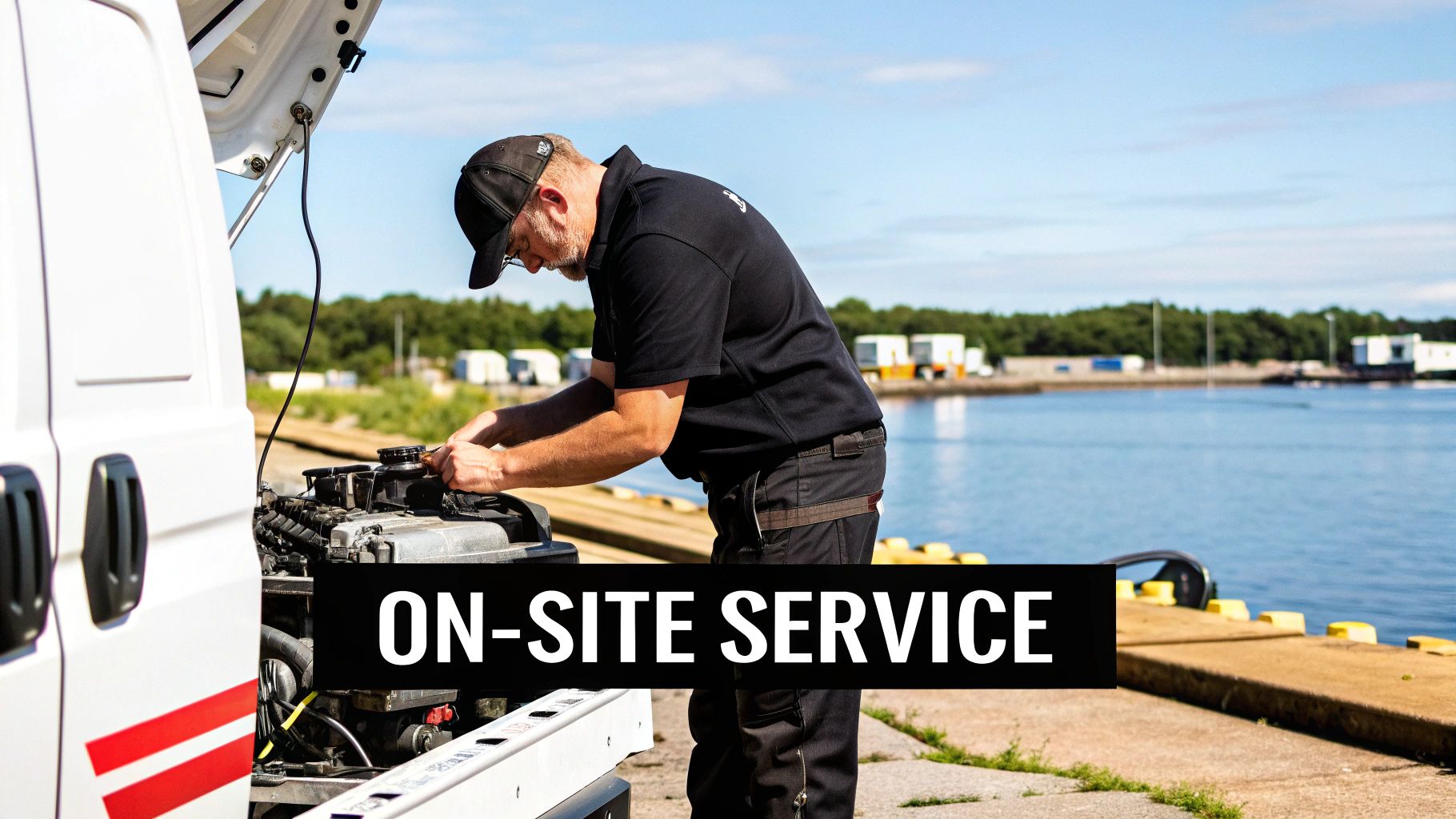
Thankfully, that old way of doing things is obsolete. Modern mobile marine service changes everything. Just imagine a factory-certified expert pulling up to your dock, equipped with the exact diagnostic tools and parts needed for your specific engine. The difference is night and day.
The Power of Dockside Expertise
Bringing the workshop to you is about more than just convenience—it's a massive strategic advantage for any boat owner who values their time. The entire repair cycle gets compressed, cutting out all the logistical nightmares and getting you back out on the water where you belong.
Here’s exactly what you gain:
- Zero Haul-Out Fees: Right off the bat, you save a significant amount of money and avoid the hassle of getting your boat lifted.
- Drastically Reduced Downtime: We can start diagnosing and fixing the problem immediately, right at your slip. No more waiting in a queue at the yard.
- Direct Communication: You get to talk face-to-face with the technician working on your boat. Ask questions, see the progress firsthand—you're always in the loop.
This modern approach turns engine maintenance from a reactive, stressful event into a smooth and efficient part of owning a boat. It’s all about respecting your time and protecting your investment.
The Certified Technician Difference
When you see the term "factory-certified," don't just brush it off as marketing speak. It's a genuine credential. It means the technician touching your high-value engine has been through rigorous, specialized training directly from Volvo Penta. They know the ins and outs of your D4 or D13 in a way a general mechanic never could.
This is the key takeaway: Choosing certified service means you're not just hiring a mechanic. You're bringing in a specialist who has the proprietary software to communicate with your engine's ECU, the specific tools to perform the repair correctly, and direct access to the latest factory service bulletins.
That level of expertise is what separates a quick patch from a permanent solution. It's the difference between guessing and knowing, ensuring your engine runs reliably for years to come. Of course, understanding the financial side is important, and you can get a better idea of what to expect by reading our guide to diesel engine repair costs.
Ultimately, investing in certified on-site service is the smartest move you can make to protect your engine and ensure it’s ready for every voyage you have planned.
Frequently Asked Questions
When you own a high-performance piece of machinery like a Volvo Penta marine diesel engine, you're bound to have a few questions. Let's tackle some of the most common things we hear from boat owners out on the water.
How Often Should I Change My Engine Oil?
You'll often hear the standard 100-200 hour rule, but the real answer isn't that simple—it really comes down to how you use your boat.
If you're a weekend boater, that annual oil change is an absolute must, even if you're well under the hour mark. Oil breaks down and attracts moisture just sitting there, and that's a recipe for internal corrosion. For the commercial guys running their boats day in and day out, you need to live by that hourly schedule. Pushing it is just asking for premature wear. And whatever you do, make sure the oil you're using has the right VDS rating specified by Volvo Penta.
What Are the First Signs of a Failing Turbo?
A turbo almost never just quits without warning. It'll give you signs, and you need to know what to look and listen for.
- Lagging Acceleration: This is the big one. You push the throttles forward, and there's a noticeable hesitation before the power kicks in. Your boat feels sluggish, almost like it's struggling to get up on plane.
- Black Smoke: If you suddenly see more black smoke puffing from the exhaust, that's a classic sign of an improper air-to-fuel mix. It often means the turbo isn't cramming enough air into the cylinders.
- Unusual Whining Noise: Hear a high-pitched whistle or a siren-like sound that spools up and down with the engine RPM? That's often the death rattle of the turbo's internal bearings.
Catching these symptoms early is crucial. If you let it go, you're not just risking a total loss of power—you're risking catastrophic engine damage if the turbo comes apart and sends metal into the intake.
We see this all the time: the turbo gets the blame, but the real culprit is a choked exhaust. Corrosion and carbon buildup inside the exhaust riser create backpressure, which puts a massive strain on the turbo and starves the engine for boost.
Is It Safe to Use Aftermarket Parts for Maintenance?
Look, I get it. Aftermarket parts are often cheaper, and it's tempting to save a few bucks. But when it comes to your Volvo Penta, using genuine parts is one of the smartest investments you can make.
Genuine parts are built to the exact specs for your engine. They just fit and work the way they're supposed to. This is non-negotiable for critical parts like fuel injectors, water pump impellers, or anything inside the engine. Using the wrong part might not just void your warranty; it can cause a failure that costs you ten times what you "saved" on the part. Think of genuine parts as an insurance policy that keeps your engine reliable and performing at its peak.
For certified, on-site diagnostics and repair of your Volvo Penta marine diesel engine in South Florida, trust the experts at GTM International. We bring the workshop to your dock, saving you time and money. Contact us today for fast, professional service.
