

For any yacht owner in South Florida, your Volvo Penta parts are the very lifeblood of your vessel. They're what stand between you and the demanding marine conditions, ensuring both performance and safety. From basic filters and impellers to sophisticated engine sensors, these components are what keep your engine humming, and choosing the right ones is key to protecting your investment.
Why Quality Parts Are Non-Negotiable for Your Engine
Think of your Volvo Penta engine as a finely-tuned race car. You wouldn't put cheap, generic tires on a Ferrari and expect it to perform at its peak, would you? The same logic applies here. Every single part, no matter how small, is engineered to work in perfect harmony within a complex system. Using a subpar component is a gamble that rarely pays off.
This is especially true in the harsh saltwater environment we deal with from West Palm Beach to Ft. Lauderdale. The relentless assault of salt, humidity, and heat puts an incredible strain on your engine's systems. This is why investing in high-quality Volvo Penta parts isn't just routine maintenance—it's a critical survival strategy.
The Real Cost of a "Good Deal"
I've seen it a hundred times: a captain tries to save a few bucks on a non-genuine part, only to face a catastrophic failure later. A cheap impeller disintegrates and clogs the cooling system, leading to a massive overheat and an engine rebuild that costs tens of thousands. That small initial "saving" suddenly looks very, very expensive.
To really grasp what's at stake, our guide on diesel engine repair costs breaks down the numbers and can help put that initial investment in quality parts into perspective.
The reliability of your yacht is a direct reflection of the parts you put in it. One weak link—a brittle hose, a worn belt, or a faulty sensor—can take down the entire system, and it always seems to happen at the worst possible moment.
A Global Benchmark for Reliability
There's a reason Volvo Penta has the reputation it does. It's built on a rock-solid foundation of engineering excellence and supported by a massive global infrastructure. The company maintains a network of 3,500 dedicated dealers across more than 130 countries, which means consistent, reliable access to the right parts for their full range of diesel and gasoline engines.
This incredible reach ensures that whether you’re cruising the Intracoastal or planning a trip to the Bahamas, you’re never far from the support you need. This commitment to quality and accessibility is exactly why sticking with genuine parts is the smartest move any serious yacht owner can make.
Getting to Know Your Volvo Penta Engine Systems
To really get a handle on maintaining your yacht, you have to understand its heart—the engine. Don't think of your Volvo Penta as some mysterious block of metal. It's really a collection of interconnected systems, each with a specific job, kind of like the circulatory or nervous systems in our own bodies. Once you see how these systems work together, figuring out problems becomes a lot less intimidating.
This shift in perspective changes everything. You go from being a passive observer to an informed captain who's in control. Instead of just hearing an alarm and hoping for the best, you'll start to recognize the specific language your engine is using to tell you what it needs. That knowledge is your absolute best defense against expensive downtime and a ruined day on the water.
This diagram gives you a great overview of how genuine parts, consistent maintenance, and smart sourcing all play a role in keeping your engine reliable.
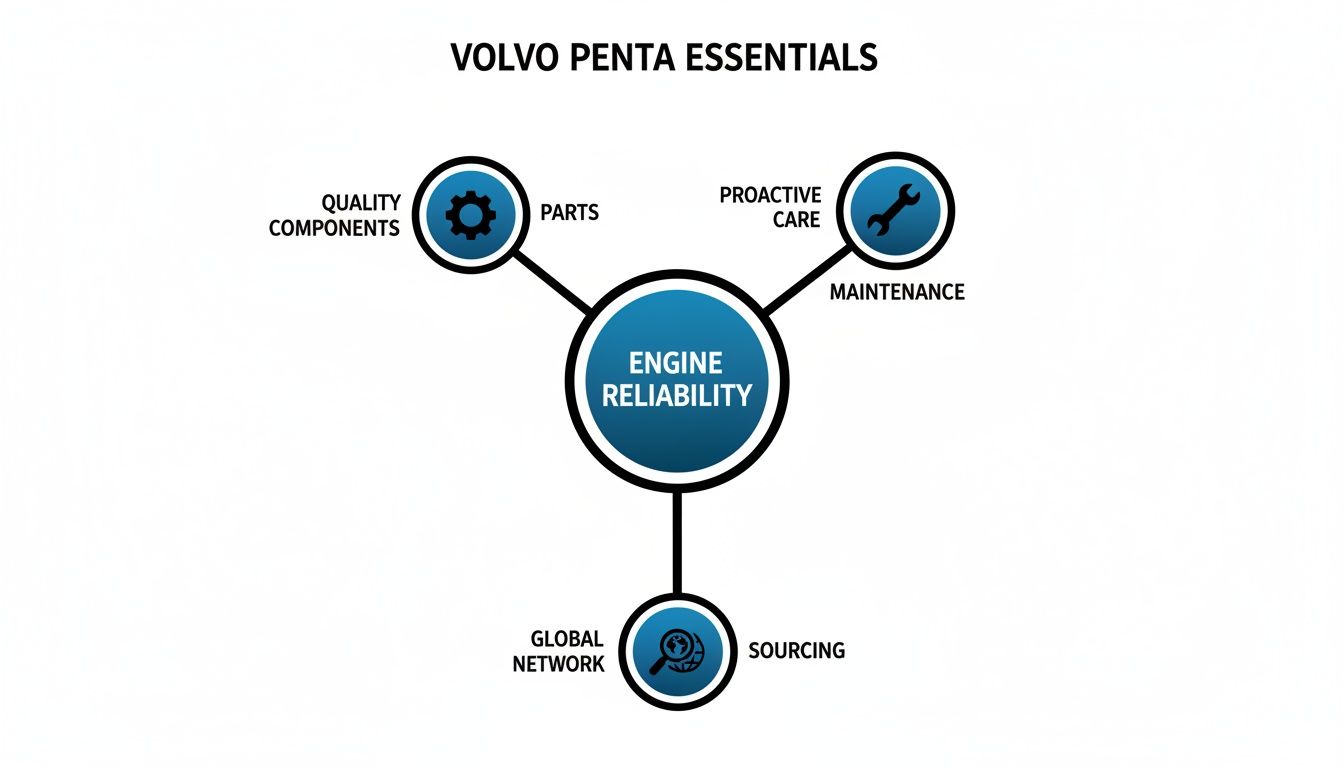
The key takeaway here is that a dependable engine isn't just about one thing. It's the result of using the right components, staying on top of upkeep, and knowing where to turn when you need something.
To help you pinpoint potential trouble spots before they become major headaches, here's a quick rundown of the most common systems, the parts that wear out, and the signs they give you when something's wrong.
| Common Volvo Penta Engine Systems and Failure Points |
| :— | :— | :— |
| Engine System | Key Wear Parts | Common Symptoms of Failure |
| Fuel System | Fuel Filters, Injectors, Lift Pumps | Sputtering, loss of power, poor RPMs, black smoke |
| Cooling System | Raw Water Impellers, Anodes, Hoses, Belts | Engine overheating, steam from exhaust, temperature alarms |
| Electrical System | Starters, Alternators, Sensors | Slow starting, batteries not charging, warning lights, limp mode |
| Drive System | Belts, Bearings, U-Joints | Unusual vibrations, strange noises, loss of propulsion |
Think of this table as your cheat sheet. When a symptom pops up, a quick glance can point you in the right direction, saving you time and frustration.
The Fuel System: Your Engine's Lifeline
The fuel system is basically the engine's digestive tract. It's responsible for pulling clean diesel from the tanks and delivering it in precise amounts to the cylinders. It’s a whole network of tanks, lines, pumps, and filters all working in concert. Here in South Florida, our humid climate makes this system especially prone to water contamination from condensation, which can lead to nasty microbial growth (the infamous "diesel bug") and corrosion.
Common failure points in this system are almost always the usual suspects:
- Fuel Filters: These are your first and best defense against gunk in your fuel. Clogged filters are probably the #1 cause of an engine that sputters, runs poorly, or just quits.
- Injectors: These are high-precision parts that can get clogged or just wear out. The result? Rough idling, black smoke pouring from the exhaust, and terrible fuel economy.
- Lift Pumps: These smaller pumps do the initial work of moving fuel from the tank to the high-pressure pump. If a lift pump starts to fail, it can starve the engine of fuel, causing it to lose power just when you need it most.
If you feel a sluggish response when you throttle up, or the engine just won't hit its top RPMs, chances are you've got a fuel delivery problem. Regularly swapping out your Volvo Penta parts like filters is the easiest, most effective thing you can do to keep this vital system happy.
The Cooling System: The Engine's Thermostat
Your engine produces a staggering amount of heat, and the cooling system is its dedicated temperature regulator. It's a two-part system, using raw seawater to cool a closed loop of coolant, which in turn cools the engine. In the warm, often debris-filled waters of South Florida, this system is working overtime, all the time.
An overheating engine isn't a small problem—it's a direct threat to the engine's most expensive components. Warped cylinder heads and damaged blocks can happen after just a few minutes of running too hot. That turns a simple issue into a massive repair bill.
The parts that take the most abuse here are:
- Raw Water Impeller: This little flexible rubber "fan" is what pulls seawater into the engine. Impellers get brittle and break down over time. A single broken vane can clog the whole system and cause an immediate overheat.
- Anodes: Think of these as little bodyguards for your engine. These small, sacrificial pieces of metal are designed to corrode so your expensive engine parts don't. Forgetting to replace them is like inviting saltwater to have a feast on your engine's insides.
- Hoses and Belts: Constant heat and vibration make rubber parts brittle. A split hose can drain your coolant in minutes, while a snapped belt can knock out your water pump instantly, leaving you dead in the water.
If you see that temperature gauge starting to climb, your first thought should always be the raw water side of the cooling system.
Electrical and Drive Systems: The Brains and Brawn
The electrical system is the engine's nervous system. It’s what starts the engine, monitors all its functions with sensors, and powers your boat's electronics. The drive system, on the other hand, is the muscle that takes all that power from the engine and transfers it to the props.
Key components to keep an eye on in these systems include:
- Starters and Alternators: Salt spray is the mortal enemy of these parts. An engine that's slow to crank or batteries that never seem to stay charged are classic signs that one of these is on its way out.
- Sensors: Modern Volvo Penta engines are covered in sensors that manage performance. A single bad sensor can set off alarms or, worse, throw the engine into a low-power "limp mode" to protect itself.
Understanding how these systems work helps you turn symptoms into solutions. That flickering light or a weird new vibration is no longer a mystery—it's a clue pointing you toward a specific set of Volvo Penta parts that need your attention. And when the symptoms suggest something more serious, like internal wear and tear, knowing your options for a professional diesel engine rebuild is key to ensuring your vessel's long-term health.
Choosing Between OEM and Aftermarket Parts
When a part on your Volvo Penta gives out, you're immediately faced with a classic dilemma. It’s a question every yacht owner and captain in South Florida has to answer: Do you spring for the Original Equipment Manufacturer (OEM) part, or can you save a few bucks with an aftermarket alternative? This isn't just about the price tag. It's a strategic decision that has a real impact on your engine's performance, its long-term reliability, and even its warranty.
Think of it like this: OEM parts are the brand-name prescription from the drugmaker. They’re guaranteed to be a perfect fit, made from materials tested to Volvo Penta’s exact standards, and backed by their global reputation. You're getting the "factory-spec" promise, which means the new component will work with your engine exactly as the original one did. No surprises.
Aftermarket parts are the generic version. They're made by other companies to be compatible with your engine, and their main selling point is almost always a lower price. That’s tempting, for sure. But that savings comes with a trade-off in quality control and consistency that you absolutely have to weigh.
The Case for Sticking with OEM Volvo Penta Parts
Going with genuine OEM parts is really an investment in certainty. You're not just buying a piece of equipment; you're buying peace of mind. The materials, the precise dimensions, and the engineering tolerances are identical to what your engine was built with. It takes all the guesswork out of the installation.
That precision is more than just a convenience. Back in 2006, Volvo Penta's operating income hit a historic SEK 1 billion, a milestone largely driven by innovations like their IPS drive system. By the end of that year, the IPS system was being used in over 100 boat models—a huge vote of confidence from the industry in their integrated, original-spec technology. Discover more about this history of trusted innovation and how it solidified their market position.
When you choose a genuine Volvo Penta part, you're buying a component that has been rigorously tested to handle the specific heat, pressure, and vibrations of your engine model. It’s the closest you can get to hitting the reset button on that part's life.
For certain systems, this guaranteed compatibility isn't just nice to have—it's non-negotiable. Here's where sticking with OEM is the only smart move:
- Sensitive Electronics: Think about components like your Engine Control Unit (ECU), sensors, and wiring harnesses. They're all calibrated to razor-thin specifications. An aftermarket sensor that's even slightly off could disrupt fuel delivery or ignition timing, leading to poor performance, bad fuel economy, or even serious engine damage.
- Internal Engine Components: When you're talking about pistons, bearings, and valves, the metallurgy and tolerances are absolutely critical. Dropping a non-OEM part in here is a high-stakes gamble that could end in catastrophic failure miles from shore.
- Warranty Protection: If your engine is still under warranty, using a non-genuine part for a repair can give the manufacturer an easy reason to deny a future claim. The money you might save on a part is nothing compared to the cost of a voided warranty.
When Can Aftermarket Parts Make Sense?
While the risks are very real, it’s not fair to say all aftermarket parts are junk. You just have to be smart and strategic about it. The quality of aftermarket Volvo Penta parts can swing wildly from one manufacturer to the next, so brand reputation is everything.
A sensible approach is to think about the part’s job. Is it a critical component? If it fails, will it cause a chain reaction of damage? For non-critical parts, a high-quality aftermarket option might be a reasonable compromise.
Here are a few scenarios where you might consider an aftermarket part:
- Cosmetic items like certain knobs, decals, or trim pieces.
- Simple filters (oil, fuel) from a well-known, trusted brand like Racor or Fleetguard.
- Standard-sized anodes that clearly meet marine-grade specifications.
Even in these cases, you have to do your homework. Research the brand, read reviews from other Volvo Penta owners, and make sure the part meets—or better yet, exceeds—OEM specs. A lower price is only a good deal if the quality is there. If you're facing a major engine issue, you might even find yourself looking at bigger solutions, where understanding your options for a professionally rebuilt marine engine can offer a reliable path back to the water without breaking the bank.
How to Source Your Volvo Penta Parts
When a critical part on your Volvo Penta gives out, the clock starts ticking. Every hour your yacht is stuck at the dock in South Florida is an hour you’re not out on the water. Minimizing that downtime is everything, and finding the right Volvo Penta parts fast becomes the only thing that matters. But where do you turn?
Your sourcing strategy can be the difference between a quick fix and a drawn-out, frustrating ordeal. The path you take is always a trade-off between speed, cost, and getting expert help. Let’s break down your options so you can make the right call for your situation.
There are really three main ways to get the parts you need to get your vessel sea-ready again.
The Local Authorized Dealer Route
Your local authorized Volvo Penta dealer is the most obvious first stop, and for good reason. Think of them as the official local outpost for the manufacturer. They’ve got deep product knowledge and a direct line to the official parts catalog, so you know you’re getting the exact component specified for your engine’s serial number.
For common wear-and-tear items—things like impellers, filters, belts, and anodes—your dealer will likely have them on the shelf. That immediate access can be a lifesaver when you just need a quick repair to salvage the weekend. Plus, the staff are factory-trained, so they can offer solid advice and double-check you’re ordering the right thing, which can save you from a costly mistake.
But that convenience and expertise often come at a premium. Dealers have higher overhead, and that gets baked into their prices. And while they’re great for common items, if you need more obscure or older Volvo Penta parts, you’ll probably have to wait for a special order.
Exploring the World of Online Retailers
The internet has blown the doors open on the marine parts marketplace, offering a massive selection and some seriously competitive prices. If you know exactly what part number you need, online retailers can be a fantastic resource. You can price-shop across a dozen vendors in minutes.
This route gives you access to a huge inventory, and you can often find those hard-to-get parts for older engine models that a local shop might not have. Ordering from your laptop and having the part show up at the marina is undeniably convenient.
Of course, that convenience comes with risks. The biggest challenge is knowing who you’re buying from. Is that part a genuine OEM component, or is it a cheap knock-off in a convincing box? Is the seller reputable? Shipping can be a guessing game, and if you accidentally order the wrong part, the return process can be a slow-motion nightmare that just adds to your downtime. You’re on your own.
The Integrated Service Provider Solution
There's a third, and often smarter, option: partnering with an integrated service provider like GTM International. This approach rolls the diagnostics, parts sourcing, and installation into one seamless solution. Instead of you shouldering the burden of figuring out the problem and hunting down the part, you have a certified technician handle everything.
This isn't just about buying a part; it's about buying a solution. An integrated partner eliminates the risk of misdiagnosis and ordering the wrong component—a mistake that can double your cost and downtime.
This model is a game-changer for complex issues where the root cause isn't immediately obvious. A technician comes to your vessel, performs on-site diagnostics to pinpoint the exact failure, and then sources the correct genuine Volvo Penta parts through their own established supply chain. They often have relationships with multiple distributors, giving them access to parts faster and at better prices than you could get on your own.
Here’s how the sourcing options stack up:
| Sourcing Channel | Speed & Availability | Cost | Expert Support |
|---|---|---|---|
| Local Dealer | High for common parts | High | Excellent |
| Online Retailer | Variable | Low to Medium | Minimal |
| Service Provider | High (streamlined) | Medium (value-added) | Comprehensive |
For the yacht owner or captain who values their time and needs absolute certainty, the integrated service provider is the clear winner. They take out all the guesswork, manage the logistics, and provide a professional installation, making sure the repair is done right the first time. It's the ultimate strategy for getting back on the water with zero hassle.
Proactive Maintenance and Installation Best Practices
The best repair is the one you never have to make. While getting your hands on the right Volvo Penta parts is half the battle, it’s the proactive maintenance and professional installation that truly shield your engine from an early grave. This isn't just about fixing things; it's about getting ahead of problems before they can ruin a perfect day on the water, saving you a fortune in time, money, and stress.
Think of your engine as a thoroughbred racehorse. You wouldn’t send it to the track without a strict training and care regimen, right? The same goes for your vessel. Small, consistent maintenance tasks are what keep your engine in peak condition, ready to answer the call when you push the throttle.
Why Professional Installation Is Non-Negotiable
When it’s time to install critical engine components, precision is everything. What looks like a simple swap can quickly turn into a disaster if it’s not done to the exact manufacturer specs. This is where a certified, professional technician earns their keep.
Take a simple bolt, for example. If it’s not torqued correctly on a heat exchanger or engine mount, it might seem fine tied up at the dock. But introduce the constant vibration and stress of running offshore, and that bolt will work itself loose. Now you’ve got coolant leaks, a misaligned engine, or worse. The same goes for a slightly misaligned seal on a raw water pump—it’s a guaranteed premature failure, starving the engine of coolant and causing a catastrophic overheat.
These aren’t just rookie mistakes; they are ticking time bombs that can turn a routine parts replacement into a full-blown engine emergency miles from shore. A pro ensures every part is fitted correctly, torqued to spec, and tested, sniffing out those hidden risks before they can bite you.
Your Practical Maintenance Checklist
You don't need an engineering degree to perform preventative maintenance. It’s all about building simple, consistent habits that train your eyes and ears to spot trouble brewing. When you make these checks part of your routine, you get a feel for what’s "normal" for your engine, making it dead simple to notice when something is off.
This need for bulletproof reliability is exactly why Volvo Penta parts are in such high demand globally, especially in harsh marine environments. It's a massive network. Just look at a country like Peru, which accounts for a staggering 79% of the import market share for these spares. It just goes to show the worldwide reliance on having a solid parts supply to keep vessels running. You can explore more about these global trade dynamics to see the bigger picture.
Here’s a practical schedule you can stick to that will keep your engine humming.
Daily and Pre-Departure Checks
These are the quick, five-minute look-overs you should do before leaving the dock. Every single time.
- Fluid Levels: Glance at the engine oil and coolant. If they’re low, that fluid is going somewhere, and you need to find out where.
- Visual Inspection: Look for any drips or puddles in the bilge. Give the belts a quick check for cracks or looseness.
- Sea Strainer: Pop the lid and make sure the basket is clear of seaweed and debris. A clogged strainer is a quick way to cook an engine.
Weekly and Monthly Inspections
These checks dig a little deeper and are your best defense against wear and tear.
- Inspect Hoses: Give the coolant and fuel hoses a good squeeze. They should feel firm, not spongy, soft, or brittle. Look for any bulging or cracking.
- Check Anodes: If you can easily see your sacrificial anodes, take a look. If they're heavily pitted and corroded, they're doing their job, but a replacement is on the horizon.
- Battery Terminals: Check for that chalky, greenish corrosion on the battery terminals. A wire brush will clean it right up and ensure you have a solid connection.
- Test Alarms: Turn the key to the "on" position (without starting the engine) and make sure you hear the audible alarms for high temp and low oil pressure. You want to know they work before you actually need them.
Seasonal and Annual Tasks
These are the bigger jobs that set the stage for a trouble-free season.
- Impeller Replacement: Your raw water pump impeller should be replaced annually, period. It doesn't matter how it looks. It’s one of the most common and easily avoidable failure points.
- Filter Changes: Swap out all fuel and oil filters based on the service interval in your owner's manual. Clean fuel and oil are non-negotiable.
- Cooling System Flush: Every so often, flush the entire cooling system. This gets rid of the salt, scale, and gunk that builds up and restricts flow, which is a leading cause of overheating.
By adopting these practices, you stop being just a boat owner and become a true captain. You earn the confidence that comes from knowing your vessel is meticulously cared for, ensuring every trip is a safe and memorable one.
Got Questions About Volvo Penta Parts? We’ve Got Answers.
When you're responsible for a high-performance yacht, questions come with the territory. Even the most seasoned captains in South Florida eventually hit a snag where they need a straight answer about their engines. We put this section together to be your quick-reference guide, cutting through the noise to give you practical advice for the most common challenges you'll face with your Volvo Penta parts.
Think of this as a chat with a trusted mechanic down at the marina. We’re digging into the real-world questions that pop up during routine maintenance, surprise repairs, and long-term planning for your engine's health. Getting the right intel quickly can save you time, prevent a costly misstep, and give you the confidence to make the right call for your vessel.
How Do I Find the Exact Part Number for My Engine?
Getting this right is everything. Ordering the wrong component is a guaranteed recipe for extended downtime and frustration. The most foolproof way to get the correct number is by finding your engine's data plate. It’s a small metal tag, usually on the engine block or valve cover, that holds your engine's specific model and, most importantly, its serial number.
Those numbers are your engine's unique fingerprint. With that serial number, an authorized dealer or an official resource like the Volvo Penta online parts catalog can pull up the exact schematic for your specific engine. This process ensures a perfect match and gets rid of the expensive guesswork that comes from ordering based on the model alone—subtle variations are common even within the same engine family.
Never assume parts are interchangeable just because they look similar or share a model name. A tiny change in production year could mean a completely different water pump or sensor. The serial number is your single source of truth.
Can Using Aftermarket Parts Void My Warranty?
In a word, yes. This is a huge risk, and it can be an incredibly costly one. Volvo Penta's warranty is very clear: it requires the use of genuine OEM parts for any and all service done during the warranty period. It's a non-negotiable part of their quality promise.
If an engine failure occurs and the technicians trace the cause back to a non-genuine part, your warranty claim for that repair—and potentially anything connected to it—will almost certainly be denied. For any engine still under warranty, the few bucks you might save on aftermarket Volvo Penta parts just don't stack up against the massive financial risk of voiding your coverage. It’s a gamble that smart owners simply don't take.
What Are the Most Common Parts to Fail in Saltwater?
Saltwater is relentless. It accelerates wear and tear on just about everything it touches. Down here in the demanding marine environment of South Florida, certain parts are in a constant battle with corrosion and are always the first to show signs of trouble.
The cooling system is ground zero for saltwater-related headaches. Keep a close eye on these top offenders:
- Rubber Impellers: These are designed to wear out, but our warm, sometimes debris-filled waters can make them brittle and cause them to fail way ahead of schedule.
- Heat Exchangers: They get clogged with salt, scale, and marine growth, choking off water flow and leading directly to overheating.
- Sacrificial Anodes: These are literally designed to dissolve to protect more expensive metal parts. Forgetting to replace them is like sending an open invitation for saltwater to feast on your engine.
Beyond the cooling system, be sure to check your fuel filters, which are constantly fighting water contamination from our humid air. Also, keep an eye on drive belts that crack from the engine heat and electrical parts like starters and alternators, which are incredibly vulnerable to the ambient salt spray.
How Can an Integrated Service Partner Help Me?
This is where you make your life a whole lot easier. An integrated service partner like GTM International offers a complete, seamless solution that takes the entire headache off your plate. Instead of you having to juggle diagnosing the problem, hunting down the right part number, vetting suppliers, and then finding a qualified mechanic, they handle everything from start to finish.
This "one-call-solves-it-all" approach saves an incredible amount of time and prevents all the common mistakes that can happen along the way. A certified technician comes to you, provides an expert diagnosis, sources the correct genuine Volvo Penta parts through their reliable channels, and then handles the professional installation.
It transforms a stressful, multi-step disaster into a single phone call. For complex issues or for busy owners who just need to get back on the water without the hassle, this kind of streamlined support is invaluable. It’s the smartest way to guarantee certainty and slash your downtime.
When you need reliable, on-site expertise to diagnose, source, and install the right Volvo Penta parts, GTM International is your trusted partner in South Florida. Our factory-certified technicians come to you, providing a seamless solution that saves you time and keeps your vessel sea-ready. Contact us today for fast, professional service.
