
For any serious yacht owner, the powerplant isn't just a component; it's the heart of the vessel. It's the decision that defines performance, dictates reliability, and ultimately, guarantees your peace of mind when you're miles from shore. That's where MTU diesel marine engines come in. As a Rolls-Royce brand, they represent the absolute peak of German engineering, delivering a potent combination of raw power and brilliant technology.
Why MTU Engines Power the World's Finest Yachts
This guide is your deep dive into the world of MTU, covering everything from the legendary Series 2000 and 4000 models to the real-world advantages that put them in a class of their own. We’ll get into exactly why these engines are the go-to choice for so many elite luxury yachts and high-performance sportfishing boats, giving you a clear picture of your vessel's most critical asset.
Don't just think of an MTU as a motor. Think of it as the central nervous system of your yacht. It's what gives you that exhilarating push when you throttle up, the unwavering dependability you need on a long crossing, and the quiet, efficient heartbeat that makes every trip a pleasure. This reputation wasn't born from clever marketing—it was forged in the toughest conditions imaginable, from commercial shipping and naval fleets to the high-stakes world of competitive sportfishing.
A Legacy of Performance and Trust
The proof is in the numbers. MTU, operating under Rolls-Royce Power Systems, has become a dominant force in marine propulsion. The company’s financial performance tells part of the story, with underlying revenue recently jumping 11% to €5.05 billion.
Closer to home in North America, the U.S. accounts for a staggering 76.4% of regional marine diesel engine installations. Of those, a full 35.5% are in demanding offshore applications, which speaks volumes about MTU's toughness in harsh saltwater environments. If you're interested in the details, you can explore their market leadership and financial strength in this official report.
At its core, the promise of an MTU engine is simple: turning raw horsepower into a refined, reliable, and incredibly responsive experience on the water. It’s all about delivering performance you can feel and dependability you can count on, whether you're cruising the Intracoastal or making a run to the Bahamas.
In this guide, we'll break down what makes these powerplants the top choice for captains and owners who simply refuse to compromise. From their advanced fuel systems to their rock-solid construction, you’ll walk away with a practical understanding of:
- Key Model Families: We'll compare the nimble Series 2000 with the powerhouse Series 4000.
- Performance Characteristics: You'll see how world-class engineering translates into immediate throttle response and impressive fuel efficiency.
- Maintenance Essentials: Learn how to protect your investment with smart, proactive service.
Choosing Your Powerplant: MTU Engine Models Explained
Picking the right engine for your yacht goes far beyond just looking at horsepower numbers. It’s really about matching sophisticated German engineering to your vessel’s specific mission. To get it right, you need to understand the philosophy behind MTU's legendary lineup, especially the two cornerstones of their marine division: the Series 2000 and the Series 4000.
Think of it like this: you wouldn't ask a world-class sprinter to run a marathon, or a marathoner to win the 100-meter dash. Each is a phenomenal athlete, but they’re engineered for completely different events. This is the key to unlocking the perfect performance profile for your yacht.
This simple chart shows where MTU fits into the bigger picture as a core part of the Rolls-Royce brand, highlighting its specific focus on world-class marine engines.
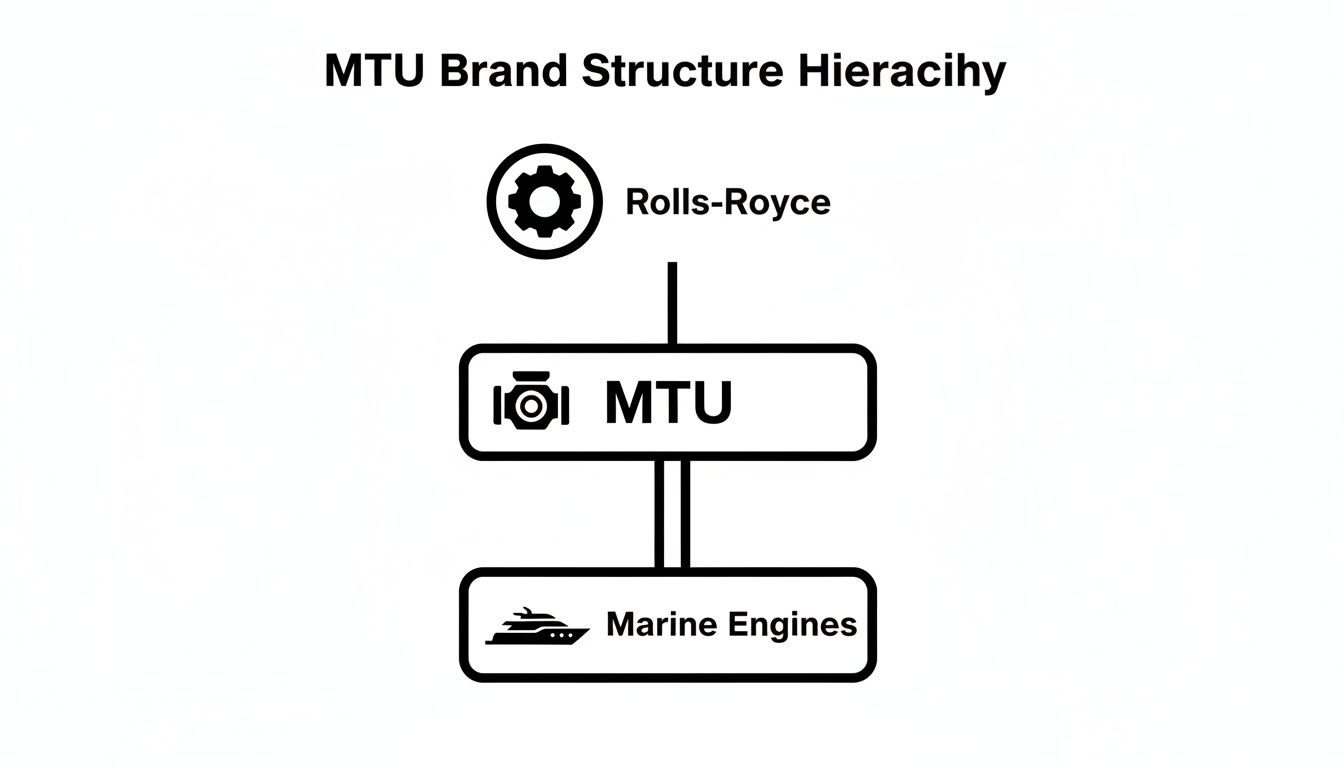
It’s a clear reminder that these powerplants are backed by the global engineering prowess of Rolls-Royce, a name that carries a legacy of quality and performance.
The Sprinter: The Agile MTU Series 2000
The MTU Series 2000, especially the popular M96 and M96L versions, is the high-revving athlete of the marine world. It's known for explosive acceleration and an incredible power-to-weight ratio, making it the undisputed champion for boats where speed and agility are everything. This is the go-to powerplant for custom sportfishing yachts that need to chase down marlin and for express cruisers built for thrilling weekend runs.
This engine is all about immediate throttle response. Thanks to its sequential turbocharging, there's virtually no lag when you push the levers forward. That's a huge deal when you're maneuvering in a tight marina or trying to get on plane quickly and efficiently. The Series 2000 delivers that exhilarating, connected feel that performance-driven captains live for.
Its compact design and lighter weight are also major advantages. For boat builders, it means more flexibility in the engine room and better overall balance. For you, the owner, it translates to sharper handling, a shallower draft, and often, better fuel efficiency at cruising speeds compared to bigger, heavier powerplants.
The Marathon Runner: The Indomitable MTU Series 4000
On the other side of the coin, you have the MTU Series 4000—the unstoppable long-distance runner. This is the durable, high-displacement workhorse built for the relentless grind of superyachts, megayachts, and commercial vessels tackling long-range voyages. Where the Series 2000 is all about nimble response, the Series 4000 is engineered for one thing above all: uncompromising reliability and sheer, unadulterated torque.
The larger physical footprint of the Series 4000 houses bigger pistons, a more robust crankshaft, and a cooling system designed for continuous high-load operation over thousands of hours. It’s built to run for days on end without breaking a sweat, pushing heavy displacement hulls through challenging seas with a quiet confidence. This series delivers its immense power at lower RPMs, which reduces stress and wear on internal parts and is the secret to its legendary longevity.
For a superyacht captain planning a transatlantic crossing, the Series 4000 isn’t just an engine—it's a promise of dependability. It provides the peace of mind that comes from knowing your powerplant was designed from the ground up for endurance.
MTU Marine Engine Series At-A-Glance Comparison
To make the differences even clearer, here's a quick side-by-side look at the two flagship series from the perspective of a yacht owner or captain.
| Feature | MTU Series 2000 M96/M96L | MTU Series 4000 |
|---|---|---|
| Best For | Sportfishing yachts, express cruisers, performance boats | Superyachts, megayachts, long-range displacement yachts |
| Power Delivery | High-revving, rapid acceleration, immediate throttle response | High torque at lower RPMs, designed for continuous high load |
| Primary Strength | Exceptional power-to-weight ratio, agility, and speed | Unmatched durability, reliability, and long-haul endurance |
| Typical Size | Vessels generally under 100 feet | Vessels generally over 100 feet |
| Key Tech | Sequential turbocharging for eliminating lag | Common-rail fuel injection, robust cooling systems |
| Analogy | The Sprinter | The Marathon Runner |
This table simplifies the choice: one is built for thrilling, high-energy performance, while the other is engineered for steadfast, ocean-crossing power.
Making the Right Choice for Your Vessel
Choosing between these two remarkable engine series isn’t about which one is "better." It's about which one is perfectly suited to your mission. The decision really hinges on your yacht's design and how you plan to use it.
- For Speed and Agility: If you own a vessel under 100 feet, like a sportfisher or a fast cruiser, the Series 2000 is almost always the clear winner. Its responsiveness and power density are second to none.
- For Endurance and Scale: For displacement or semi-displacement yachts over 100 feet, especially those embarking on long-haul journeys, the Series 4000 provides the durability and continuous power you absolutely need.
Ultimately, the right MTU engine should feel like a natural extension of your vessel. The Series 2000 makes a fast boat feel thrillingly alive, while the Series 4000 gives a large yacht the steadfast, reliable heartbeat it needs to conquer oceans.
How MTU Engineering Translates to Superior Performance
So, what really separates an MTU from the pack when you’re miles offshore? It’s not just about the raw horsepower you see on a spec sheet. It's about how they seamlessly blend brute strength with incredibly smart engineering. This is where we go beyond the numbers and get into the real-world feel—the operational advantages that truly define the MTU diesel marine engines experience.
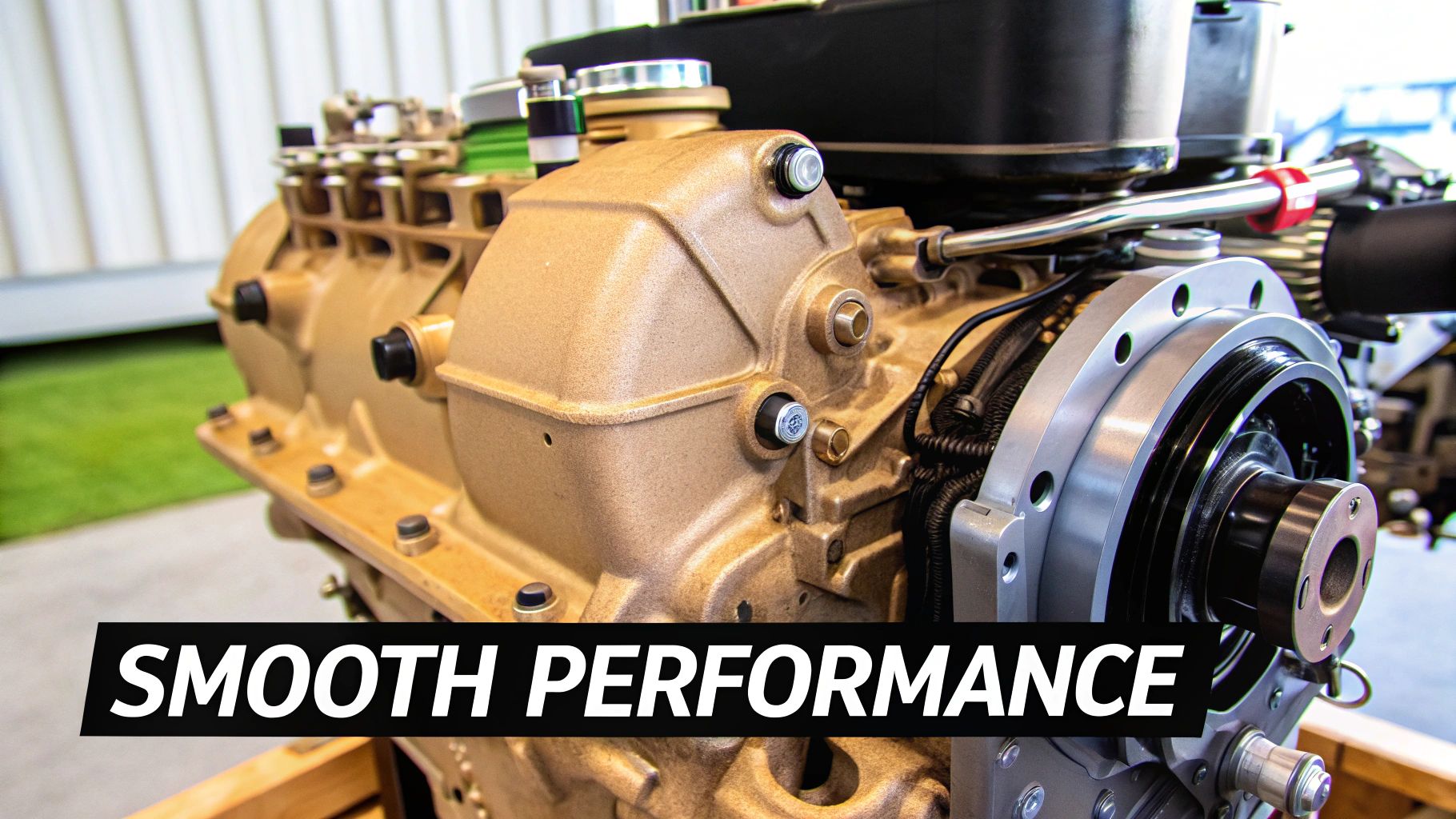
This kind of performance doesn't happen by accident. It's the direct result of decades of relentless innovation, turning complex mechanical systems into tangible on-water benefits. We're talking a smoother ride, lower fuel burn, and the confidence that comes from having instant power on demand.
The Brains Behind the Brawn: Common-Rail Injection
Think of an old-school fuel injection system like a simple garden hose nozzle. It gets the job done, but the pressure and timing are pretty basic. MTU’s advanced common-rail fuel injection is more like a sophisticated, computer-controlled sprinkler system, delivering the perfect mist of atomized fuel into each cylinder at precisely the right millisecond.
The system holds fuel under immense pressure in a central "rail," ready to be fired instantly. This precision gives you some massive advantages:
- Quiet and Smooth Operation: By perfecting the combustion process, MTU all but eliminates the clatter and vibration you often associate with powerful diesels.
- Impressive Fuel Efficiency: Less wasted fuel means more range and lower operating costs, whether you're island-hopping in the Bahamas or running up the coast.
- Cleaner Emissions: A perfect fuel-air mixture ensures a more complete burn, which drastically cuts down on smoke and harmful emissions.
This kind of technology is a big reason why diesel continues to dominate marine propulsion. The global marine engines market, currently valued at $19.7 billion, is expected to hit $26.9 billion by 2030, with diesel engines showing the fastest growth. Innovations in fuel injection and turbocharging have made the popular 1,000-5,000 HP engines more efficient than ever, solidifying their place as the workhorses of the sea. You can read the full research on marine engine market trends to dig deeper into how this evolution is shaping the industry.
MTU’s common-rail system is the secret sauce for a refined yachting experience. It transforms raw power into a smooth, quiet, and efficient ride, proving that you don’t have to put up with a noisy, rough engine to get immense strength.
This level of control means your MTU is always running at its best, whether you're idling out of a no-wake zone or cruising at 30 knots.
Eliminating Lag with Sequential Turbocharging
Every captain knows that feeling—you push the throttles forward and wait that split second for the turbos to spool up. That slight delay is known as "turbo lag." On many MTU diesel marine engines, it’s a thing of the past, thanks to sequential turbocharging.
Instead of relying on one massive turbo that takes time to build pressure, this system uses multiple turbos that activate in stages. Think of it like a relay race: a smaller, quicker turbo gets the engine moving instantly from a standstill, then hands off to a larger turbo to provide a massive wave of power at higher RPMs.
The result on the water is nothing short of spectacular. You get instantaneous, lag-free throttle response across the entire power band. This isn't just a nice-to-have feature; it’s a critical element for performance and safety.
On-Water Benefits You Can Actually Feel
When you put these technologies together, the engineering translates directly into a better, more confident boating experience.
- Docking with Confidence: The instant low-end torque and smooth power delivery make maneuvering in tight quarters—like a busy South Florida marina on a Saturday—far less stressful.
- Exhilarating Acceleration: For sportfishing yachts, getting on plane instantly without a puff of black smoke is a game-changer when you need to chase down a fish.
- Comfort on Long Crossings: Reduced vibration and a quieter engine room mean significantly less fatigue for crew and guests on those long hauls.
At the end of the day, MTU’s commitment to advanced engineering isn't just about building a powerful engine. It’s about creating a powerplant that elevates the entire yachting experience, delivering performance that is not only immense but also intelligent, responsive, and incredibly refined.
Protecting Your Investment with Proactive Maintenance
An MTU diesel engine isn't just a piece of machinery; it's the heart of your vessel. It’s a serious investment in precision German engineering, built for one purpose: to deliver uncompromising power when you demand it. But like any high-performance machine, its legendary reliability isn’t a given. It’s earned through disciplined, proactive care.
Running an MTU without a strict maintenance schedule is like asking a thoroughbred to win the Derby without proper conditioning. Sooner or later, performance will drop, and a catastrophic failure becomes a very real, very expensive possibility.
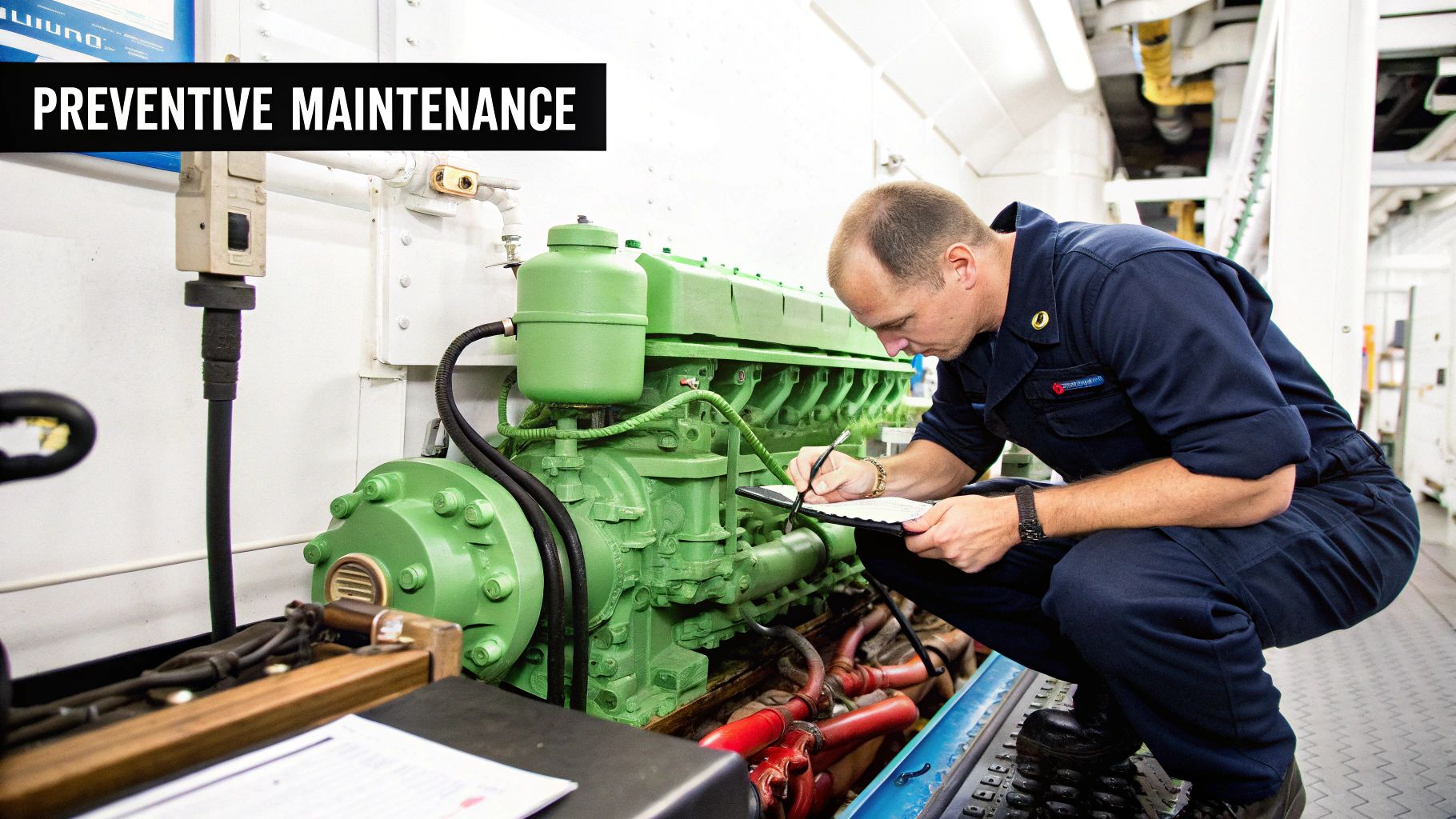
Think of preventative maintenance not as an expense, but as the best insurance policy you can buy for your yacht’s powerplant. It’s about catching the small stuff—on a schedule—before it has a chance to mushroom into a major, trip-ending disaster. This flips the script from a reactive "fix-it-when-it-breaks" headache to a proactive strategy that keeps your MTU running exactly the way it was designed to.
From Simple Checks to Major Overhauls
A solid maintenance plan for an MTU is layered. It starts with quick daily checks and builds up to comprehensive overhauls based on engine hours. The real secret is translating that thick factory service manual into a practical, real-world checklist that keeps you on track.
Here’s a simplified look at what that schedule usually involves:
- Daily Pre-Departure Checks (Before Every Trip): This is your first line of defense. We’re talking visual checks on oil and coolant levels, a quick scan for leaks, and making sure the sea strainers are clear. This five-minute walk-through can honestly catch over 80% of common problems before they escalate.
- Minor Service Intervals (Every 250-500 Hours): This is the basic, non-negotiable stuff. Changing the engine oil and filters, swapping out fuel filters, and giving the belts and hoses a good look for wear and tear.
- Major Service Intervals (Every 1,000-2,000 Hours): Now we get a bit deeper. This includes tasks like valve adjustments, full coolant system flushes, and servicing the heat exchangers and aftercoolers. In the warm waters of South Florida, clogged coolers are a primary cause of overheating and power loss.
- Top-End & Major Overhauls (W4/W5/W6 Services): These are the big ones, scheduled after thousands of hours of operation. They involve getting into the engine's internals—inspecting and replacing major components like injectors, cylinder heads, and turbos to bring it all back to factory spec.
"A disciplined maintenance log is the most valuable document on any yacht. It not only proves diligent care to a future buyer but, more importantly, provides a clear history that helps technicians diagnose issues faster and more accurately."
Decoding the Warning Signs
Your MTU is always talking to you through subtle little cues. The trick is learning to listen. A trained ear and a watchful eye can spot trouble brewing long before a fault code ever flashes on the screen.
For instance, see a faint wisp of black smoke on acceleration that wasn't there last week? That could be a clue to a dirty air filter or a tired injector. Feel a slight, new vibration through the deck? That might be a failing engine mount or something off with the running gear. Even a small but consistent drop in your max RPMs could signal a fuel delivery problem or a fouled bottom.
Common Failure Points and Their Symptoms
MTU engines are built like tanks, but the harsh saltwater environment eventually takes its toll. Knowing what to watch for is half the battle for any sharp captain or owner.
- Fuel System Contamination: Water or gunk in the fuel is the arch-nemesis of any high-pressure common-rail system. The symptoms? Rough idling, a frustrating loss of power, and a slew of fault codes. Clean fuel is everything.
- Cooling System Blockages: In our local waters, salt, sand, and marine growth are constantly trying to choke your heat exchangers, aftercoolers, and gear coolers. The first sign is usually a slow creep in engine temp under load, well before an alarm ever goes off.
- Injector Wear: After a few thousand hours, injectors naturally wear out. This leads to poor fuel atomization, which you'll see as more smoke, higher fuel bills, and a noticeable drop in that classic MTU punch.
- Turbocharger Issues: A failing turbo will often make itself known with a high-pitched whine. You’ll also feel a major loss of power and see a lot more black smoke than usual.
These problems often snowball; a cooling issue can raise internal temperatures, which then puts extra stress on everything else. While your daily checks are vital, only a certified technician has the diagnostic gear to find the root cause of a complex electronic or fuel system problem.
For anyone running a yacht in South Florida, partnering with a specialist for scheduled inspections is a critical part of responsible ownership. Understanding the value of professional total diesel repair is what keeps small issues from becoming season-ending failures.
Troubleshooting Common Issues and When to Call for Backup
There’s a unique kind of dread that hits when an alarm screams to life miles offshore. Your heart drops. In that moment, knowing the difference between a quick fix and a trip-ending failure is everything. This is your first-response guide for your MTU diesel marine engines—the smart, initial steps to take before you even think about calling for help.
Modern MTUs are masterpieces of engineering, but they're also incredibly complex. Some issues are straightforward, but many are guarded by sophisticated electronics that require specialized diagnostic gear. Knowing when to stop and call a pro isn't about giving up; it's about protecting a massive investment and ensuring your safety.
Your First-Response Checklist
Before you grab the satellite phone, a few basic checks can often pinpoint—or even solve—the problem. Think of this as engine room triage. Your mission is to gather intel and rule out the simple culprits that often masquerade as something far more sinister.
Here’s the logical sequence I run through myself:
- Check the Displays: What are the screens telling you? Look for any active fault codes. Jot down the exact code and a quick description of the alarm. This single piece of information is gold for a technician and gives them a huge head start before they even step on board.
- Inspect Sea Strainers: A clogged sea strainer is hands-down one of the most common causes of an overheating alarm. Carefully check for any seaweed, plastic, or junk restricting raw water flow. A clear strainer is critical for the cooling system to do its job.
- Examine Fuel Filters: Water in the fuel is poison for a common-rail diesel. Check the sight bowls on your primary filters (like the Racors) for any water or nasty-looking sediment. Draining a little water might get you going again, but it’s a red flag that you’ve got a bigger fuel contamination issue to deal with.
When You've Hit a Wall
The steps above cover the low-hanging fruit. But the advanced electronics and high-pressure fuel systems on today's MTU engines draw a very clear line in the sand. Pushing past this point without factory training and proprietary software is asking for trouble.
It's critical to remember that these aren't the old mechanical diesels we used to wrench on. The ECU is the brain, managing thousands of data points a second. Trying to bypass or fool these systems is a recipe for a very, very expensive disaster.
It's time to call for backup when the problem points to any of these areas:
- Complex Fault Codes: Any code related to sensors, injectors, rail pressure, or electronic timing is a hard stop. These require MTU-specific diagnostic software to interpret correctly.
- Fuel System Pressures: The common-rail systems on these engines operate at insane pressures, often over 25,000 PSI. Messing with these lines without the right training and tools is not only dangerous but can easily destroy expensive components.
- Internal Engine Noises: Any new or weird mechanical sound—knocking, grinding, a high-pitched whine from a turbo—is a sign of a serious internal problem. Shut it down and get a professional opinion, period.
- Persistent Performance Loss: If you've checked the basics and the engine still won't make full power or feels sluggish, the issue is deeper. It's likely buried in the fuel delivery, air intake, or electronic management systems.
Knowing when to make that call saves more than just your engine; it saves you time and money. A technician who arrives with good information can diagnose the real problem quickly, avoiding the costly guesswork. To get a better handle on what to expect, understanding the factors that influence professional diesel engine repair costs will help you make a smart call when things go sideways.
Finding Expert MTU Service and Support in South Florida
In the yachting capital of South Florida, your engine's performance is only as good as the team standing behind it. An MTU is a world-class piece of engineering, but keeping it at peak performance in our demanding marine environment means partnering with a certified, local service provider. This isn't just about fixing things when they break; it's about having a dedicated expert on your side who lives and breathes the unique challenges of our local waters.
The value here is immense. A premier service provider brings far more to the dock than just a toolbox. They have the proprietary MTU diagnostic software—the digital "key" needed to accurately read complex fault codes and troubleshoot sophisticated electronic systems. General mechanics simply don't have access to this, and that access means faster, more precise diagnostics that save you from expensive guesswork and agonizing downtime.
The Hallmarks of a Premier MTU Service Provider
So, what really sets a top-tier service team apart? It’s a blend of factory-certified knowledge, rapid-response capability, and a deep, intuitive understanding of the local boating scene. When your season is on the line, you need a crew that delivers.
Look for these key differentiators:
- Proprietary Diagnostic Software: For modern MTUs, the ability to plug directly into the engine's ECU is non-negotiable.
- Genuine Parts Inventory: A healthy stock of genuine MTU filters, sensors, and common replacement parts turns a multi-day repair into a job that's done in hours.
- 24-Hour Mobile Service: Problems don’t keep business hours. Expert mobile techs who can get to your slip in West Palm Beach or Fort Lauderdale are absolutely essential.
- Local Knowledge: A team familiar with South Florida’s conditions knows the enemy—the punishing heat, the relentless humidity, and the aggressive saltwater environment.
This level of specialized support is more critical than ever. The global marine diesel engine market is exploding, projected to hit $12.06 billion by 2029. This boom is fueled by a surge in international maritime trade that now tops 11 billion tons a year. All that growth pushes diesel technology forward, making specialized, up-to-date expertise non-negotiable. You can get more details on this global expansion in a detailed market report.
More Than a Mechanic—A True Partnership
Ultimately, you want to build a relationship with a team that treats your vessel’s reliability as their own personal mission. This proactive mindset is all about creating customized preventative maintenance programs designed to head off problems before they ever start. It’s the perfect combination: MTU’s incredible engineering backed by dedicated, expert local support. That’s an unbeatable recipe for reliability and peace of mind.
Choosing a certified service provider isn’t just a transaction; it's a strategic decision to protect your investment. It ensures that every hour you spend on the water is backed by the highest level of technical expertise available.
For yacht owners who demand the absolute best from their equipment, partnering with certified MTU diesel engine specialists provides the confidence to operate anywhere, anytime. That synergy between world-class machinery and expert local support is the real key to unlocking flawless performance and enjoying every single moment on the water.
A Few Common Questions About MTU Engines
When you're running some of the best marine powerplants in the world, you're bound to have questions. Let's tackle a few of the most common ones we hear from captains and owners every day.
How Often Do MTU Engines Need Service?
The short answer is: it depends on your operating hours. While you should be doing daily checks before getting underway, the first real service interval for things like oil and filters usually falls between 250 and 500 hours.
Of course, the more intensive work—think cooler maintenance and valve adjustments—comes at much longer intervals. The single best piece of advice I can give anyone is to stick to the factory schedule like glue. It’s the surest way to get that legendary MTU longevity and sidestep a massive, unexpected repair bill down the road.
Are MTU Engines Reliable?
Absolutely. Their reputation for being rock-solid is well-earned and a huge part of why they're a top choice. These engines are designed for the most demanding jobs out there, from military patrol boats to globe-trotting superyachts.
But here’s the crucial part: that reliability isn't unconditional. It's a direct result of consistent, professional maintenance and always using genuine MTU parts. When you treat them right, they are without a doubt among the most dependable engines you can have in your vessel.
At their core, MTU engines are built for endurance. They're designed to run hard and keep going, but that level of performance hinges on disciplined care and, just as importantly, clean fuel.
What's The Most Common Problem With MTU Engines?
If there's one weak spot, it's their sensitivity to fuel quality. Those high-precision common-rail injection systems are incredible for performance, but they don't tolerate dirty fuel. By far, the most frequent problems we see trace back to water or microbial growth in the fuel tanks.
This contamination wreaks havoc, causing injector failures, a noticeable loss of power, and a cascade of fault codes. Down here in South Florida, our warm, humid climate is the perfect breeding ground for this stuff. That makes vigilant fuel polishing, top-tier filtration, and regular tank cleaning non-negotiable.
Another thing to watch for is the cooling system. Saltwater debris can easily cause blockages, leading to overheating if you aren't flushing and servicing the coolers regularly.
For certified diagnostics, 24-hour mobile repairs, and proactive maintenance programs for your MTU engines in West Palm Beach and across South Florida, trust the experts at GTM International. Contact us today to schedule your on-site service.
