

When you talk to old salts and experienced yacht captains about reliable marine power, one engine comes up time and time again: the Cummins 4BTA. This isn't some newfangled, computer-controlled marvel. It's a legendary 3.9-liter, four-cylinder diesel workhorse, celebrated for its raw mechanical simplicity and almost stubborn refusal to quit.
Its turbocharged and aftercooled design strikes a perfect balance between solid performance and surprising fuel efficiency, making it the gold standard for anyone who values getting home safely over having the latest tech.
The Legendary Workhorse of the Waterways
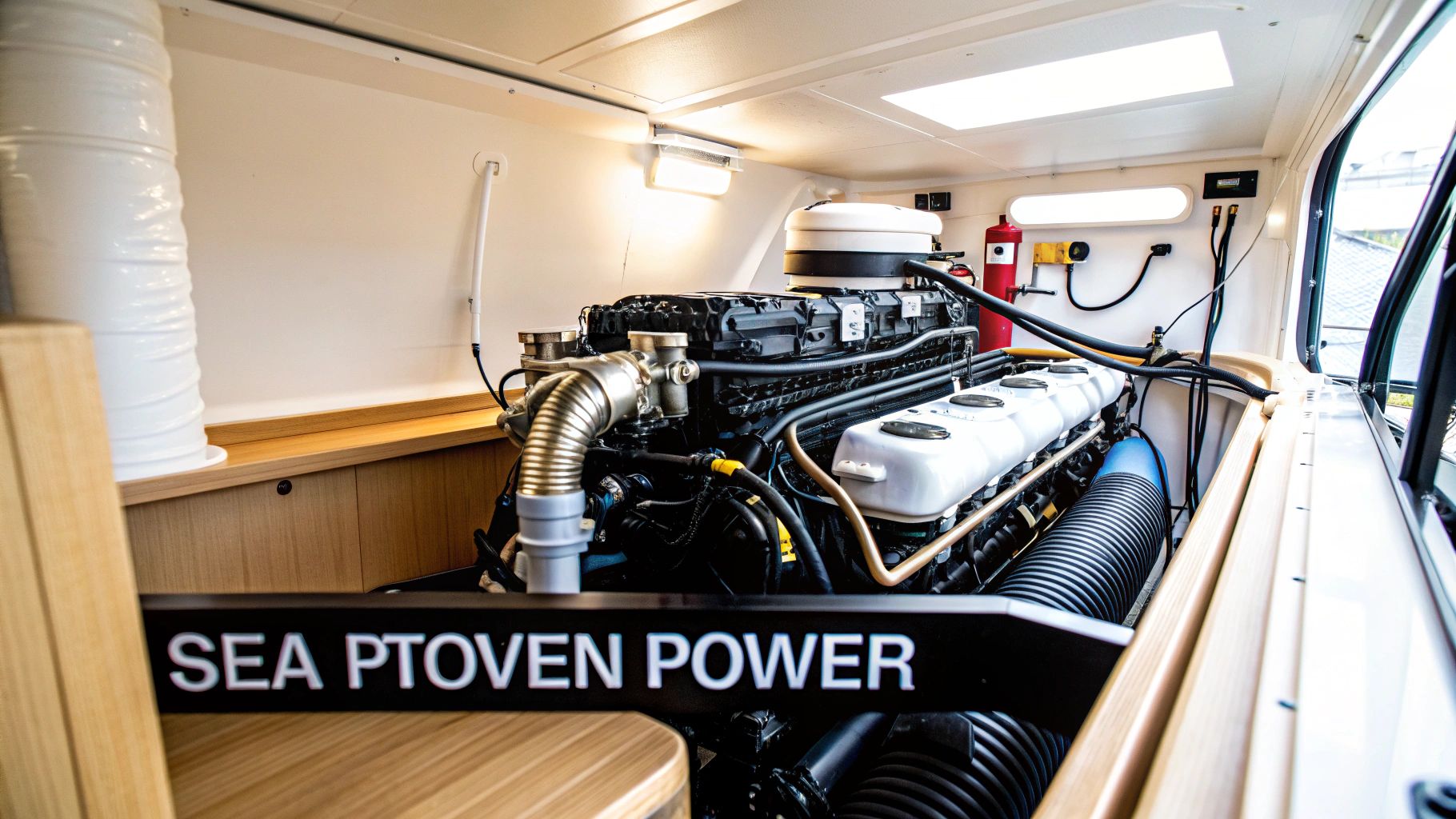
For a captain, an engine isn't just a hunk of iron below deck. It's the heart of the vessel, the difference between a great day on the water and a very, very bad one. The ocean doesn’t care about excuses; it demands a power source that fires up on command and hums along reliably, whether you're navigating a calm inlet or pushing through a nasty chop miles from shore.
This is the world where the Cummins 4BTA earned its stripes. It’s a masterpiece from an era before complex sensors and proprietary software took over the engine room. Back then, durability was measured in thousands of hours, not just by the length of a warranty.
Built for the Demands of the Sea
Life on the water is brutal on machinery. Constant loads, corrosive salt spray, and the absolute need for reliability create a set of challenges you just don't see on land. The Cummins B-Series was engineered for this kind of heavy-duty punishment from day one, and the 4BTA model was perfected for the marine environment.
Its strengths are clear and simple:
- Mechanical Simplicity: No ECU, no complex wiring harnesses. The fuel system is all-mechanical, which means you can often diagnose and fix problems with a standard set of tools. That's a huge advantage when the nearest mechanic is a day's journey away.
- Proven Durability: These engines were built to last. With a tough parent bore block and high-strength components, it's not uncommon to see a well-maintained 4BTA run for 8,000 to 12,000 hours before needing a major overhaul.
- Efficient Power: The turbocharger and aftercooler work together to pack dense, cool air into the cylinders. The result is strong, reliable horsepower and torque without guzzling fuel.
For a quick overview of what makes this engine tick, here are the key specifications.
Cummins 4BTA Marine Engine At a Glance
| Specification | Value |
|---|---|
| Engine Type | Inline 4-Cylinder Diesel |
| Displacement | 3.9 Liters (239 cubic inches) |
| Aspiration | Turbocharged & Aftercooled |
| Bore & Stroke | 4.02 in x 4.72 in (102 mm x 120 mm) |
| Fuel System | Mechanical Inline Injection Pump |
| Horsepower Range | Typically 150 hp to 250 hp |
| Peak Torque | Varies by rating, approx. 400-600 lb-ft |
| Dry Weight | Approx. 950 lbs (431 kg) |
| Service Life | 8,000 – 12,000 hours before major overhaul |
These numbers tell a story of a well-balanced engine designed for longevity and steady performance.
The real value of a Cummins 4BTA isn't just its power output; it's the peace of mind it provides. Knowing you have a simple, tough, and serviceable engine below deck is invaluable when you're navigating challenging waters.
This guide is your complete resource for this iconic powerhouse. We'll dive into common maintenance needs, walk through troubleshooting, and explore what truly makes it a reliable partner on the water. Whether you already own one or are looking at a boat with a 4BTA in the bilge, you'll get the insight you need to keep it running strong for years to come.
Anatomy of a Marine Powerhouse
To really get what makes the Cummins 4BTA tick, you have to appreciate its core philosophy. It’s less of a delicate, complex machine and more of a seasoned marathon runner—built not for flashy sprints but for relentless, day-in, day-out work. Its power comes from a straightforward synergy of tough, overbuilt components working in perfect harmony.
The secret sauce isn't one single feature, but how three key elements—the core engine block, a turbocharger, and an aftercooler—come together. This trio creates a powerhouse that’s both impressively strong and surprisingly efficient. This design wasn't a happy accident; it was a deliberate and brilliant evolution of its already-tough predecessor, the 4BT.
What’s in a Name? Decoding "4BTA"
The engine’s designation is practically a spec sheet in itself. Each letter and number tells you something important about its design and what it's built to do out on the water.
- 4: This one’s easy—it has four cylinders. The inline-four layout is a signature of the B-Series, prized for being inherently balanced, smooth-running, and relatively compact. That last part is a huge plus when you're trying to shoehorn it into a tight engine room.
- B: This puts it squarely in the legendary Cummins B-Series family. These engines are known around the world for one thing above all else: being incredibly durable and dead-simple to work on.
- T: This stands for Turbocharged. Think of a turbo as a performance-enhancing breathing apparatus for the engine. It uses otherwise wasted exhaust gas to spin a turbine, which crams more air into the cylinders. More air means a bigger bang, which translates to a serious jump in horsepower and torque without making the engine bigger or heavier.
- A: And this is the magic ingredient: Aftercooled. The turbocharging process heats the air, but hot air is less dense. An aftercooler—usually a seawater-to-air heat exchanger on marine models—cools that pressurized air after the turbo but before it enters the engine. Cooler, denser air carries more oxygen, which means even more power, better fuel economy, and less thermal stress on internal components.
It's this one-two punch of turbocharging and aftercooling that really sets the 4BTA apart from a more basic diesel.
The Evolution: From a Good Engine (4BT) to a Great One (4BTA)
The original Cummins 4BT was already a solid, respected workhorse. But adding the aftercooler to create the 4BTA was an absolute game-changer for marine use. A later variant took things even further by introducing a four-valve-per-cylinder head, a move that really uncorked its potential.
This engineering leap pushed the 4BTA's output to 170 horsepower and a stump-pulling 420 lb-ft of torque. That’s a nearly 62% increase in horsepower over the original 105 hp 4BT and a massive 58% boost in torque from the first-gen's 265 lb-ft. You can really see the impressive generational leap in these diesel engine specs.
This wasn't just about chasing bigger numbers on a dyno. It was about creating a more complete marine package—an engine that had the grunt to get a heavy boat on plane and the stamina to hold it there all day without breaking a sweat.
The aftercooler is the hero here. By chilling the hot, pressurized air from the turbo, it allows for a much more complete and powerful combustion. This doesn't just add horsepower; it also helps keep exhaust gas temperatures in check, which is absolutely critical for an engine's lifespan in the demanding, high-load world of marine propulsion. The result is an engine that runs stronger, cleaner, and with far greater reliability.
This clever bit of engineering is what transforms a dependable industrial engine into a true marine powerhouse. The 4BTA delivers the modern performance that boaters demand while holding onto the simple, all-mechanical soul that made the B-Series a legend in the first place.
Mastering Your 4BTA Maintenance Schedule
Think of routine maintenance on your Cummins 4BTA not as a chore, but as the best insurance policy you can buy for your time on the water. Just like a professional athlete sticks to a strict training plan to stay at the top of their game, your engine needs a consistent schedule to deliver that rock-solid performance you rely on. Skipping it is like asking that athlete to run a marathon without training—sooner or later, something’s going to give.
A proactive approach is what separates a passenger from a true captain. It’s about knowing why you're doing something. You understand that fresh oil is more than just a lubricant; it's the lifeblood that keeps the turbocharger's high-speed bearings from self-destructing. You recognize that a clean cooling system is the only thing standing between your engine and a costly, trip-ending overheat.
This diagram breaks down the simple but powerful process the 4BTA uses to make its horsepower.
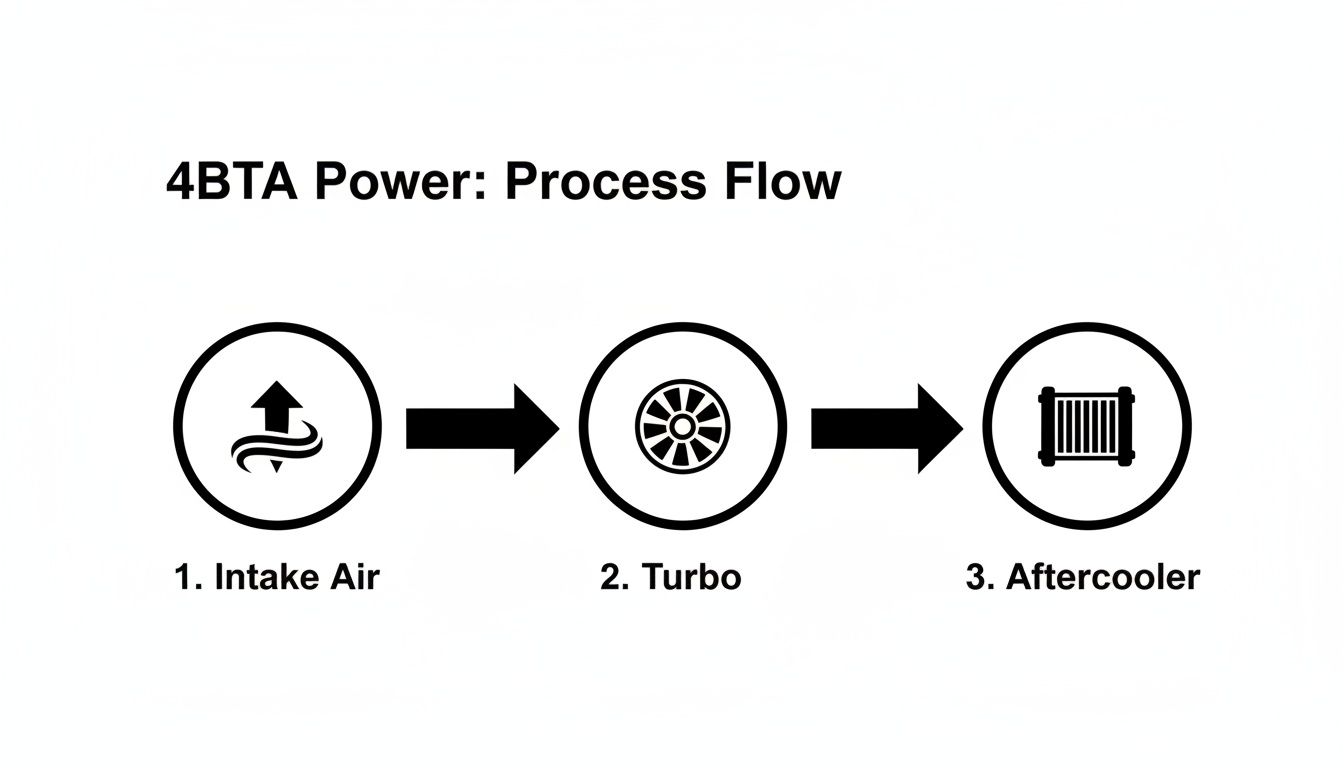
It’s a great visual reminder of how crucial the turbo and aftercooler are. Keeping those systems clean and efficient is the key to getting every ounce of power out of your engine.
The Non-Negotiable Pre-Departure Checks
Before you even think about casting off the lines, a quick but thorough once-over is your first line of defense. These checks take less than five minutes but can save you from hours of grief out at sea. Make it a ritual.
- Engine Oil Level: Pull the dipstick, wipe it, stick it back in, and pull it again. The level should be sitting comfortably between the 'add' and 'full' marks. Too little oil starves critical parts, while too much can create dangerous pressure in the crankcase.
- Coolant Level: Just peek at the level in the expansion tank. Remember, never open a hot radiator cap. Low coolant is the number one cause of overheating, which is public enemy number one for any marine diesel.
- A Quick Leak Check: Scan the area under and around the engine for any drips or shiny spots. A tiny leak at the dock can turn into a gusher when the engine is under load. Look for oil, fuel, or coolant.
- Sea Strainer: Pop the top and make sure the basket is clear of seaweed, plastic bags, or any other gunk. A clogged strainer chokes off the raw water supply, and your engine will overheat in a hurry.
Think of these steps as your pre-flight checklist. They build confidence and give you peace of mind that your Cummins 4BTA is ready to go.
Essential Service Intervals for Long-Term Health
Beyond the daily checks, a more structured maintenance schedule is what gives these engines their legendary longevity. The good news is that the 4BTA is a refreshingly mechanical beast, making these jobs totally manageable for a hands-on owner.
Every 100-150 Hours (or Once a Year):
- Change the Engine Oil and Filter: This is, without a doubt, the single most important thing you can do. Old oil gets contaminated and loses its ability to protect. Use a quality 15W-40 diesel-rated oil and stick with genuine or top-tier equivalent filters.
- Change the Fuel Filters: Your fuel system is incredibly sensitive to water and dirt. Swapping out both the primary (the pre-filter, often in a clear bowl) and the secondary (on-engine) filters is cheap insurance against expensive injector and fuel pump problems.
- Check the Zinc Anodes: The little zinc pencils in your heat exchanger sacrifice themselves to prevent corrosion. Pull them out and have a look. If they're more than 50% gone, it's time for new ones.
Every 250-300 Hours (or Every Two Years):
- Replace the Raw Water Pump Impeller: This little rubber star is a wear item, plain and simple. Replace it before it fails, not after you're dead in the water with a screaming overheat alarm. Keep the old one as a "get-home" spare if it still looks decent.
- Service the Heat Exchanger and Aftercooler: Over time, the insides of these coolers get clogged with salt, scale, and marine growth. They need to be professionally cleaned to maintain cooling efficiency. If your engine is running warmer than it used to, this is often the culprit.
Sticking to a maintenance schedule turns engine care from a reactive headache into a proactive strategy. You're not just fixing problems; you're stopping them from ever starting. That’s how you ensure your Cummins 4BTA remains the reliable workhorse it was designed to be.
Solving Common Cummins 4BTA Engine Issues

Even a workhorse like the 4BTA is going to have an off day. When something feels wrong, the worst thing you can do is panic. The best thing? A calm, methodical approach. Think of it less like a crisis and more like a conversation. Your engine is telling you exactly what's wrong; you just need to learn how to interpret its signals.
This guide is your translator. We'll walk through the common symptoms, point to the likely culprits, and give you a clear plan of attack. When you can confidently troubleshoot these issues, you’re not just a passenger anymore—you're in command.
Decoding Engine Smoke Signals
One of the most obvious red flags is a change in your exhaust smoke. The color of that smoke is a direct clue pointing you straight to the heart of the problem. Don't ever ignore it.
- Black Smoke: This is the classic sign of incomplete combustion. Simply put, the engine is getting too much fuel or not enough air. Start by checking the simple stuff: a clogged air filter is a frequent offender. From there, you might be looking at a failing turbocharger, or even dirty injectors that aren't atomizing fuel properly.
- White Smoke: Think unburned fuel. When you see white smoke, it means raw diesel vapor is making it through the exhaust. This can be caused by low compression, incorrect injection timing, or—a common one—water in your fuel. A little white smoke on a cold startup is normal, but it should clear up fast as the engine warms.
- Blue or Gray Smoke: This is the one you don't want to see—it's the tell-tale signature of burning oil. Oil is getting into the combustion chamber where it absolutely doesn’t belong. This could be from worn piston rings, shot valve stem seals, or something as simple as an overfilled crankcase.
If you’ve narrowed down your smoke issues to the fuel system, getting your injectors looked at is a smart move. A professional diesel fuel injector rebuild can often restore lost power and efficiency, clearing up that exhaust for good.
Quick Diagnostic Table
When you're faced with a symptom, it helps to have a quick reference. This isn't a substitute for proper diagnostics, but it can point you in the right direction fast.
Common 4BTA Symptoms and Potential Causes
| Symptom | Primary Suspect | Secondary Suspect |
|---|---|---|
| Black Smoke | Clogged Air Filter | Faulty Injectors or Turbo |
| White Smoke | Water in Fuel | Low Compression |
| Blue Smoke | Worn Piston Rings | Overfilled Oil |
| Overheating | Clogged Sea Strainer | Worn Raw Water Impeller |
| Hard Starting | Clogged Fuel Filters | Failing Lift Pump |
| Loss of Power | Fuel Starvation | Air Intake Obstruction |
Remember, start with the easiest and most common cause first. More often than not, the problem is simpler than you think.
Tackling Overheating Scenarios
That high-pitched screech from an overheating alarm is a sound that will stop any captain's heart. It means shut down now and figure it out. Running a marine diesel too hot, even for a few minutes, can cause catastrophic failure.
Fortunately, the root cause is usually pretty straightforward. Work your way through this list, from easiest to hardest to check:
- Check the Sea Strainer: This is always, always stop number one. A stray plastic bag or a wad of seagrass is the most common party crasher, completely choking off your raw water flow.
- Inspect the Raw Water Pump Impeller: Think of this little rubber part as a wear item, like a tire. It has a finite life. If it’s old and brittle, it can shed a vane, immediately crippling its ability to pump water.
- Examine Belts and Hoses: A loose or snapped belt driving the raw water pump will kill your cooling instantly. Check the tension and look for cracks or fraying.
- Assess the Heat Exchanger: If your engine's temperature has been creeping up slowly over the season, your heat exchanger is the likely culprit. Its internal passages get clogged with scale and marine growth, making it less and less efficient at transferring heat.
Addressing Starting and Performance Problems
Your trusty Cummins suddenly won't fire up, or it feels gutless out on the water? The problem is almost certainly related to fuel or air. These old-school mechanical diesels are brilliantly simple: give them clean fuel and plenty of clean air, and they'll run forever.
When you're dealing with a hard start or a sudden loss of power, here's your checklist:
- Fuel Supply: It sounds silly, but first, make sure you have fuel in the tank! Next, check your fuel filters. Water in the bowl or a dark, clogged element is a dead giveaway you've found the issue.
- Air Intake: An engine needs to breathe. Pop open the air filter housing and make sure the filter isn't choked with grime. It's also worth checking that an intake hose hasn't collapsed on itself.
- Lift Pump Operation: That mechanical lift pump has the job of pulling fuel all the way from the tank. If it's weak or has failed, the injection pump gets starved and the engine will sputter and die.
By working through these common issues one by one, you can solve the vast majority of problems you'll ever encounter with a 4BTA, keeping your vessel reliable and your mind at ease.
Sourcing Parts and Finding Expert Service
Sooner or later, even the most bulletproof engine will need a new part or a skilled hand to keep it running right. The good news is, one of the best things about owning a Cummins 4BTA is that you’re never truly on your own.
This engine’s legendary status wasn't just earned in the bilge of a yacht; it was forged in a million different commercial and industrial jobs all over the world. That widespread use is your secret weapon.
Back when it launched in 1983, the 4BT and its turbocharged big brother, the 4BTA, became the go-to power plant for everything from bread trucks to farm equipment. They were everywhere. Because of that massive production run, parts and real-world expertise are still incredibly easy to find, which is a huge leg up compared to some of the more obscure marine diesels out there.
First Things First: Decode Your Engine Data Plate
Before you can order a single gasket, you have to know exactly what you’re working with. The most important piece of metal on your engine is the engine data plate, that little tag usually riveted to the gear housing. Think of it as your engine's birth certificate.
This plate holds two numbers that are pure gold:
- Engine Serial Number (ESN): The unique fingerprint for your specific engine.
- Control Parts List (CPL): This number tells you the exact original configuration and every part used to build your engine from the factory.
When you call a parts supplier or a mechanic, leading with these two numbers is a pro move. It completely eliminates guesswork and ensures you get the exact right part the first time, saving you from the headache and cost of a bad order.
OEM vs. Aftermarket Parts: Knowing When to Spend and When to Save
The debate over Original Equipment Manufacturer (OEM) parts versus aftermarket is a tale as old as time in the marine world. When it comes to the 4BTA, the smart owner knows where to spend the money on genuine Cummins quality and where a high-quality aftermarket part makes perfect sense.
Stick with OEM for: Anything critical to the fuel system (injectors, injection pump), internal engine components (pistons, bearings), and the turbocharger. These are precision-engineered parts where Cummins' R&D and quality control pay huge dividends in performance and longevity. Don't cheap out here.
Aftermarket is fine for: Common service items. Think filters, belts, hoses, zinc anodes, and most gaskets. Reputable aftermarket brands often meet or exceed OEM specs for these consumable parts, usually at a much friendlier price point.
Finding a Mechanic Who Truly Knows the B-Series
Let's be clear: not all diesel mechanics are created equal. You need someone who speaks fluent "B-Series." When you’re vetting a technician, don’t be shy about asking them directly about their hands-on time with these specific engines.
Look for a mechanic who:
- Cut their teeth on mechanical diesels, not just the modern common-rail engines that rely on a laptop for everything.
- Asks for your ESN and CPL right out of the gate before talking parts or prices. This is the sign of a pro.
- Can actually diagnose a problem by listening and observing, not just by plugging in a computer.
- Understands the whole marine package, from the heat exchanger to the raw water pump. An engine in a boat isn't the same as one in a truck.
Finding the right support is everything. Partnering with certified diesel engine specialists who have a deep, practical understanding of the Cummins 4BTA is the best way to keep you on the water and out of the repair yard. Their experience is your best guarantee of a job done right.
Why the 4BTA is Still Your Most Trusted Crew Member
We've spent this guide pulling apart every bolt, hose, and system of the Cummins 4BTA. But to really get it, you have to stop seeing it as just a collection of parts. Think of it as a promise—a mechanical handshake that guarantees it'll get you home, every single time. For any serious mariner, this engine isn't just hardware; it's your most reliable partner at sea.
Its reputation wasn't built on flashy tech or complicated electronics. It was forged in the simple, brilliant engineering that so many modern engines have left behind.
The Four Pillars of On-the-Water Confidence
When you boil it all down, the incredible loyalty boaters have for the Cummins 4BTA comes from four things that matter most when you're miles from the nearest mechanic:
- Legendary Reliability: With its all-mechanical design, there's just less to go wrong. No mysterious sensors to fail, no complex computer to fry. This isn’t just an engine; it’s peace of mind cast in iron.
- Beautifully Simple to Work On: When something goes sideways offshore, simplicity is your best friend. The fact that you can diagnose and often fix problems with a basic toolkit is a massive advantage when the closest help is over the horizon.
- Packs a Punch Without the Pounds: The 4BTA delivers serious grunt to power through heavy seas, but it does so without weighing your vessel down. That stellar power-to-weight ratio makes it a go-to choice for both repowers and new builds.
- Parts Are Everywhere: Because this engine was a workhorse in so many commercial trucks and tractors, finding quality parts is a breeze. You’ll spend more time on the water and less time waiting for a special order to arrive.
These aren't just features on a spec sheet. They come together to create a power source that does more than just push your boat—it gives you the confidence to cast off the lines and head out. It’s the dependable muscle that lets you focus on the journey, not what’s rattling around in the engine room.
Owning a Cummins 4BTA is an investment in self-reliance. Its mechanical soul empowers you to truly understand, maintain, and trust your machinery in a way that’s almost impossible with today's sealed, "black-box" electronic engines.
At the end of the day, how long your 4BTA lasts is up to you. Following the maintenance routines we’ve laid out isn't just about servicing a machine; it's about upholding your end of the partnership. You take care of this engine, and it will give you decades of unwavering, get-you-home service in return.
Your 4BTA Questions, Answered
When you're dealing with an engine as well-known as the Cummins 4BTA, a lot of questions come up. It doesn't matter if you're eyeing a boat with one in the engine room or you've been running one for years—getting straight answers is what counts. Here are the most common questions we hear from captains and owners about this legendary diesel.
We pulled these questions right from our conversations on the docks and in the boatyard, so the answers are based on real-world experience, not just a spec sheet.
What’s the Real-World Fuel Burn on a Cummins 4BTA?
Fuel economy is always on a boater's mind, and for a mechanical diesel from its time, the 4BTA is pretty respectable. A solid rule of thumb for any marine diesel is a burn rate of about 1 gallon per hour for every 18 to 20 horsepower you're actually using.
Of course, what this really means for your boat depends entirely on its hull, weight, and how heavy your hand is on the throttle. Most owners running at a sensible cruising speed report burning somewhere in the neighborhood of 4 to 8 gallons per hour. That sweet spot between power and efficiency is a huge part of why these engines are still so popular.
Can I Just Drop a Truck 4BTA into My Boat?
While it’s true that the core engine block is the same, converting a truck engine for marine duty—a process called "marinization"—is a whole different animal. It's a massive, costly undertaking that's way more involved than just swapping a few parts.
To do it right, you need a long list of specialized, water-cooled hardware:
- A marine heat exchanger and expansion tank
- A raw water pump and all the plumbing that goes with it
- A water-cooled exhaust manifold and turbo housing
- A marine-rated transmission and the right adapter plate
Let me be blunt: in almost every case, it's cheaper, safer, and far more reliable to buy a proper marine Cummins 4BTA from the start. The hidden costs and potential headaches of a DIY marinization job just aren't worth it when you can get an engine built from day one to handle the salt.
How Much Weight Are We Talking About for a 4BTA?
Engine weight is a huge deal for a boat's balance and performance. The Cummins 4BTA engine block itself, bone dry, tips the scales at around 750 to 800 pounds (about 340-363 kg). But that's just the starting point.
By the time you add a marine gear (like a ZF or Twin Disc), the heat exchanger, aftercooler, alternator, starter, and fill it with fluids, the complete "dressed" weight is typically between 1,000 and 1,100 pounds. Its fantastic power-to-weight ratio is still one of its best features, especially for repower projects where it can replace an older, heavier engine and noticeably improve how a boat handles.
How Long Will a Well-Maintained 4BTA Actually Last?
The durability of the B-Series is the stuff of legends, and the 4BTA lives up to the hype. These engines were built to take a beating in commercial applications, which means in most pleasure boats, they are barely breaking a sweat. If you stay on top of maintenance, their lifespan is seriously impressive.
A properly cared-for marine 4BTA will often run for 8,000 to 12,000 hours before even thinking about a major overhaul. For the typical boater, that translates to decades of reliable service. It's not just an engine; it's a long-term partner on the water.
When you need certified, on-site service for your marine diesel engine, trust the experts at GTM International. Our mobile technicians bring the workshop to your dock, providing expert diagnostics, maintenance, and repairs to keep your vessel sea-ready. Learn more and schedule your service by visiting us at https://www.marinetechsvcs.com.
