
Let's be clear: fuel injector rebuilding isn't just a quick clean-up. It's a full-on, deep-dive restoration that brings a tired, worn injector all the way back to original factory performance standards, and it does it for a fraction of the cost of buying a brand-new part. We're talking about a complete disassembly, replacing every worn internal component, and then precisely recalibrating it. This is more than a simple repair; for your engine, it’s a lifeline.
Why Fuel Injector Rebuilding Is Your Engine's Lifeline
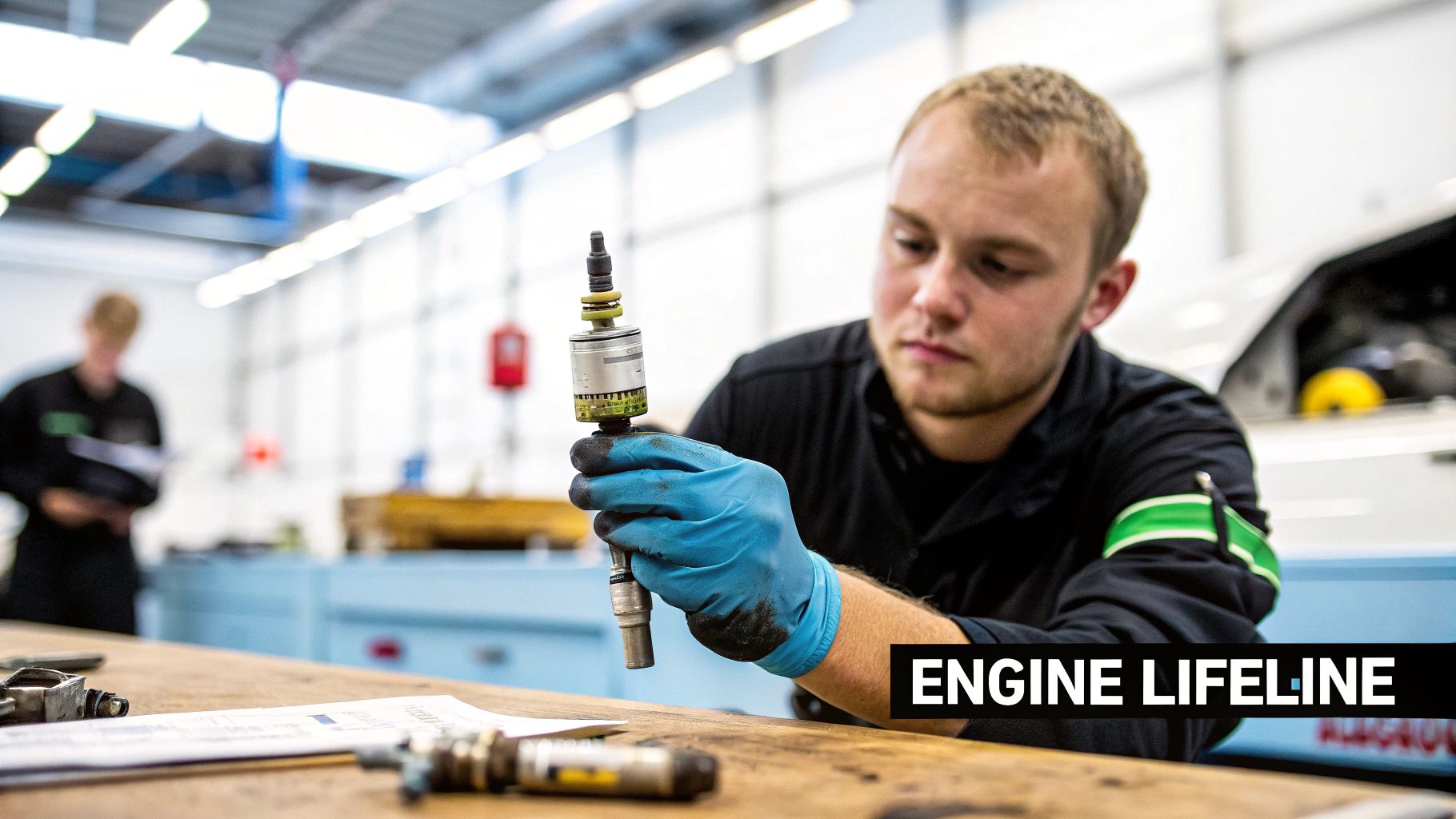
Think of your fuel injectors as the heart valves of your engine. They need to deliver the lifeblood—fuel—with absolute precision and perfect timing. After thousands of hours of relentless work and exposure to tiny contaminants, these intricate parts start to wear down, and the whole system feels it. You might notice a loss of power, a sudden thirst for fuel, or even that dreaded plume of black smoke.
Rebuilding an injector isn't just about patching a problem. It’s about getting to the root cause of the failure and restoring the engine's core efficiency, ensuring every single drop of fuel is perfectly atomized for clean, powerful combustion.
The Critical Difference: Cleaning vs. Rebuilding
It's easy to get confused, but a basic cleaning service is worlds away from a professional rebuild. Sure, cleaning might blast away some surface-level carbon gunk, but it does absolutely nothing for the internal wear and tear on critical parts like the springs, O-rings, seals, and nozzle tips.
A true rebuild is a complete overhaul. A technician will meticulously take the injector apart, inspect every single piece under magnification, replace any component that doesn't meet strict OEM specs, and then put it all back together. Finally, it's calibrated on a specialized test bench to ensure it’s working perfectly.
This distinction is especially crucial for marine diesel engines, where you can't just pull over to the side of the road. Out on the water, reliability isn't a luxury—it's everything. A half-fixed injector is a risk that could leave you stranded, while a professionally rebuilt one delivers true peace of mind.
To make the choice clearer, it helps to see the options side-by-side.
Comparing Fuel Injector Servicing Options
| Service Option | Process Overview | Best For | Outcome |
|---|---|---|---|
| Basic Cleaning | External and ultrasonic cleaning to remove carbon deposits. No disassembly. | Routine maintenance on low-hour, well-functioning injectors. | Removes external buildup and may temporarily improve spray pattern. Does not fix internal wear. |
| Professional Rebuilding | Complete disassembly, inspection, replacement of all worn parts (seals, nozzles, springs), reassembly, and calibration on a test bench. | Injectors showing signs of wear like poor economy, smoke, or power loss. A cost-effective alternative to replacement. | Restores injector to original factory specifications for performance, efficiency, and reliability. |
| Full Replacement | Installing a brand-new or remanufactured injector. | Catastrophic injector failure (e.g., cracked body) or when a rebuild isn't possible. | Guarantees factory-new performance but comes at the highest cost. |
Ultimately, rebuilding offers the most comprehensive solution for restoring performance without the steep price of a new part.
Restoring Peak Performance and Efficiency
The real magic of a rebuild is restoring that perfect, cone-shaped fuel spray pattern. When that happens, the benefits are immediate and obvious:
- Restored Horsepower: Your engine gets that crisp, powerful response it had when it was fresh off the line.
- Improved Fuel Economy: When fuel is delivered precisely, none of it goes to waste. That means lower operating costs every hour you run.
- Reduced Emissions: Complete combustion drastically cuts down on harmful exhaust and that embarrassing black smoke.
- Enhanced Reliability: By replacing all the worn-out internal parts, you're not just fixing a current problem—you're preventing future ones.
This focus on precision is why the demand for expert injector services is booming. The global automotive fuel injector market is projected to skyrocket from USD 79.35 billion in 2025 to USD 149.08 billion by 2035. That's not just a random statistic; it shows how vital these components are to modern engines. You can dig into the automotive fuel injector market trends on PrecedenceResearch.com yourself.
Making the smart choice to rebuild is a direct investment in your vessel's long-term health, performance, and value.
Spotting the Warning Signs of Failing Fuel Injectors
Your engine is always talking to you. The trick is knowing how to listen. When it comes to fuel injectors, the warnings usually start small—a slight change in performance, a puff of smoke—before they escalate into something that can leave you stranded. Catching these early signs is the key to choosing a smart, cost-effective fix like fuel injector rebuilding before you're facing a catastrophic, engine-killing failure.
A healthy marine diesel should fire up reliably, run smooth, and give you clean, responsive power. When injectors start to go, that whole delicate balance gets thrown out of whack. It’s like an orchestra with one instrument playing sharp; pretty soon, the whole performance is a mess. Recognizing the symptoms is your first and most important line of defense.
The Smoke Signal You Can't Ignore
One of the most obvious signs of injector trouble is what’s coming out of your exhaust. Sure, a little smoke on a cold start is one thing, but if you're seeing persistent, heavy smoke once the engine's warmed up, that’s a major red flag.
Excessive Black Smoke: This is the classic sign of over-fueling. It means your engine is getting way too much diesel, or the fuel is being dumped in as a sloppy dribble instead of a fine, atomized mist. That unburnt fuel turns into soot, creating that embarrassing black cloud at the dock and absolutely killing your fuel economy. It's a dead giveaway that an injector is probably stuck open or has a completely worn-out nozzle.
White Smoke: Don't mistake this for steam. If you see consistent white smoke, it often means fuel is getting into the cylinder but isn't igniting correctly. This usually points to an injector with a terrible spray pattern or one that's dripping fuel when it should be shut tight.
This isn't just about looks. It's a clear symptom of poor combustion that can lead to damaging carbon buildup on your pistons and valves. If you’re laying down a smokescreen, it's time to get those injectors checked out.
Feeling the Loss of Power and Performance
Sometimes, the first sign isn't what you see, but what you feel at the helm. When your injectors start failing, you'll notice it in the boat's performance, and that can really shake your confidence out on the water.
A significant loss of power is a common complaint. You push the throttles forward, but the boat feels sluggish and just won't get on plane like it used to. It feels like the engine is fighting itself, struggling to deliver the punch it once had. That’s because clogged or faulty injectors are starving the cylinders of the precise fuel charge they need to make real power.
Another sign you can literally feel is a rough or shaky idle. At the dock, your engine should have a steady, smooth hum. If you're feeling a lot of vibration or hearing the engine stumble and shake, it's a strong indication that one or more cylinders aren't firing properly because an injector is failing to do its job.
An engine misfire from a bad injector is more than just an annoyance—it's actively harming your engine. Every time a cylinder misfires, raw fuel washes lubricating oil off the cylinder walls, which dramatically accelerates wear and tear on your pistons and rings.
The Sound of Trouble and Other Telltale Signs
Your other senses can be great diagnostic tools, too. That distinct, acrid smell of raw diesel around the exhaust is a dead giveaway that fuel is passing straight through the engine without being burned. Not only is that a waste of money, but it can also point to a serious internal leak.
Trouble starting the engine, especially from a cold start, is another classic symptom. Proper combustion depends on that perfectly atomized mist of fuel. Worn injectors that just squirt a weak stream make it incredibly difficult for the engine to fire up, leading to long, labored cranking that's tough on your starter and batteries.
Finally, just pay attention at the fuel dock. If you suddenly find yourself filling up 15-20% more often but your habits haven't changed, your injectors are almost certainly the culprits. They're just pouring unburnt fuel out the exhaust. Getting them rebuilt can bring that efficiency right back. Understanding these signs is step one, and you can dive deeper into how the pros tackle these problems in our guide on how to repair diesel injectors. Acting on these warnings quickly will save both your engine and your wallet in the long run.
A Look Inside the Meticulous Rebuilding Process
Let's get one thing straight: rebuilding a fuel injector is a world away from a simple cleaning. It's a highly technical process, almost like a resurrection, that brings a dirty, tired component back to life. When done right, a rebuilt injector doesn't just work again—it meets or even beats the original factory specs. This isn't a quick fix; it's a multi-stage journey that demands specialized gear and a seasoned technician's touch.
Interestingly, the whole thing kicks off not with a wrench, but with a diagnostic test. Before we even think about taking an injector apart, we mount it on a computerized test bench. This isn't just a basic check; it's a full-blown performance physical. The machine simulates everything your engine does, from a lazy idle to wide-open throttle, giving us a baseline report on fuel delivery, spray pattern, and response time. This "before" snapshot tells us exactly where the injector is failing.
Most of the time, the symptoms that bring an injector to our bench are pretty obvious if you know what to look for.
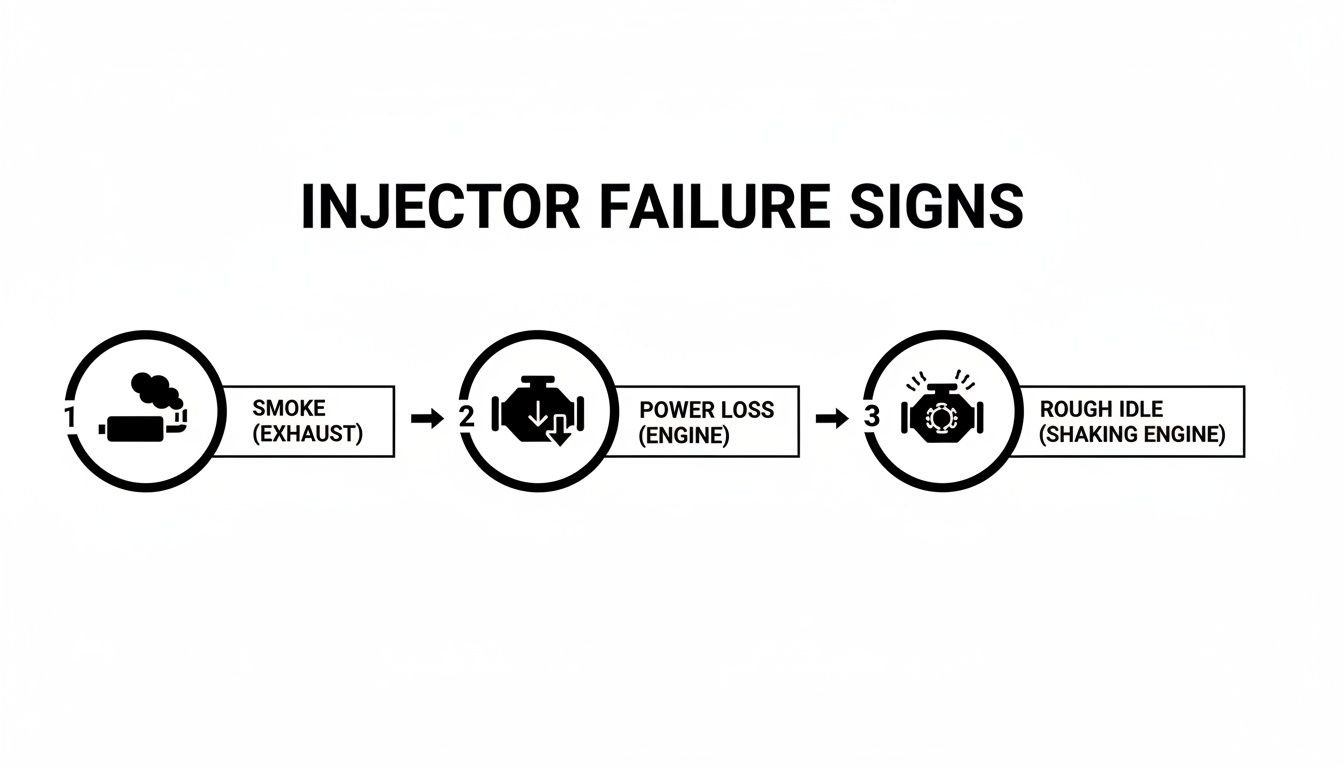
These signs are your engine's way of telling you that its fuel system is out of whack and needs a professional look.
The Art of Disassembly and Decontamination
With the performance data in hand, the teardown begins. This is where a steady hand and years of experience really count. A modern diesel injector is a complex little machine, packed with dozens of tiny, precision-made parts. A technician carefully disassembles the entire unit, laying out every single component for inspection—the nozzle, needle valve, delicate springs, solenoids, you name it.
Next, every one of those parts goes for a swim in a heated ultrasonic cleaning tank. This is far more than a solvent bath. We use high-frequency sound waves to create millions of microscopic bubbles that implode with incredible force, literally blasting away years of baked-on carbon and gunk from every last crevice. It’s a deep clean that reaches internal passages you could never get to with a brush, leaving us with a perfectly clean slate to rebuild from.
Microscopic Inspection and Component Replacement
After the ultrasonic bath, the real detective work begins. We put every single component under a high-powered microscope for a tough inspection. We’re not just looking for obvious cracks; we're hunting for microscopic wear on valve seats and nozzle tips—damage completely invisible to the naked eye. We measure wear down to the micron.
The heart of a professional rebuild is this simple rule: any part showing even the slightest sign of wear gets tossed. This is what separates a cheap "fix" from a genuine restoration.
We only use OEM-quality or better replacement parts. That means every rebuild gets a fresh set of:
- New Nozzles: Absolutely critical for achieving that perfect, atomized spray pattern.
- Seals and O-Rings: Essential for stopping both internal and external leaks.
- Internal Springs: These control timing and pressure, and they weaken over time.
- Filters and Pintle Caps: Small but vital parts that protect the injector from future contamination.
By replacing all the wearable items, the fuel injector rebuilding process doesn't just clean the component; it makes it new from the inside out.
Precision Reassembly and Final Calibration
Putting it all back together has to happen in a sterile, clean-room-like environment. The last thing you want is a microscopic piece of dust contaminating your freshly cleaned parts. Our technicians use specialized tools and follow the manufacturer's exact torque specs to make sure every component is seated perfectly. It’s like watchmaking—one tiny slip-up can throw the whole thing off.
The final, make-or-break stage is calibration. The rebuilt injector goes right back on the test bench for another round of grueling tests. This time, we’re fine-tuning it, adjusting flow rates and response times until its performance is a perfect match for the original factory blueprint. We finish with a detailed "after" report, giving you concrete proof that your rebuilt injector is performing just like a brand-new one. It’s this painstaking process that guarantees you get all your power, efficiency, and reliability back.
DIY Rebuilding Versus Professional Service
Let's be honest, the idea of rebuilding your own fuel injectors is tempting. You see the potential to sidestep some significant labor costs, and it feels like a job you can probably handle. But when we're talking about the high-pressure heart of a modern marine diesel, this isn't just a simple cost-benefit analysis—it's about managing enormous risk.
A botched injector rebuild isn't like hanging a picture crooked. A single mistake—a tiny speck of dirt, a spring that’s a fraction of a millimeter off, or a calibration that isn't perfect—can unleash absolute havoc inside your engine. We're talking about catastrophic failure: melted pistons, scored cylinder walls, or even a completely washed-out cylinder. Suddenly, that few hundred dollars you hoped to save turns into a five-figure engine replacement bill.
The Hard Truth About DIY Rebuilds
The single biggest roadblock for any weekend warrior is the equipment. Proper, professional-grade fuel injector rebuilding demands specialized, eye-wateringly expensive tools. This isn't stuff you'll find at the local auto parts store or even in a well-equipped mechanic's garage.
- Computerized Test Benches: A professional shop uses test benches that cost tens of thousands of dollars. They simulate real-world engine conditions, measuring fuel delivery down to the cubic millimeter and checking response times in microseconds. Without one, you're just guessing.
- Ultrasonic Cleaning Tanks: To get injectors truly clean, you need heated, high-frequency ultrasonic tanks. They blast away baked-on carbon from deep inside the injector—places no brush or solvent could ever hope to reach.
- Microscopic Inspection Tools: How do you spot a hairline fracture or microscopic wear on a nozzle tip? You can't, not without the high-powered magnification a pro uses.
- Precision Assembly Tools: Injectors have to be reassembled in a meticulously clean, dust-free environment using calibrated torque wrenches set to exact factory specifications.
Attempting a rebuild without this equipment is like trying to perform surgery with a pocketknife. You might get it apart, but you have no way to ensure it goes back together with the life-or-death precision required.
Why Professional Service Is an Investment in Peace of Mind
Choosing a certified professional isn't just another bill to pay. It's an investment in your boat's reliability, your safety on the water, and the long-term health of your engine. When you hire an expert, you're buying a guarantee that the job is done right the first time, backed by training, accountability, and a warranty.
This professional assurance is only becoming more important. The broader fuel injection market is already valued at USD 10.7 billion, and as manufacturers push into alternative fuels and next-gen systems, the technology gets more complex. You can see a full analysis of the alternative fuel injection systems market on gminsights.com to get a sense of where things are headed.
When you go with a pro, you get:
- Certified Technicians: You're getting an expert trained by manufacturers like MTU and MAN who lives and breathes the precise tolerances of your engine's fuel system.
- Warrantied Parts and Labor: If a professionally rebuilt injector fails, it's on them to make it right. If your DIY job goes south, you're on the hook for 100% of the cost of the collateral damage.
- Guaranteed Performance: The injectors are professionally cleaned, rebuilt, and calibrated to meet or exceed OEM specs. That means your engine’s power, efficiency, and reliability are restored to factory standards.
In the end, it boils down to a simple risk-versus-reward calculation. The few dollars you might save doing it yourself are dwarfed by the massive financial risk of a catastrophic engine failure. Investing in professional service protects your engine and gives you the confidence to enjoy your time on the water, not worry about whether a costly mistake is about to rear its ugly head. To put this in perspective, check out our guide on typical diesel engine repair costs.
Why On-Site Certified Service Is a Game Changer

If you own a yacht, you know the most valuable thing you have isn't the boat itself—it's your time on the water. Every day your vessel is laid up in a shipyard is a day you can't enjoy your investment. The old way of getting things fixed often means dealing with the logistical headache of a haul-out, then leaving your boat in a yard for weeks. It turns a relatively straightforward job like fuel injector rebuilding into a massive disruption.
This traditional repair model isn't just a hassle; it's expensive. You're the one paying for haul-out fees, daily yard costs, and all the overhead of a big facility. Thankfully, there’s a much smarter, modern alternative that completely flips the script on marine diesel service.
Bringing the Workshop to Your Watercraft
What if you could skip the shipyard queue entirely? That’s exactly what mobile, on-site service does. We bring the expert technician and all the specialized equipment right to your slip. This completely changes the repair experience by eliminating the biggest frustrations boat owners face.
Instead of trying to coordinate haul-outs and transport, you just make a single phone call. A certified expert shows up where you are, runs the diagnostics, pulls the bad injectors, and can often handle the entire fuel injector rebuilding service without your boat ever leaving its dock.
The biggest win with on-site service is how much downtime it cuts. A job that might take weeks at a traditional yard can often be wrapped up in just a few days. You get back on the water faster than you ever thought possible.
This efficiency doesn't just save you time. By cutting out the middleman and the huge overhead of a brick-and-mortar shipyard, mobile service offers some serious cost savings. The money you'd normally burn on a haul-out and yard fees can go directly into quality parts and expert labor where it belongs.
The Power of a Factory Certification
When a technician steps aboard your yacht, their qualifications are everything. The term "factory-certified" isn’t just marketing fluff; it's your guarantee of quality, deep expertise, and accountability. It means the technician has been trained by the very people who built your engine, whether it’s MTU, MAN, or CAT.
This certification gives you several critical advantages:
- Manufacturer-Approved Procedures: They know how to follow the exact, up-to-date service protocols from the factory, so you know the work is done right the first time.
- Specialized Diagnostic Tools: They come equipped with the same proprietary software and diagnostic tools the manufacturer uses to pinpoint problems with dead-on accuracy.
- Warranty Protection: Using a certified technician is often a requirement to keep your engine's warranty valid.
This level of expertise is more important than ever. Modern diesel engines are built for incredible fuel efficiency and strict emissions compliance, and the injectors are at the heart of making that happen. Professional fuel injector rebuilding is all about restoring that precision, which is essential for perfect combustion and meeting maritime emissions standards.
Choosing certified professionals for on-site diesel marine repair isn't just about making your life easier. It's a strategic move to protect your investment, demand peak performance from your engines, and maximize every single moment you get to spend out on the water. It’s simply the smarter way to handle marine engine maintenance.
Your Top Fuel Injector Questions, Answered
When it comes to marine diesel engines, fuel injectors can feel like a bit of a black box. But they don't have to be. Let's pull back the curtain and tackle the most common questions we hear from yacht owners. Getting clear, straightforward answers will help you make smarter, more confident decisions for your vessel.
How Often Should I Have My Marine Fuel Injectors Rebuilt?
There’s no magic number that fits every engine. The right service interval really depends on your engine manufacturer's recommendations, your total operating hours, and even the quality of the fuel you’re running.
That said, a good rule of thumb is to have your injectors professionally tested every 2,000 to 4,000 hours. Think of this as preventative medicine for your engine. You wouldn't wait for a heart attack to see a doctor, right? Regular testing lets a technician spot declining performance long before you feel it, allowing for a rebuild before a failing injector can cause catastrophic damage to pistons or cylinder walls.
Of course, sometimes your engine will tell you exactly what it needs. If you start seeing excessive black smoke, feeling a loss of power, or hearing a rough, shaky idle, don't wait. Those are clear distress signals that it's time for an immediate inspection.
What’s the Typical Cost and Turnaround Time?
This is where rebuilding really shines. Choosing to rebuild your existing injectors instead of buying new ones can save you a staggering 50% to 70%. It's one of the smartest financial decisions you can make for your vessel, giving you factory-fresh performance without the brand-new price tag.
The exact cost will hinge on your specific engine and injector model, but the value is always there.
The real game-changer, especially for yacht owners, is the turnaround time offered by a mobile service. Technicians can come directly to your vessel, remove the injectors, perform the rebuild, and reinstall them, often in a matter of days. This efficiency drastically minimizes your vessel's downtime, getting you back on the water far sooner than a traditional shipyard ever could.
Will Rebuilt Injectors Perform as Well as New Ones?
Absolutely. This is a critical point that’s often misunderstood. When a certified technician rebuilds an injector with high-quality, OEM-spec parts, it’s not just a patch-up job—it's a full restoration to factory standards.
The process is incredibly precise. After a complete teardown, ultrasonic cleaning, and replacement of every worn component, each injector is mounted on a computerized test bench. This machine puts the injector through its paces, simulating real-world engine conditions to dial in fuel delivery, spray pattern, and response time until they perfectly match the manufacturer's original blueprint. You even get a detailed report showing the "before and after" data as proof.
The result? An injector that delivers the power, fuel efficiency, and reliability you’d expect from a brand-new part, straight out of the box.
Can Bad Fuel Wreck My Injectors?
Without a doubt. Contaminated fuel is public enemy number one for fuel injectors. These are precision instruments with tolerances measured in microns, and they don't play well with impurities. The usual suspects are:
- Water Contamination: Even a little water in your diesel can kickstart microbial growth (the dreaded "diesel bug") and cause corrosion on delicate internal parts.
- Debris and Sediment: Tiny particles of dirt, rust, or sand will clog the nozzle holes, which are often finer than a human hair. This messes up the spray pattern and can cause the injector to stick open or shut.
- Poor Lubricity: Modern ultra-low sulfur diesel doesn't have the natural lubricating properties of older fuels, which can lead to accelerated wear and tear on moving parts inside the injector.
Your best line of defense is good fuel hygiene. Always buy fuel from trusted sources, stick to a strict filter-change schedule, and think about using a quality biocide additive to keep microbial growth at bay.
Your vessel deserves expert care from technicians who understand the demands of the marine environment. The team at GTM International provides mobile, factory-certified fuel injector rebuilding and diesel engine services directly at your dock. Don't let engine troubles keep you ashore—get the professional, on-site support you need by visiting GTM Marine Technologies to schedule your service today.
