
When it comes to your yacht, that steady, reassuring hum from the engine room is the sound of freedom. It's the sound of a vessel ready to take you wherever you want to go. But that reliability isn't just luck—it’s the direct result of a smart, proactive diesel engine maintenance schedule.
Too many owners fall into the "fix-it-when-it-breaks" trap. That's not just a bad habit; it's a high-stakes gamble with your most critical asset. Thinking of maintenance as a chore misses the point entirely. It's your best insurance policy against a trip gone wrong.
Why a Proactive Maintenance Schedule Is Your Best Insurance
Think of it this way: what would you rather deal with? A simple, inexpensive belt replacement caught during a routine check in the comfort of your home port? Or a total engine shutdown, miles from shore, with rough seas building? A proactive schedule is all about catching those small issues before they snowball into catastrophic, trip-ending failures.
This isn't just about avoiding disaster, either. It’s about performance and protecting the very heart of your vessel.
The True Cost of Neglect
Putting off service to "save a few bucks" is one of the most expensive mistakes you can make. It’s a classic case of being penny-wise and pound-foolish. A neglected engine doesn't just run poorly; it actively works against you. It guzzles more fuel, chokes out higher emissions, and grinds down its own internal components at an alarming rate.
The payoff for staying on top of your maintenance is huge and immediate:
- Better Fuel Efficiency: An engine that's properly tuned and serviced simply burns less fuel. It operates at its peak, saving you real money every hour you're underway.
- Higher Resale Value: Nothing tells a potential buyer you’ve cared for your yacht like a thick, detailed service log. It's concrete proof of your investment and one of the strongest negotiating tools you can have.
- More Time on the Water: This is the big one. Proactive care means you spend your time cruising and enjoying your boat, not tied to the dock waiting for a mechanic to fix something that never should have broken in the first place.
A well-maintained marine diesel doesn't just run better—it gives you the confidence and peace of mind you need for every single voyage. It’s an investment in reliability that pays you back every time you cast off the lines.
Ultimately, your diesel engine maintenance schedule is the roadmap. It’s the definitive guide to keeping your engine ready for anything the sea throws at it. From the quick daily once-over to the comprehensive annual service, every check is a vital part of protecting your yacht and ensuring every journey is a safe one.
Decoding Your Engine Maintenance Intervals
Knowing what your engine needs—and more importantly, when it needs it—is the single most important part of a smart diesel maintenance plan. This isn't about blindly following a generic checklist; it's about getting in sync with the rhythm of your engine's specific demands. Think of it as a personalized fitness regimen for your yacht's powerhouse, where every check-up and service builds on the last to keep it in peak fighting form.
This is how you move from just ticking boxes to acting with real confidence. From the quick, daily fluid checks that are like a morning pulse reading, all the way to the deep seasonal preps that brace your engine for a busy season, every single action has a clear purpose. Let's break down these service requirements into straightforward, time-based intervals so you can master your engine's care from the inside out.
The journey from reactive, hope-for-the-best maintenance to a proactive, confidence-driven strategy is a big one. It's the difference between crossing your fingers and knowing you're ready for anything.
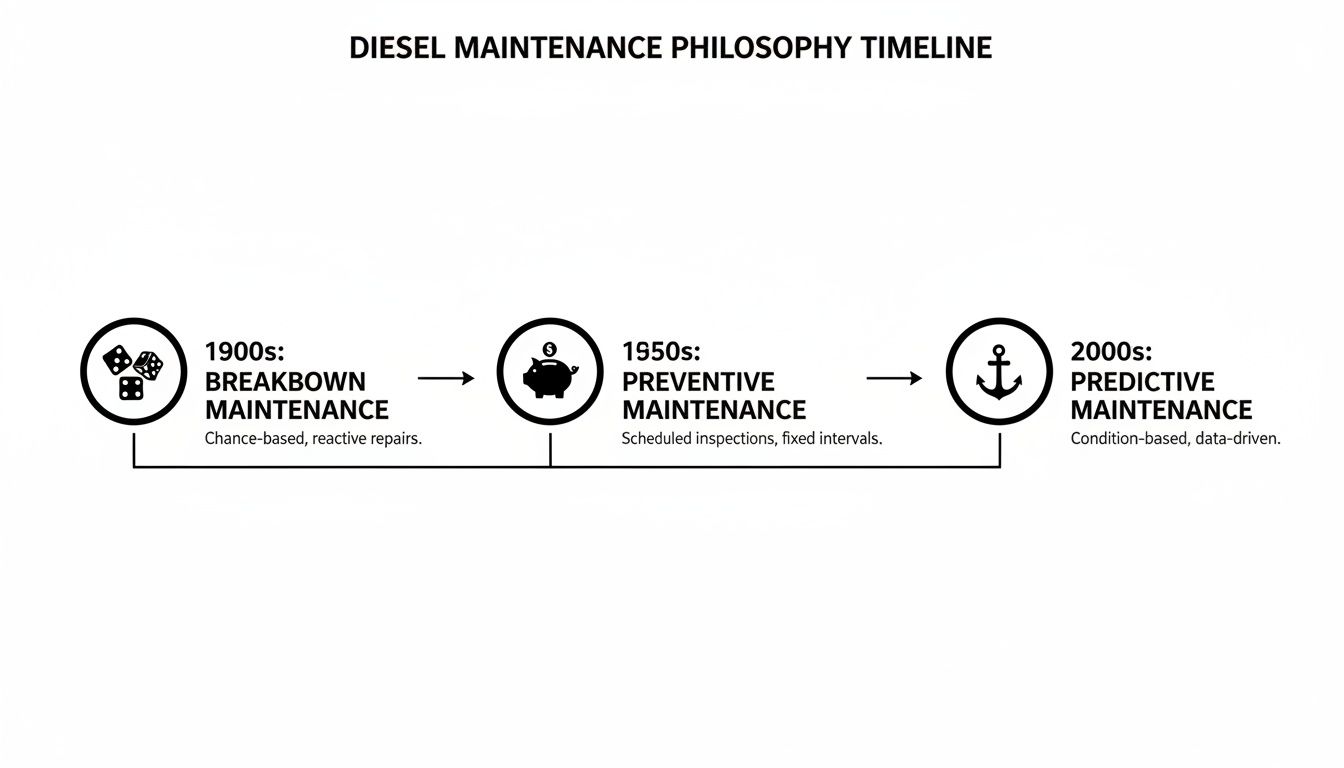
As you can see, investing in a consistent schedule completely changes the game. It swaps the costly uncertainty of a sudden breakdown for the quiet assurance that your engines are ready to perform when you are.
Time-Based vs. Usage-Based Schedules
Your engine’s maintenance calendar isn’t carved in stone. It’s a living document shaped by two critical factors: time and usage (engine hours). While certain tasks, like checking for fuel degradation or coolant effectiveness, are tied to the calendar, most of the heavy lifting is dictated by how much you actually run your engines.
Manufacturers like MTU, MAN, and CAT lay out detailed service schedules based on operating hours. A primary fuel filter change, for instance, might be recommended every 250 hours. If you’re a weekend cruiser, that could mean once a season. But for a hard-working charter yacht, that might be every couple of months. The golden rule is simple: follow whichever interval comes first—time or hours.
A common and costly mistake is ignoring a time-based recommendation just because the engine hours are low. Gaskets and seals can dry out, and vital fluids lose their protective properties even when an engine is sitting idle at the dock.
This dual approach ensures your engine gets the right care, whether it's constantly underway or laid up for an extended period. Getting familiar with the specific needs of your model, like those we cover in our guide to Volvo Penta marine diesel engines, is the key to tailoring your schedule perfectly.
The Financial Case for Proactive Maintenance
Sticking to a structured schedule isn't just about reliability—it's one of the smartest financial decisions you can make as a yacht owner. The data doesn't lie: preventive maintenance for diesel engines is proven to cut breakdown-related costs by up to 50% compared to a reactive, "fix-it-when-it-breaks" approach. For owners here in South Florida, that translates to thousands of dollars saved over the life of an engine.
This is exactly why we built GTM International’s mobile 24-hour services to slot right into your maintenance schedule. We bring the workshop to your slip, ensuring these crucial inspections and services happen on your terms, eliminating the logistical nightmare and expense of a haul-out. Whether it's monthly safety checks, quarterly ECM downloads, or in-depth annual inspections, we handle it right at your vessel’s location.
Your At-A-Glance Diesel Maintenance Timetable
While your manufacturer's service manual is always the final word, a general timetable gives you a powerful framework to plan and budget for your engine’s needs. It helps you see what's coming so there are no surprises.
Here is a simplified checklist that breaks down the essential tasks across the most common service intervals.
| Interval | Key Maintenance Tasks | Purpose |
|---|---|---|
| Daily (Before Departure) | Check oil & coolant levels, visually inspect for leaks, check bilge, glance at sea strainers | A quick "health check" to catch obvious problems before leaving the dock. |
| Weekly (or every 50 hours) | Clean sea strainers, inspect belts & hoses for wear/tension, test alarm systems | Prevent overheating and ensure critical warning systems are functioning correctly. |
| Monthly (or every 100 hours) | Clean battery terminals, inspect zinc anodes, check raw water pump impeller | Address corrosion, protect underwater metals, and ensure proper cooling system flow. |
| Annually (or every 250-500 hrs) | Change engine oil & filters, replace fuel filters, service heat exchangers, inspect exhaust | The comprehensive "deep clean" that resets the clock and prepares the engine for another year. |
This table is your starting point. By understanding the "why" behind each task in your maintenance schedule, you transform a chore into a strategy—a powerful way to guarantee safety, peak performance, and total peace of mind every time you head out on the water.
Mastering the Annual Overhaul and Long-Term Care
Daily checks and monthly inspections are the steady, reassuring drumbeat of a healthy vessel. But the annual overhaul? That’s the main event. This is, without a doubt, the single most important service on your diesel engine maintenance schedule. It’s where we move past the quick look-overs and get our hands dirty to secure your engine's long-term health, performance, and legendary durability.
Think of it as the engine's most thorough physical exam. If a daily check is like taking your temperature, the annual service is the full battery of tests—the blood work, the stress test, and the specialist consultations all rolled into one. This isn't just about swapping out fluids; it’s a deep diagnostic mission aimed at catching major failures before they ever get a chance to start.
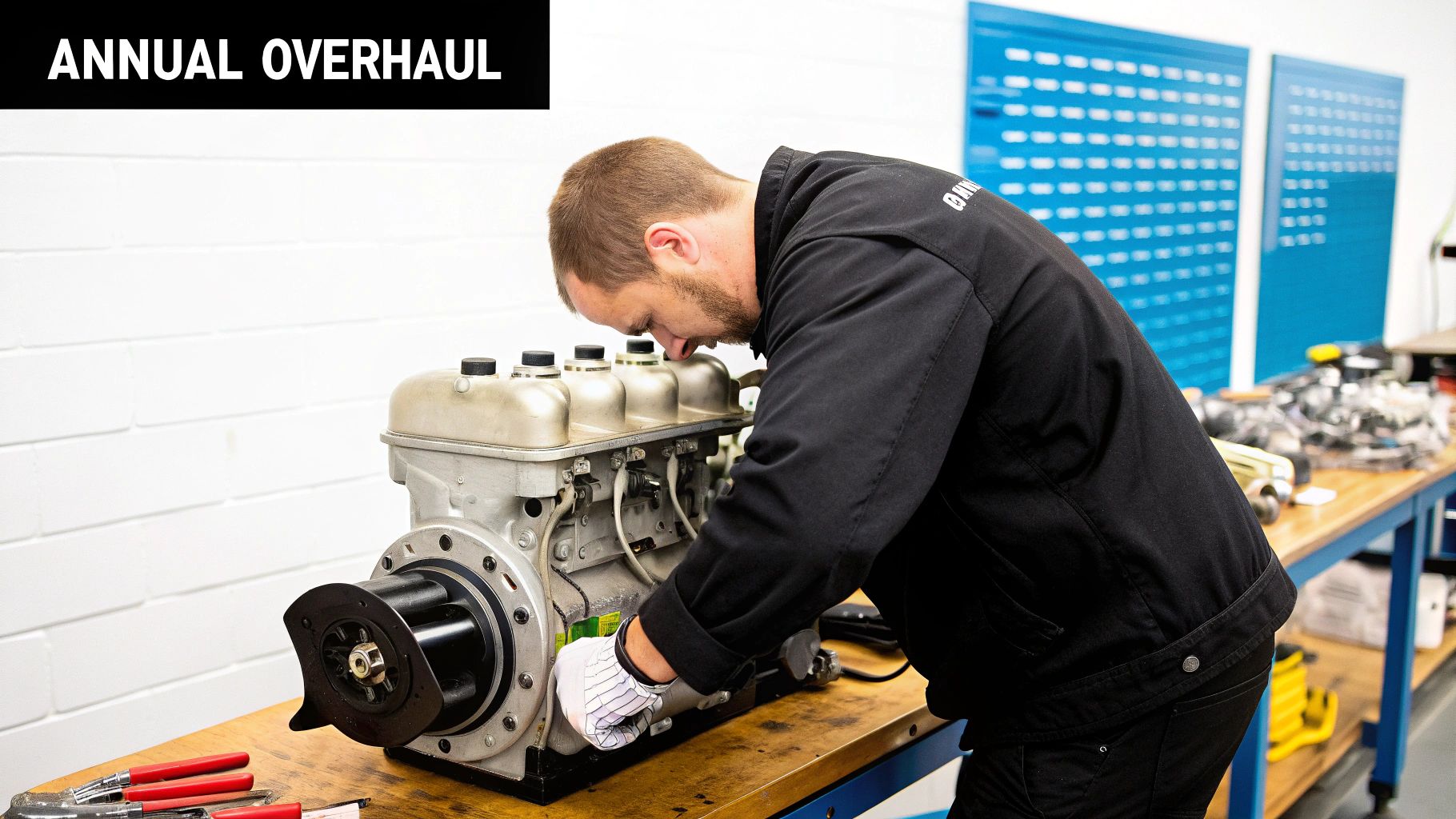
This is the kind of meticulous care that unlocks the incredible longevity marine diesels are famous for. When treated right, these engines are built to last. It’s not uncommon for well-maintained diesel engines to hit 300,000 to 500,000 miles, and some commercial workhorses have even pushed past the 1,000,000-mile mark, leaving their gasoline cousins in the dust.
Key Components of a Comprehensive Annual Service
An annual overhaul is a systematic, top-to-bottom process that touches every critical system. It’s worlds away from a simple oil change and filter swap. The good news is, our mobile teams at GTM International come prepared to handle these intensive tasks right at your slip, saving you the headache and cost of a haul-out.
Here’s a snapshot of what’s involved:
- Cooling System Flush and Service: Over time, coolant loses its protective qualities and can turn acidic, which spells trouble for the inside of your engine. A complete flush gets rid of the old, contaminated fluid, and we replace it with fresh coolant and conditioners to guard against corrosion.
- Heat Exchanger and Aftercooler Servicing: These are essentially your engine's radiators. We take them apart, clean them thoroughly, and pressure-test them to make sure they’re clear of the salt, scale, and marine growth that choke off cooling flow and cause overheating under load.
- Turbocharger Inspection: The turbo is a high-precision beast, spinning at incredible speeds. We check for any wobble in the shaft, look for tell-tale signs of oil leaks, and inspect the turbine blades for damage—all early warnings of a failure that could send metal fragments flying through your engine.
The annual overhaul is an investment, not an expense. It's the difference between controlling your maintenance costs on your own terms and having a catastrophic failure dictate them for you, often at the worst possible time.
Beyond the Basics: Engine Alignment and Injector Health
Two critical areas often get overlooked in long-term care: engine alignment and fuel injector performance. Even a slight misalignment puts a massive strain on your transmission, cutlass bearings, and engine mounts, causing nasty vibrations and accelerating wear. During an annual service, we put a straight edge on it and verify the alignment is perfect for smooth power delivery.
Fuel injectors are just as vital. When they get clogged or start to fail, fuel doesn't atomize correctly. This leads to lost power, more smoke, and can even cause serious internal engine damage. We inspect and test them to ensure they’re spraying the precise fuel pattern your engine needs for clean, efficient combustion. Getting these details right is crucial, and our guide on what's included in a comprehensive diesel engine overhaul dives even deeper into this process.
Protecting Your Investment and Preserving Value
At the end of the day, a documented history of annual overhauls is one of the best things you can have for your yacht. It’s hard proof of meticulous care, a huge plus when it comes to preserving resale value. More importantly, it gives you the peace of mind that your engine is ready to perform safely and reliably, whenever you ask it to.
When you stick to a professional diesel engine maintenance schedule, you’re doing more than just servicing a machine. You're safeguarding your adventures. You’re ensuring the heart of your vessel is ready to carry you to the horizon and back again, season after season.
How to Recognize Early Warning Signs of Engine Trouble
Forget the scheduled maintenance checklist for a moment. Your own eyes, ears, and even your nose are the most powerful diagnostic tools you have. A diesel engine almost never fails without giving you a heads-up first. It speaks its own language through subtle sounds, strange smells, and visual cues. Learning to interpret these signals is like understanding a distress call—it gives you the power to act before a small problem becomes a trip-ending catastrophe.
Think of yourself as the engine's primary doctor. You’re with it every day, so you're the first one who will notice when something just feels… off. This constant, low-level awareness is a vital part of any real-world diesel engine maintenance schedule. It’s what turns a potential disaster into a manageable repair, and it’s often the difference between a simple fix and a six-figure overhaul.
What Is That Smoke Telling You?
The smoke coming from your exhaust is one of the most direct messages your engine can send about its internal health. Changes in its color or thickness are never something to ignore. Each hue tells a very specific story about what’s going on inside the combustion chamber.
- Black Smoke: This is the most common signal and almost always points to a fuel issue. It means you have too much fuel or not enough air, causing a dirty, incomplete burn. Think of a fireplace with a blocked flue—all soot, no clean flame. The culprit could be anything from a clogged air filter to faulty injectors or a turbo problem.
- Blue Smoke: If you spot a bluish-gray haze, your engine is burning oil. This is a more serious sign, telling you that oil is seeping past worn-out piston rings or valve seals and getting into the combustion chamber. It’s an undeniable symptom of internal engine wear that needs a professional diagnosis, and soon.
- White Smoke: Thick, billowing white smoke, especially if it has a sweet smell, is a classic sign of a coolant leak. A blown head gasket or a cracked cylinder head could be letting coolant into the cylinders, where it turns to steam. This is a five-alarm fire—a critical problem that can cause catastrophic engine damage if you don’t shut it down.
The Symphony of Sounds You Don’t Want to Hear
A healthy diesel has a deep, rhythmic hum—a sound of pure power. When that rhythm changes, you need to listen closely. New or unusual noises are almost always a mechanical cry for help.
A sudden knocking or pinging, for instance, can signal a serious issue with fuel detonation or failing internal parts like bearings. A high-pitched squeal often points to a slipping belt that drives critical systems like your alternator or raw water pump. And that awful grinding noise? That could be a failing water pump or another component with bearings that have given up the ghost.
Never write off a new engine noise. Your engine is a finely tuned machine, and any sound that breaks from its normal operating hum is an alarm bell that demands immediate investigation.
These audible warnings are your engine's way of telling you exactly where the pain is. This is precisely why GTM International’s 24-hour mobile service exists. When you hear something that isn't right, our technicians can be on-site fast to trace the sound to its source and stop the damage before it gets worse.
Translating Engine Symptoms into Actionable Insights
Spotting the signs is only half the battle; knowing how to react is what truly matters. Every symptom is a clue, and your response determines the final outcome. The table below is a quick diagnostic guide to help you connect common warning signs to their likely causes and decide on the best course of action.
| Symptom | What It Could Mean | Recommended Action |
|---|---|---|
| Sudden Loss of Power | Clogged fuel filters, an air leak in the fuel system, or a turbocharger problem. | Check fuel filters first. If the problem persists, schedule a diagnostic service immediately. |
| Engine Overheating | A clogged sea strainer, a failing raw water pump impeller, or low coolant levels. | Shut down the engine safely. Check strainers and coolant levels once cool. |
| Excessive Vibration | A fouled propeller, engine misalignment, or a problem with an engine mount. | Visually inspect the propeller for debris. Have a professional check engine alignment and mounts. |
| Sheen on the Water | A leak from fuel, oil, or hydraulic lines. | Immediately identify the source of the leak. Tighten fittings or replace hoses as needed. |
Understanding these connections empowers you to make the right call, whether it’s a quick on-the-spot fix or bringing in a certified mechanic to head off a major failure.
Using Logbooks and Modern Diagnostics for Peak Performance
In today's world of yachting, being smart with data is just as important as the fuel in your tanks. Waiting for something to break is a thing of the past. The real key to reliability comes from combining the old-school discipline of a detailed logbook with the powerful insights from modern diagnostics.
Think of your engine logbook as its personal diary or medical chart. It's more than just a place to jot down dates and hours. Every note on fuel burn, every oil pressure reading, and every little observation you make builds a complete history. This baseline becomes your single most important tool when you're trying to figure out what’s wrong down the line.

This kind of detailed record-keeping is also your best defense for preserving warranties and can seriously boost your yacht’s resale value. Nothing says "well-cared-for" like a comprehensive service history.
The Power of the Engine Logbook
A good logbook takes the guesswork out of maintenance. Instead of just feeling like the engine "sounds a little different," you can flip back and see that the oil pressure has actually dropped by 2 PSI over the last 50 hours at cruising speed. That’s how you turn a vague worry into a concrete, actionable problem.
A great logbook doesn't just record what was done; it documents how the engine responded. This narrative is the key to identifying subtle performance degradation long before it becomes an audible or visible problem.
So, what should you be writing down? Make sure you're consistently tracking:
- Engine Hours: The heartbeat of your entire diesel engine maintenance schedule.
- Fluid Levels: Keep a note of any oil or coolant you add between scheduled changes.
- Temperatures and Pressures: Record these at a consistent RPM to build a reliable baseline.
- Fuel Added: This helps you track consumption and spot any sudden inefficiencies.
- Observations: Any new sounds, strange vibrations, or a change in the exhaust smoke? Write it down.
The Digital Revolution in Engine Diagnostics
While a paper log gives you the history, modern diagnostic tools and telematics give you a live, real-time look into your engine's soul. These systems are completely changing the game, moving us from a world of scheduled maintenance to one of data-driven, predictive care. It’s a natural evolution for an industry where reliability is everything.
The global diesel engine market is massive—valued at $567 billion—and it continues to dominate demanding fields like the marine industry because of this constant push for better technology. With telematics, we can monitor live data, fine-tune service intervals, and prevent surprise failures with incredible accuracy. To get a bigger picture of where this is all headed, you can discover the full industry analysis on freedoniagroup.com.
Predictive Maintenance: The GTM Advantage
This is where the GTM International approach really makes a difference. Our technicians show up with more than just a toolbox; they arrive with advanced diagnostic equipment that plugs right into your engine’s Electronic Control Module (ECM). We don’t guess, we analyze.
Here’s what that lets us do:
- Download Fault Codes: We can pull a complete history of every alert the engine has ever thrown, even the intermittent ones you might have missed.
- Monitor Live Data: We watch how things like injector performance and turbo boost pressure behave under real-world load, not just at the dock.
- Identify Trends: By comparing today’s data with past reports, we can spot a component that’s starting to drift out of spec and flag it for service long before it fails.
This combination of old-school record-keeping and new-school diagnostics is the future of yacht engine management. It delivers unmatched peace of mind and gives you the confidence to point the bow toward the horizon and go.
Achieving True Peace of Mind at Sea
At the end of the day, a well-executed diesel engine maintenance schedule gives you something far more valuable than a reliable boat—it delivers genuine peace of mind. Every single voyage, from a short run along the coast to an ambitious offshore passage, depends entirely on the heart of your yacht beating strong. This guide has laid out the roadmap, from quick daily checks to the big annual overhaul, all built on one powerful idea.
Unwavering reliability at sea isn't about luck. It's earned through consistent, deliberate, and expert care.
Your Investment in Confidence
When you commit to a proactive maintenance philosophy, you fundamentally change your relationship with your vessel. You're no longer just servicing a piece of machinery; you're investing in the safety of your guests, the long-term value of your asset, and the pure, unburdened joy of every trip you take.
Each checklist you complete and every service hour you log builds a foundation of confidence you can feel the moment you cast off the lines.
This approach also makes incredible financial sense. By catching small issues before they snowball, you sidestep the often-shocking costs tied to major failures. A quick look at potential diesel engine repair costs makes the value of staying ahead of problems crystal clear.
The goal is simple: control your maintenance on your own terms, in your home port, rather than letting a sudden breakdown dictate the time, place, and price of a repair at sea.
Take Command of Your Vessel’s Health
The final takeaway is clear: don't leave your voyage to chance. Your command over the vessel starts in the engine room, long before you ever lay a hand on the helm. When you take ownership of your engine’s health, you turn uncertainty into assurance.
You ensure that the deep, steady hum of your diesel becomes a sound of freedom and adventure, not a source of constant worry. Sail with the profound confidence that comes from knowing you haven't just hoped for the best—you've prepared for it. With a solid plan in place and an expert partner like GTM International in your corner, you are truly ready for anything the sea throws your way.
A Few Common Questions We Hear
Even with the best checklist in hand, questions always pop up. It's only natural. Your yacht's diesel engine is a complex piece of machinery, and you want to be sure you’re making the right calls. Let's tackle some of the most frequent questions we get from owners here in South Florida.
We want you to feel completely confident about your engine's health, so here are some straight answers based on decades of experience.
Can I Stretch My Service Intervals Just a Little Bit?
Look, we get it. It's tempting to push that oil change another 50 hours or let a filter ride a bit longer to finish out a trip. But this is one area where you really don't want to roll the dice.
Engine manufacturers spend millions on research to determine those service intervals. They're not just arbitrary suggestions; they're calculated to protect critical, and very expensive, internal components from premature wear. Pushing past those limits can easily accelerate damage and could even give the manufacturer a reason to deny a warranty claim.
The golden rule is simple: stick to the schedule. Whichever comes first—running hours or the calendar—is the one you follow. It’s the single best way to keep fluids from breaking down and components from aging too quickly.
What's the Single Most Neglected Maintenance Item?
Hands down, it’s the raw water cooling system. We see it all the time. Owners are diligent about oil changes and fuel filters but completely forget about the heat exchangers and aftercoolers.
A clogged cooler won't just make the engine run a little warm; it can lead to catastrophic overheating when you need power the most. The damage from a serious overheat is far more devastating (and expensive) than what a little dirty oil might cause. In our warm saltwater environment, annual servicing of your coolers isn't just a good idea—it's absolutely critical for engine survival.
My Yacht Sits for Long Stretches. How Often Should I Run the Engines?
If your boat doesn't see much action, you absolutely need to fire up the engines at least once a month. Don't just start them and shut them down, either. You need to let them run long enough to reach full operating temperature and stay there for a good 30-45 minutes.
This isn't just about making noise. This simple monthly routine is a powerful preventative measure. It does three crucial things:
- Drives Out Moisture: It cooks off the condensation that builds up in the engine and exhaust, which is a major source of corrosion.
- Keeps Things Lubricated: It circulates fresh oil over every internal part, preventing rust and keeping vital seals from drying out and cracking.
- Tops Off the Batteries: It gives the alternators time to properly charge your starting batteries, ensuring they're ready to crank when you are.
Making this part of your diesel engine maintenance schedule is one of the smartest things you can do to combat the slow, silent damage that occurs when a powerful machine is left sitting.
Your engine is the heart of your vessel and your investment. Don’t leave its health to guesswork. GTM International brings certified, 24-hour mobile diesel engine services right to your dock, so you get expert care without the headache. Schedule your next service with us today.
