

When you talk about legendary diesel engines, the Detroit Diesel Series 60 is always part of the conversation. This heavy-duty workhorse earned its reputation the old-fashioned way: through incredible fuel efficiency, bulletproof reliability, and an almost unbelievable lifespan.
It wasn't just another engine; it was a game-changer. The Series 60 was one of the very first to come standard with fully integrated electronic controls, completely redrawing the map for performance and durability. That benchmark it set decades ago? It still holds up today.
How the Series 60 Became a Legend
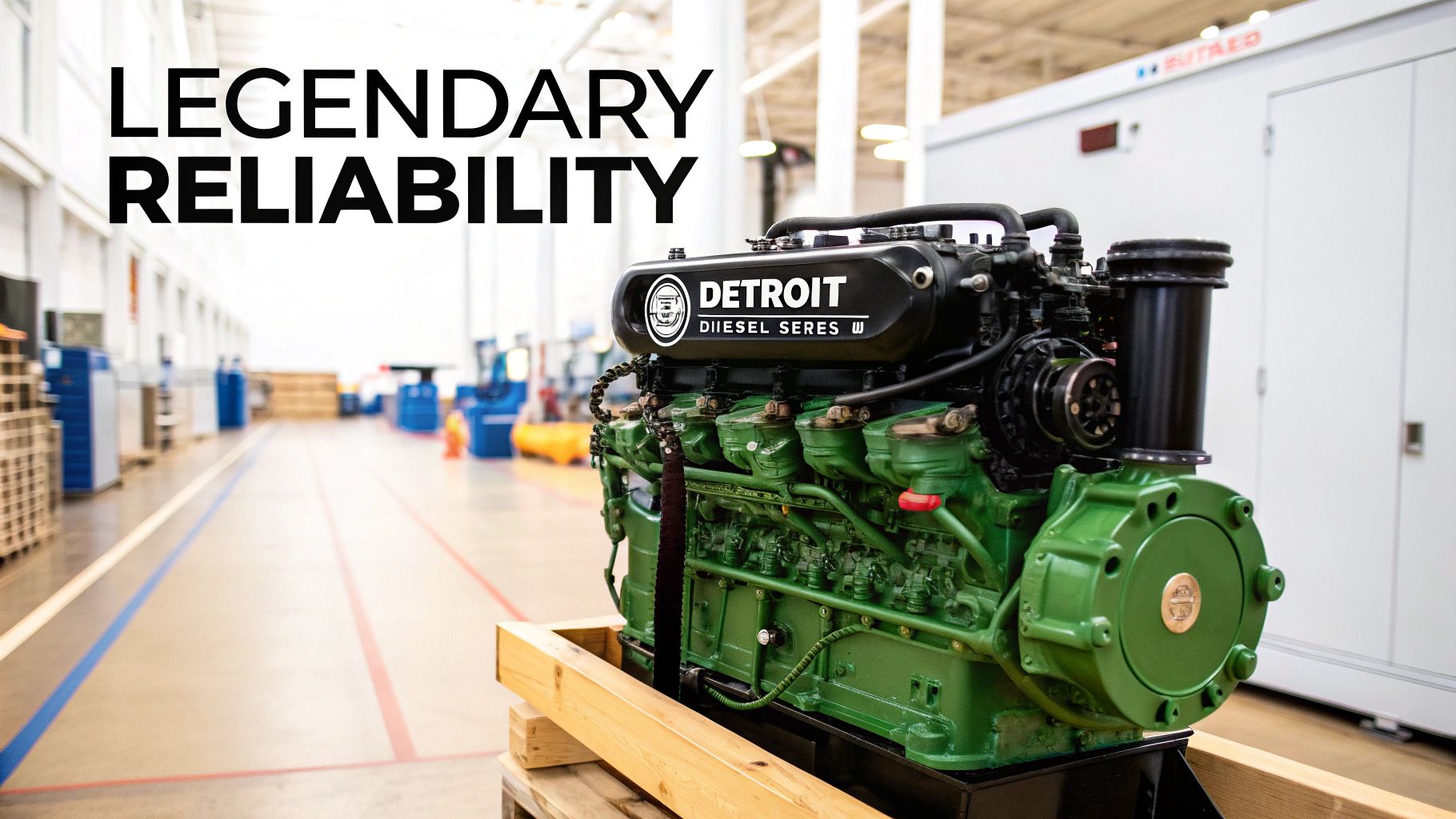
Let's be clear: this engine didn't just follow the rules of the industry—it wrote them. If you're an owner, you already know this isn't just a lump of iron. It's the beating heart of your vessel here in South Florida, the powerhouse you depend on. The Series 60 has been the gold standard for a reason, and that reputation was forged in the real world, not on a spec sheet.
The secret to its success was smart, forward-thinking design. It was among the first production engines to feature an overhead camshaft paired with fully electronic controls, a system called DDEC (Detroit Diesel Electronic Controls). You can think of DDEC as the engine's central nervous system, constantly optimizing fuel injection and timing with digital precision. This was a quantum leap beyond the purely mechanical engines that came before it.
What Made It So Good?
For owners and operators, the benefits weren't theoretical. They were felt immediately, impacting everything from fuel budgets to peace of mind on the water.
- Unbeatable Fuel Economy: The DDEC system fine-tuned the combustion process so precisely that it could wring every last bit of energy from each drop of fuel. It set a new standard for miles per gallon.
- Built to Go the Distance: These engines were engineered for the long haul. With a tough-as-nails inline-six design and high-quality components, reaching one million miles before a major overhaul wasn't just possible—it was expected.
- Easy to Work On: Despite its sophisticated electronics, the Series 60 was designed for the real world of maintenance. Mechanics appreciated its logical layout, which made routine service and troubleshooting far less of a headache than many competitors.
This blend of cutting-edge efficiency, old-school durability, and practical serviceability is what cements the Series 60's legacy. It proved an engine could be both smart and incredibly tough.
This guide is your complete owner's manual. We'll cover everything from its history to the nuts and bolts of maintenance, giving you the knowledge to keep your Series 60 running at its peak for years to come.
The Story of an Industry Legend: The Detroit Diesel Series 60
To really get a feel for the Series 60, you have to picture what the heavy-duty engine world was like back in the late 1980s. It was a pressure cooker. Fuel prices were a constant headache, and a new wave of emissions rules was forcing every manufacturer back to the drawing board. The old ways of building purely mechanical engines just weren't going to cut it anymore.
This is the world the Series 60 was born into. A joint venture between Penske Corporation and General Motors saw the writing on the wall. They decided against just updating an old design and instead took a massive risk: they started with a completely blank sheet of paper. The goal wasn't just to meet the new standards, but to build an engine for the future.
That gamble paid off in a big way. The Series 60 wasn't a small step forward; it was a giant leap that left everything else in the dust.
A New Era: The Brains Behind the Brawn
The single biggest game-changer in the Series 60 was its electronic brain: the Detroit Diesel Electronic Controls (DDEC) system. This wasn't some tacked-on feature—it was the heart and soul of the engine. While competitors were still relying on clunky mechanical governors and fuel pumps, the Series 60 was the first production engine with fully integrated computer controls.
Think of it as the difference between an old carbureted motor and a modern fuel-injected powerhouse. The DDEC system was the central command, constantly reading dozens of inputs—engine speed, load, air temperature, you name it—and making thousands of micro-adjustments every second. It gave the engine pinpoint control over the fuel injectors, optimizing timing and fuel delivery for every single power stroke.
This was 'drive-by-wire' tech decades ahead of its time. For operators, the results were immediate and obvious:
- Unbeatable Fuel Economy: DDEC took the guesswork out of fueling, squeezing every last drop of power from the diesel. It set a new benchmark for efficiency that competitors scrambled to match.
- Smooth, Consistent Power: By perfecting the combustion cycle, the engine delivered reliable torque and horsepower exactly when you needed it.
- Smarter Diagnostics: For the first time ever, a mechanic could simply plug a computer into the engine and get a full health report. This slashed troubleshooting time from days to hours.
The picture below shows the legendary Series 60 12.7L, the workhorse that built a dynasty.
You can see its classic inline-six design, a layout prized for its inherent balance, smooth operation, and easy service access.
Built to Last, Designed to Evolve
The Series 60 wasn't just a flash in the pan. Detroit Diesel built it as a platform for constant improvement. The original 1987 launch with the 11.1L and 12.7L models was just the start. They later rolled out the mighty 14L variant to handle even tougher jobs, always refining and upgrading the DDEC system along the way.
The engine quickly earned a reputation for being borderline indestructible. The first recommended overhaul interval was already an impressive 500,000 miles. But as these engines spent years on the road and on the water, real-world experience proved they were even tougher. Detroit Diesel eventually pushed that number to an incredible 750,000 miles. That kind of longevity comes from smart, robust engineering coupled with the protective oversight of the DDEC system.
The Detroit Diesel Series 60, launched in 1987, was the first production engine with fully integrated electronic controls and an overhead camshaft, fundamentally changing heavy-duty diesel technology. This design addressed urgent industry needs for better fuel efficiency and lower emissions, and by 1993, its market success was undeniable, generating over $80 million in revenue for Detroit Diesel. You can explore its groundbreaking history and impact on its Wikipedia page.
The table below charts the engine's journey from a bold idea to an industry icon.
Key Milestones in Series 60 History
This table highlights the major developments and achievements in the history of the Series 60 engine, showcasing its evolution over time.
| Year | Milestone Event | Significance |
|---|---|---|
| 1987 | Official Launch of the Series 60 | Introduced the world's first fully integrated electronic engine controls (DDEC I). |
| 1993 | DDEC II & III Upgrades | Enhanced diagnostic capabilities and improved fuel mapping for better efficiency. |
| 1998 | Introduction of the 14L Variant | Provided a higher displacement option for more demanding, high-horsepower applications. |
| 2002 | EGR Integration (DDEC V) | Met stricter EPA emissions standards by incorporating Exhaust Gas Recirculation technology. |
| 2007 | DPF Addition for EPA 2007 | Added a Diesel Particulate Filter to comply with new, even tighter emissions regulations. |
From its initial launch to its final iterations, the Series 60 continually adapted to new demands without sacrificing the core principles that made it great.
Ultimately, the Series 60 didn't just compete; it dominated. For years, it was the best-selling heavy-duty diesel engine in North America. It stands as a powerful testament to what happens when you prioritize reliability, efficiency, and forward-thinking engineering.
Getting to Know Your Series 60: The Specs That Matter
If you want to get the most out of your Detroit Diesel Series 60, you first need to understand what you're working with. Think of it like a seasoned captain knowing every inch of his vessel; understanding the engine's DNA is the foundation for peak performance and reliability. The Series 60 wasn't a one-size-fits-all engine—it was a versatile platform with a few key variations, each built with a specific purpose in mind.
At its heart, every Series 60 is an inline-six. This design is inherently balanced, meaning it runs smoother and vibrates less than a V-type engine. On the water, that translates to a quieter, more comfortable ride and less stress on all the components bolted to the engine. It's a classic, no-nonsense layout that also makes maintenance and even major overhauls much more straightforward.
But the real power comes from how it breathes. Every Series 60 is turbocharged. A turbo is basically an air pump driven by the engine's own exhaust, forcing a massive amount of air into the cylinders. This lets the engine burn more fuel, creating far more power than a non-turbo engine of the same size could ever hope to produce. To make things even better, it’s paired with an air-to-air intercooler, which chills that compressed air before it goes into the engine. Colder air is denser, packing more oxygen and giving you an even bigger bang for your buck.
The Three Flavors of the Series 60
Over its legendary run from 1987 to 2011, the Series 60 came in three main sizes. Each had its own personality and best-use case.
- The 11.1L: This was the original, smaller version. It was a dependable workhorse in lighter heavy-duty trucks and helped build the Series 60's reputation for fuel-sipping efficiency before it was discontinued in 1998.
- The 12.7L: This is the one everyone talks about. For years, the 12.7L was the king of the road in North America, famous for its perfect mix of power, incredible fuel economy, and million-mile durability. It’s hands-down the most popular model you'll find, both in trucks and marine conversions.
- The 14L: Introduced later in the game, the 14L was the big brother, built for pure grunt work. It delivered a serious boost in torque and horsepower for heavy-haul applications.
Power ratings climbed steadily over the years. The early 11.1L engines started around 350 bhp, but by the time the DDEC-IV controlled 12.7L hit its stride, it was pushing out up to 500 hp and 1,850 lb-ft of torque. The design was so ahead of its time that it met tough 1990s EPA rules with only minor tweaks. You can dig deeper into the specs and history over at Highway and Heavy Parts.
DDEC: The Brains Behind the Brawn
What truly set the Series 60 apart was its brain: the Detroit Diesel Electronic Control, or DDEC. Each new generation of DDEC was a major step up, giving the engine more intelligence for better performance, fuel efficiency, and diagnostics.
DDEC was the engine's command center. It managed everything from fuel injection timing to turbo boost, constantly fine-tuning the engine to run at its absolute best, no matter the conditions.
This chart gives you a bird's-eye view of the key components that made the Series 60 such a game-changer.
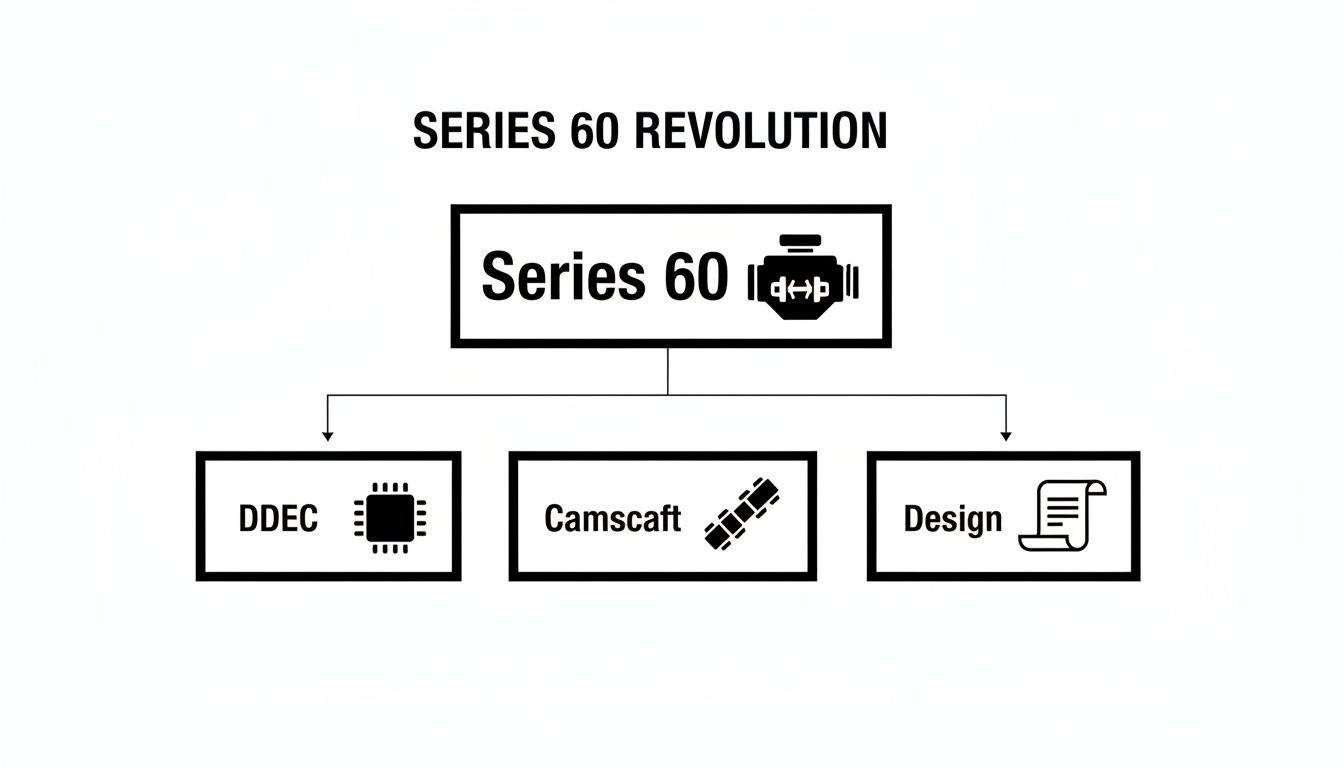
You can see how the combination of cutting-edge DDEC electronics, a modern overhead camshaft, and a fresh design created an engine that was simply unbeatable for its time.
- DDEC I & II: These were the pioneers. They introduced the world to electronic engine controls and gave technicians the ability to read basic fault codes. A whole new ballgame.
- DDEC III & IV: These were huge leaps. With faster processors and more detailed fuel mapping, they brought in features like cruise control. Many old-timers will tell you DDEC IV was the sweet spot—maximum power and reliability before complex emissions gear was added.
- DDEC V: The final major update, this version was all about meeting stricter emissions rules. It introduced Exhaust Gas Recirculation (EGR) and had the most sophisticated diagnostic capabilities of the series.
Knowing which DDEC system is running your engine is absolutely critical. It dictates how you troubleshoot problems, what to expect performance-wise, and how to get the most out of your investment.
Common Series 60 Problems and What to Do About Them
Even a legendary engine like the Series 60 has its quirks. Let’s be honest, after thousands of hours at sea, every engine starts to show its personality, and the Series 60 is no different. The key is knowing what to look for—recognizing the specific weak points that decades of real-world use have uncovered.
This isn't just a generic list of engine troubles. Think of this as a field guide from someone who's spent years with their hands on these powerplants. Knowing these issues helps you catch small problems before they become catastrophic failures that leave you stranded and calling for a tow. It’s about turning down the radio, listening to your engine, and catching that first quiet whisper of trouble before it starts screaming at you.
The Infamous Injector Cups
If you spend enough time around Series 60 mechanics, you’ll hear them talk about injector cups. These are small sleeves, usually brass or stainless steel, that create a critical seal between the fuel injector and the engine’s coolant passages. They’re like tiny, precision gaskets that keep two very different systems—fuel and coolant—from mixing.
The problem is, after countless heat cycles and constant vibration, these cups can crack or the seal can let go.
When a cup fails, high-pressure fuel gets forced directly into your cooling system. The first tell-tale sign is the unmistakable smell of diesel in your coolant expansion tank. You might even see a slick rainbow sheen on top of the coolant. Don't ignore this. That diesel will eat away at every rubber hose, seal, and plastic part in the cooling system, leading to massive overheating and potentially ruining the engine.
EGR Headaches on Later Models
To meet stricter emissions rules, the later Series 60 engines (especially those with DDEC V electronics) were fitted with an Exhaust Gas Recirculation (EGR) system. While it did its job for emissions, it also introduced a whole new layer of complexity and, frankly, new things to break.
The EGR valve, the cooler, and all the sensors that run the system are common troublemakers. Here’s what you need to watch for:
- A Sticking EGR Valve: If the valve gets gummed up with soot and sticks open or shut, you’ll notice it right away. The engine will idle rough, your fuel burn will go up, and you'll feel a definite lack of power when you push the throttles.
- A Cracked EGR Cooler: This one is serious. A crack in the cooler lets engine coolant leak straight into the exhaust. You'll see clouds of white smoke (which is actually steam) pouring from the exhaust, and you'll be losing coolant fast.
- Bad Sensors: Sometimes the mechanical parts are working just fine, but a sensor goes bad and starts feeding garbage information to the engine's computer (the DDEC), tricking it into running poorly.
You have to jump on EGR cooler issues immediately. If you let a leak go, it can fill a cylinder with coolant. When you try to start the engine, that liquid won't compress. The result is called hydrostatic lock, and it's a death sentence for an engine—it can bend connecting rods or even crack the engine block.
Watching for Camshaft Wear
The overhead camshaft is a signature design element of the Series 60, but it’s not invincible. After thousands of hours of service, the lobes on the camshaft—the precision-ground bumps that push open the valves and fire the injectors—can start to wear down. It happens slowly, so the signs are subtle at first.
A classic symptom is an engine that needs its "overhead" run more and more often. If your mechanic is constantly having to adjust the valve and injector lash because they're out of spec, it's a huge red flag that your cam lobes are going flat. This erosion leads to sloppy combustion, less power, and more fuel burned. In the worst cases, you might start to hear a faint "ticking" or "clacking" from the top of the engine.
The Usual Suspects for Oil Leaks
Every engine has its favorite places to leak oil from, and the Series 60 is no exception. Finding a few drips is no reason to panic, but catching them early keeps them from turning into a gusher that can starve the engine of oil.
Keep a close eye on these three spots:
- The Bull Gear Cover: This is at the front of the engine, and the big gasket behind it can get brittle and start to seep over time.
- The Rear Main Seal: This is a tougher fix. A leak here shows up as a drip between the engine and the marine gear.
- The Valve Cover Gasket: Also called the "rocker cover," this is probably the most common leak source. It's a messy one, but luckily, it's a relatively easy and inexpensive repair.
The best defense is a clean engine room. When your bilge and engine are clean, a fresh drip of oil stands out immediately. Make it a habit to wipe things down and give these areas a quick look during your regular checks.
Your Essential Preventive Maintenance Checklist
Want to know the real secret behind getting a million miles—or its marine equivalent in hours—out of a Detroit Diesel Series 60? It’s not some hidden trick. It’s consistency. A proactive, almost obsessive maintenance schedule is what separates an engine that seemingly runs forever from one that suffers an early, wallet-draining demise. This is more than just changing the oil; it's a disciplined routine that protects your investment.
Think of it as a health and wellness plan for your engine. You’re doing the small, regular check-ups to avoid a catastrophic emergency room visit down the road. This mindset shifts maintenance from a reactive chore into a powerful strategic advantage, making sure your vessel is ready to go whenever you are.
Let’s build that definitive checklist.
Daily and Weekly Checks: Your First Line of Defense
Your most powerful maintenance tool is a sharp pair of eyes. Simple, consistent checks before you head out can catch well over 90% of potential problems before they have a chance to grow. These tasks take only a few minutes, but they are absolutely non-negotiable.
Before every single startup, make a habit of doing a quick visual inspection. Get to know what "normal" looks like. You're searching for any new drips, leaks, or loose connections that weren't there yesterday.
- Check Engine Oil Level: This is basic but critical. Pull the dipstick, wipe it clean, re-insert it fully, and then check the level. It must be within the safe operating range.
- Inspect Coolant Level: A quick glance at the coolant expansion tank is all it takes. Low coolant is one of the fastest ways to overheat and cause serious damage.
- Examine Fuel Water Separator: Look at the clear bowl. See any water? Drain it immediately. Water in your fuel system is poison to your high-pressure injectors.
These simple steps are your early warning system. Everything else we do is built on this solid foundation of daily diligence.
Here's a pro tip: A clean engine room is a well-maintained engine room. When your engine and bilge are spotless, even the tiniest new drop of oil or coolant stands out like a sore thumb. It turns a potential disaster into a minor, easy fix.
Scheduled Service Intervals: The Heart of Longevity
Now, let's get into the scheduled work. Beyond those daily glances, your Series 60 needs periodic service based on hours of operation. If you want that legendary lifespan, sticking to this schedule is not optional.
Here is a quick-glance table to help you keep track of the most critical tasks.
Series 60 Marine Preventive Maintenance Schedule
| Task | Interval (Hours/Time) | Key Considerations for Marine Use |
|---|---|---|
| Engine Oil & Filter Change | 250-300 hours or annually | Salt-laden air and high humidity can degrade oil faster. Don't skip the annual change, even with low hours. |
| Fuel Filter Replacement | 250-300 hours (with oil) | Marine fuel can be of varying quality. Replace both primary and secondary filters without fail to protect injectors. |
| Raw Water Pump Impeller | Inspect annually, replace every 2 years | This is your engine's heart for cooling. A failed impeller means immediate overheating. It's a cheap part; don't risk it. |
| Cooling System Anodes | Inspect every 3-6 months | Sacrificial zincs are your defense against galvanic corrosion in the heat exchangers. They're designed to be eaten away. |
| Heat Exchanger/Aftercooler | Clean & test every 2-3 years | Salt and scale buildup will choke your cooling system. This is a vital service, especially in South Florida's warm waters. |
| Run the Overhead | Every 500-1,000 hours | This involves adjusting valve lash and injector timing. It's essential for peak power, efficiency, and smooth operation. |
This schedule is your roadmap. Sticking to it religiously is how you keep your Series 60 running strong for years to come.
Specialized Marine and Advanced Maintenance
For any yacht owner in South Florida, the brutal saltwater environment adds another layer of complexity. These marine-specific tasks are just as important as your oil changes.
First, that raw water pump impeller. It's a simple rubber component, but if it fails, your engine will overheat in minutes. You need to inspect it annually and replace it every two years, no matter how good it looks.
Your heat exchangers and aftercoolers are constantly battling salt and scale buildup, which acts like a blanket, trapping heat inside the engine. Have them professionally cleaned and pressure tested every few years to keep your cooling system working at peak efficiency. And don't forget the zinc anodes—these small, sacrificial metal plugs protect thousands of dollars worth of engine components from being eaten away by corrosion.
Finally, there's the "overhead run." This isn't a DIY job. It's an advanced procedure where a certified technician meticulously adjusts the valve lash and injector timing. A properly set overhead is the key to unlocking maximum power, getting the best possible fuel economy, and ensuring that signature smooth idle. Plan on having this done every 500-1,000 hours, or anytime you notice a drop in performance.
Expert Guidance for Repairs and Overhauls
When your Detroit Diesel Series 60 is pushing a yacht through South Florida’s saltwater, the rulebook for a highway truck engine gets tossed overboard. This isn’t just an engine anymore; it's a marine powerplant battling one of the most punishing environments on earth. Knowing what sets it apart—and who to call for help—is the key to keeping your vessel ready for the open water.
The biggest switch from land to sea for a Series 60 is the cooling system. A truck uses a familiar radiator and fan, but your yacht relies on a heat exchanger system. Just think of it as a radiator that uses raw seawater instead of air to pull the intense heat out of the engine's sealed coolant loop. It’s incredibly efficient, but it also means you’re in a constant fight against saltwater's corrosive nature.
There's also a fundamental difference in how they work. A truck engine might hit its peak load for a few minutes while climbing a steep grade. A marine Series 60, on the other hand, can be asked to run at a high percentage of its total power for hours at a time. This sustained load creates a massive amount of heat and stress, which is exactly why the marine-specific maintenance we covered earlier is so non-negotiable.
Finding the Right Mobile Marine Technician
In a place like West Palm Beach, your most valuable tool isn't in a toolbox—it's the cell number of a first-rate mobile marine diesel technician. But let's be clear: not all mechanics are built the same. Finding someone who truly gets the specific quirks of a marine Series 60 will save you a fortune in headaches and money down the road.
Look past general diesel experience and hunt for factory-level certifications. While any wrench-turner is a start, a certification from MTU (the company that now owns Detroit Diesel) is a flashing sign that this person has specialized, up-to-date training on your specific engine.
A certified technician has direct access to the latest service bulletins, the correct diagnostic software, and proprietary tools for your engine. This is about more than just brute force; it’s about applying precise knowledge that a general mechanic simply won't have.
Before you let anyone on your boat, ask these direct questions:
- Do you specialize in Detroit Diesel engines, specifically for marine use?
- What diagnostic software do you use for the DDEC system? (The right answer is crucial!)
- Can you give me a few references from other yacht owners in the area?
- Are you fully licensed and insured for dockside work at my marina?
Confident, professional answers are what you're listening for. A top-tier mobile tech, like the crew at GTM International, brings the workshop to you, saving you the immense cost and hassle of moving your vessel to a shipyard.
Your Pre-Service Inspection Checklist
You can make any repair job faster and more accurate by giving your technician good intel from the start. Before you even pick up the phone, run through this quick checklist.
- Document the Problem: Get specific. What’s the engine doing? Is there a new noise, weird smoke, a drop in power, or is it running hot?
- Check the Fluids: What’s the oil level and condition? Is the coolant low? Do you see an oily sheen in the coolant expansion tank?
- Record Engine Hours: Have the current hours ready.
- Note Recent Service: What was the last major job done, and when?
- Take Photos or Videos: A quick video of the engine acting up is worth a thousand words.
This little bit of prep work arms your technician with valuable clues, allowing them to start diagnosing the problem before they even step aboard. The result is almost always a faster, more effective repair.
The Big Question: Overhaul or Replace?
Sooner or later, every owner faces the tough call: is it time for a major overhaul, or do you bite the bullet and replace the engine entirely? The right answer really comes down to a few key things.
An overhaul is an intensive rebuild. The engine is torn down, and all the "wear" components—pistons, liners, bearings, seals—are replaced. It's a fantastic option if your core engine block and crankshaft are still in great shape. For a Series 60, a proper overhaul will typically run you between $20,000 and $30,000, depending on what they find once they get inside.
A full replacement, often called a "repower," means pulling the old engine out and dropping in a brand new or fully remanufactured one. It’s definitely the more expensive route, often starting at $40,000 and going up, but it buys you a fresh start, the latest engineering updates, and a new warranty.
Consider an overhaul if:
- Your engine has a solid, well-documented service history.
- The main components like the block and crank are structurally sound.
- You want to keep the original, proven power plant.
Consider a replacement if:
- You've had a catastrophic failure, like a cracked block.
- The projected overhaul costs are getting uncomfortably close to the price of a reman unit.
- You see an opportunity to upgrade to a more modern, efficient, or powerful engine.
In the end, only a detailed inspection and a transparent cost breakdown from a marine diesel expert you trust can give you the clarity you need to make the best financial decision for your vessel.
Your Top Series 60 Questions, Answered
After working on these engines for years, I've heard just about every question in the book. Let's tackle some of the most common ones that pop up for yacht owners. Think of this as the quick-reference section to clear up those lingering thoughts.
What’s the Real-World Lifespan of a Series 60?
You'll hear talk of these engines hitting 1 million miles in trucks, and it's absolutely true. In a marine environment, that translates to an incredible number of hours before a major overhaul is on the table. The Series 60 earned its legendary reputation for a reason—it was built to last.
But there's no magic to it. Reaching that potential comes down to one thing: meticulous, by-the-book maintenance. We're talking religious oil changes, keeping a close eye on the coolant system, and never skipping overhead adjustments. For a boat, that also means giving your raw water pump and heat exchangers the constant attention they demand. Do that, and the engine will reward you with unparalleled reliability.
The 12.7L vs. the 14L: Which One is the Right Choice?
This is a classic debate, but honestly, it’s not about which engine is "better." It's about which one is better for the job at hand. The 12.7L is the undisputed king for most marine conversions. It hit the sweet spot with a perfect blend of power, incredible fuel economy, and near-bulletproof reliability. It’s the engine that built the legend.
The 14L came later, designed to give truckers more grunt for pulling heavier loads up steep grades. It's a fantastic engine, but for the vast majority of yachts, the 12.7L delivers all the power you'll ever need. Plus, its long history means parts are everywhere and every seasoned tech knows it inside and out.
The real question isn't about superiority, it's about suitability. For most yacht owners, the proven, efficient, and powerful 12.7L is the smartest choice for their vessel.
How Do I Squeeze More Fuel Efficiency Out of My Series 60?
Getting the most out of every drop of diesel starts with the simple stuff. A clogged air filter makes the engine gasp for air, forcing it to work harder and drink more fuel. That’s an easy fix. Beyond that, perfectly functioning injectors and a fresh overhead adjustment are crucial for an efficient, clean burn.
On the water, though, your biggest gains come from outside the engine room. A clean, slick hull without a hint of marine growth is your best friend. The same goes for a propeller that’s pitched perfectly for your boat. These two things will slash drag and do more for your fuel burn than almost anything else. Finally, learn your engine's sweet spot—that optimal RPM range where it's happiest—and live there. Pushing it to the limit all the time is the fastest way to empty your tank.
Here at GTM International, we bring factory-certified diesel expertise directly to your slip in West Palm Beach and throughout South Florida. Our mobile technicians live and breathe the Detroit Diesel Series 60, handling everything from routine maintenance to complex diagnostics and repairs. Keep your vessel ready for the water without the hassle. Visit us online to see how we can help: https://www.marinetechsvcs.com.
