

When the heart of your yacht—its powerful diesel engine—starts showing its age, you’re faced with a big decision. That hesitation when you throttle up, the wisp of smoke that shouldn’t be there… these are symptoms you can’t ignore. For any yacht owner in South Florida, this moment isn't just about a repair; it’s about making a strategic choice for a major investment.
A professional diesel motor rebuild is a powerful option, restoring your engine to factory-fresh specifications for often 40-60% less than the cost of a full replacement. This isn't just a patch-up job. It's a comprehensive process that gets to the root of component wear, giving your engine a new lease on life and ensuring it performs reliably for thousands of hours more.
Is a Diesel Motor Rebuild the Right Choice for Your Yacht?
So, how do you know if you need a simple repair, a full overhaul, or a brand-new engine? Understanding the lingo is the first step. The terms "repair," "overhaul," and "rebuild" get tossed around a lot, but they mean very different things in terms of scope, cost, and outcome.
To clear things up, here’s a quick breakdown of what each service typically entails for high-performance marine engines like MTU, MAN, or CAT.
Engine Service Options at a Glance
| Service Option | Scope of Work | Typical Scenario | Relative Cost |
|---|---|---|---|
| Repair | Addresses a single, specific failure (e.g., replacing a failed water pump, injector, or turbo). | A known component has failed, but the rest of the engine is in good health. | $ |
| Overhaul | More extensive. Typically involves servicing the "top end" of the engine—cylinder heads, valves, injectors, turbos—without removing the engine block from the boat. | The engine is losing compression or burning oil but the core "bottom end" (crankshaft, pistons) is still solid. Often done at a scheduled service interval. | $$ |
| Rebuild | The most comprehensive service. The engine is completely disassembled. Every internal part—pistons, liners, bearings, crankshaft—is measured, inspected, and brought back to factory specifications. | The engine has suffered a major internal failure, has very high hours, or is showing widespread signs of wear and fatigue. | $$$ |
| Replacement | The old engine is removed entirely and a brand-new or remanufactured one is installed. | The engine block is catastrophically damaged (e.g., cracked), parts are obsolete, or the owner desires a full repower. | $$$$ |
This table gives you a framework, but the right choice always depends on a thorough diagnosis.
Rebuild vs. Replace: A Strategic Comparison
When major engine trouble hits, the first thought for many is a complete replacement. But hold on. That route often comes with eye-watering costs, serious yard time, and logistical nightmares—especially with premier brands like MTU, MAN, and CAT.
A rebuild offers a much smarter path forward.
A well-executed rebuild can restore up to 95% of your engine's original efficiency and dependability. It zeros in on the core wear and tear without the massive price tag and structural boat modifications that a full engine swap often demands.
Think about it: a full replacement can have your yacht stuck in the yard for weeks, or even months, waiting on a new engine to arrive and then for the shipyard to cut into your boat to get it in. In contrast, a diesel motor rebuild can be done far more efficiently, especially when you bring the experts to you.
The Mobile Service Advantage
The old-school way meant a costly haul-out and moving your yacht to a shipyard. Today, a certified mobile service brings the shop right to your slip. This completely changes the game by cutting out the logistical headaches and drastically slashing your downtime. You get back on the water, faster.
Here’s why a rebuild with a mobile specialist makes so much sense:
- Serious Cost Savings: You sidestep the sky-high price of a new engine and the heavy yard and labor fees that come with a swap.
- Minimal Downtime: The work starts right away, letting you bypass the long backlogs at the shipyards.
- Preserving Originality: You keep your vessel’s original, factory-fitted engine, which is a big plus for its history and resale value.
Ultimately, choosing to rebuild your diesel engine is a calculated decision that puts performance, value, and your time first.
Reading the Telltale Signs: When Your Marine Diesel Is Crying for Help
Your marine diesel engine is always talking to you. That hum, that rumble, every puff of smoke—it's all a language that tells the story of what’s happening deep inside its metal heart. The single most important skill any yacht owner can develop is learning to listen and interpret those signals. It’s the difference between being in control and sailing blind into a storm.
Think of it like this: a new, funny-looking wisp of smoke isn't just a quirk. It's a direct message, a flare sent up from the combustion chamber, telling you something specific is wrong. Catching these early warnings is almost always what separates a planned, manageable diesel motor rebuild from a catastrophic failure that leaves you stranded miles from the nearest port.
What the Smoke Is Telling You
The color of your exhaust is one of the most honest, straightforward clues you’ll ever get. Each shade points to a very specific problem brewing inside.
- Black Smoke: This is unburnt fuel. It’s a sign of a rich air-fuel mixture, meaning there’s too much diesel or not enough air. The most common culprits are an overloaded engine, a clogged air filter starving it for oxygen, or injectors that are gummed up and just dumping fuel. It’s like a fireplace with a blocked chimney—all fuel, no clean burn.
- Blue Smoke: Ah, the dreaded blue haze. This is the unmistakable sign of burning oil. It means oil is getting past the components designed to keep it out of the combustion chamber. You’re likely looking at worn-out piston rings, failing valve seals, or scored cylinder liners.
- White Smoke: A thick, sweet-smelling cloud of white smoke is a serious red flag. This usually means coolant is leaking into the cylinders, often from a failed head gasket or a cracked cylinder head. This is an urgent, stop-the-engine kind of warning, as coolant can quickly wreck internal components.
When to Worry About Noises
Your ears are one of your best diagnostic tools. You know the steady, rhythmic sound of your healthy engine. Anything else—any new clank, tick, or grind—is a reason to pay close attention.
A deep, metallic "knocking" sound, especially when the engine is under load, is a classic symptom of worn rod bearings. These are the crucial cushions between the piston rods and the crankshaft. When they go, it’s metal slamming into metal, and a seized engine isn't far behind.
Whining or grinding sounds can often be traced back to accessory components like the water pump, alternator, or turbocharger. Hearing these noises early gives you the chance to fix a single part before its failure causes a chain reaction of damage.
Feeling the Difference at the Helm
Finally, pay attention to how your yacht feels. Your engine's performance—its power, its responsiveness—is a direct reflection of its health.
A sudden loss of power is a huge sign something is wrong. If you’re pushing the throttle and the engine just won't get up to its usual RPMs, you could be dealing with low compression. That’s a direct result of wear and tear on the pistons, rings, and cylinders. Likewise, if you find yourself suddenly topping off the oil far more often, that oil is going somewhere. It’s either leaking out or, more likely, burning up, which points right back to the internal wear that makes a diesel motor rebuild necessary.
This isn’t just a marine issue; it’s a global trend. For superyachts running big MTU mains, the refurbishment market is booming as these incredible machines age. Industry giants like Cummins and Caterpillar have long set the standard here. This approach mirrors what's been happening in Europe's automotive sector for years, where using rebuilt parts can slash costs by 50-60%. This smart strategy extends service life by up to 50% and helps prevent the very breakdowns that sideline nearly 30% of untreated engines annually. You can learn more about the global market for rebuilt engines to see how widespread this practice has become.
From Dockside Diagnosis to Sea Trial: The Rebuild Unpacked
Let's be honest, the thought of a full marine diesel rebuild can be daunting. It’s a huge job. But when you break it down, it's a logical, step-by-step process that brings the heart of your yacht back to life. Think of it less as a mystery and more as major surgery performed by a specialist—a procedure designed to transform a tired, failing engine into a reliable powerhouse once again.
The whole thing starts right where your boat is tied up, whether that’s in a West Palm Beach slip or a Fort Lauderdale marina. One of the biggest reliefs for our clients is that we come to them. There's no immediate need for an expensive haul-out; our certified mobile team kicks off the entire process dockside, saving you a massive logistical headache from day one.
Before we even pick up a wrench, we need to understand what the engine is telling us. The signs below are usually the first indicators that something serious is going on.
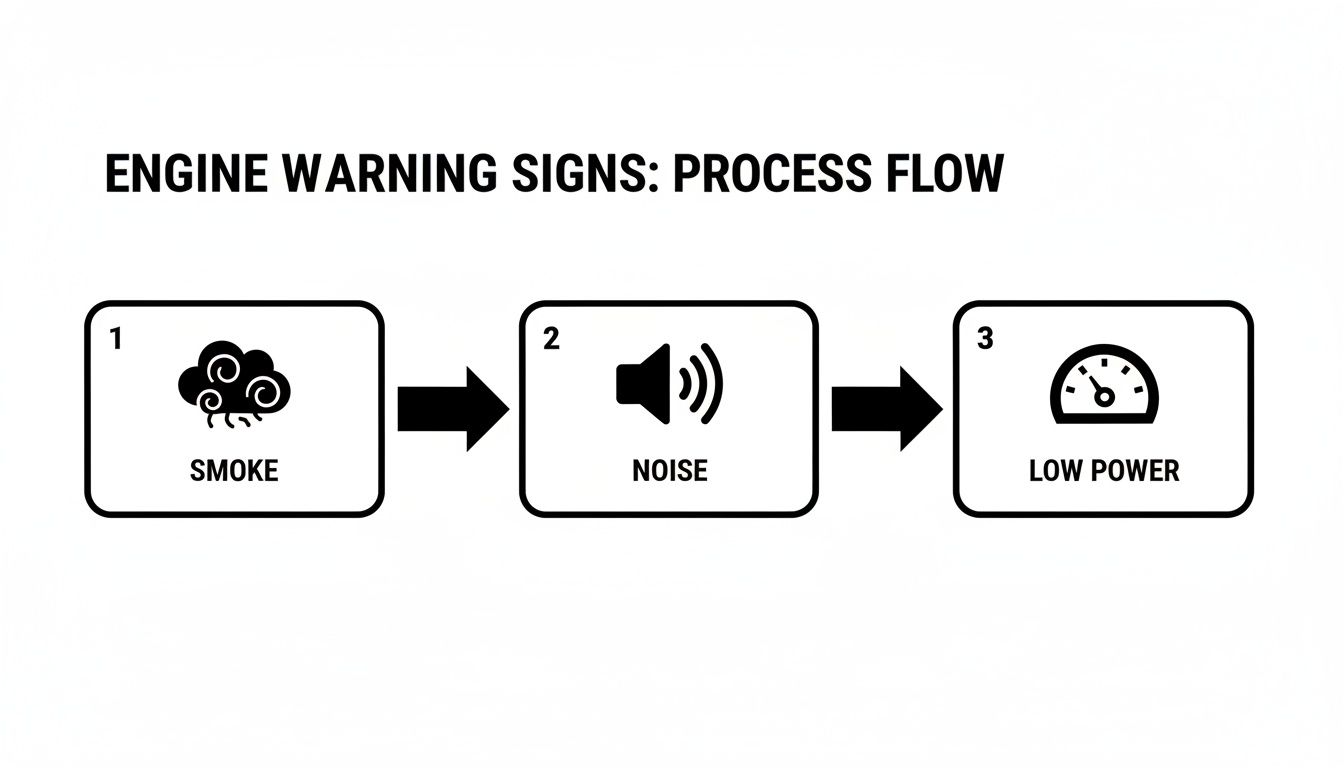
Think of smoke, weird noises, or a sudden lack of power as your engine's way of shouting for help. Our job is to translate those shouts into a concrete action plan.
Step 1: On-Site Diagnostics and Engine Assessment
The first move isn’t to tear things apart—it’s to gather intelligence. Our technicians use specialized diagnostic equipment to get a clear, non-invasive look at the engine's internal condition.
This critical first phase is all about hard data:
- Borescope Inspection: We feed a tiny camera into the cylinders. This gives us eyes inside the engine to spot scoring on the cylinder walls, damage to the pistons, or valve problems without a major teardown.
- Compression Testing: This is a classic test for a reason. It tells us how well each cylinder is sealing. If the numbers are low or all over the place, it’s a dead giveaway for worn piston rings, liners, or valves.
- Oil Analysis: We send a sample of your engine oil to a lab. The report comes back showing any microscopic metal particles, coolant, or fuel contamination, pointing us directly to which internal parts are failing.
This initial diagnostic work gives us the evidence we need to confidently say, "Yes, a rebuild is the right call," and allows us to scope the project accurately.
Step 2: Meticulous Teardown and Component Inspection
With the decision made, the careful work of disassembly begins. Our mobile setup is designed to handle a significant teardown right at the dock, often saving you the cost and hassle of pulling the engine out of the boat entirely.
Every single component is systematically removed, labeled, and cleaned for a thorough inspection. This isn't just about taking an engine apart; it's a forensic investigation. We're measuring the block, crankshaft, camshaft, pistons, and connecting rods with micrometers and other precision tools, comparing every dimension against the original factory specs from giants like MTU, MAN, and CAT.
This is where real-world experience is everything. Spotting a hairline crack in a crankshaft or measuring wear that's just a few thousandths of an inch out of spec is what separates a long-lasting, reliable rebuild from a cheap fix that will fail you 100 miles offshore.
Step 3: Precision Machining and Parts Sourcing
Any component that doesn't measure up to the manufacturer's strict specifications is sent to our trusted machine shop. This is where the engine block might be decked, cylinders bored, or the crankshaft polished. The entire goal is to bring every critical surface back to its original, perfect tolerance, creating a flawless foundation for reassembly.
While the machining is underway, we're sourcing all the new parts. We insist on using Original Equipment Manufacturer (OEM) parts. For us, this is non-negotiable. Genuine components ensure a perfect fit and the durability the engine was designed to have, giving you the peace of mind you need when you're depending on it.
Step 4: Reassembly and Dockside Reinstallation
With the freshly machined components back and a full set of new parts ready, the engine is painstakingly put back together. It’s a clean, methodical process. Every bolt is torqued to exact specs, and every gasket, seal, bearing, piston, and ring is brand new. We're essentially hitting the reset button on your engine's life.
Once the motor is fully assembled, we carefully reinstall it in your vessel. All the fuel, electrical, cooling, and exhaust systems are expertly reconnected. Before we even think about turning the key, we run through a meticulous series of final checks and top off all the fluids.
Step 5: The Final Sea Trial and Fine-Tuning
The real test of a rebuild isn't at the dock—it's out on the water. A comprehensive sea trial is the ultimate quality control check. We push the engine through its paces, running it at various loads and temperatures while keeping a close eye on oil pressure, coolant temp, and exhaust gas readings.
This is where we fine-tune everything to perfection. The sea trial is our final confirmation that we've not only fixed the root problem but have also restored the engine’s power, efficiency, and—most importantly—its reliability for many seasons to come.
Calculating the Cost and Timeline of Your Engine Rebuild
When you're staring down the barrel of a potential diesel motor rebuild, two questions instantly jump to the front of your mind: "What's this going to cost me?" and "How long will my yacht be laid up?" These aren't just minor details; they're the bottom-line factors that shape your next move.
So, let's cut through the fluff and talk real-world numbers and timelines, especially for those of us here in the South Florida marine scene.
The final bill for a rebuild isn't some fixed price on a menu. It’s a custom figure shaped by a few critical variables—namely, the make and model of your engine, the extent of the damage we find once we get inside, and how readily available the right OEM parts are.
That said, a solid rule of thumb is that a top-tier, professional rebuild will typically run you somewhere between 40% to 60% of the cost of a brand-new engine. When you stop and think that a new marine diesel from a premium brand like MTU or MAN can easily rocket into the six figures, the financial sense of a quality rebuild becomes incredibly clear.
Breaking Down the Major Cost Drivers
To really understand the quote you're given, it helps to see where the money is actually going. Your final invoice isn't just one big number; it's a combination of expert labor, precision machine work, and the best components.
- Engine Complexity and Size: It's just a different ballgame rebuilding a monster MTU V16 compared to an inline-six on a smaller cruiser. The sheer scale and number of parts directly influence the hours our technicians need to put in.
- Extent of Internal Damage: An engine that's simply tired from high hours is a much more straightforward—and less expensive—job than one that's suffered a catastrophic failure. A thrown rod or a major overheating event can damage core components like the engine block or crankshaft, adding complexity and cost.
- Cost of OEM Parts: There's a real price difference in pistons, liners, bearings, and gaskets between manufacturers like MAN, MTU, and CAT. We insist on sourcing the correct, high-quality OEM parts because that's what guarantees a reliable, long-lasting result.
A rebuild isn't just a repair; it's a strategic investment in your vessel's future. You're not just fixing a problem—you're restoring your engine to its peak performance and ensuring its reliability for thousands of hours to come, all while saving a huge amount of cash compared to a full replacement.
For the kind of powerhouses from MTU, MAN, and CAT that you find in most luxury yachts around South Florida, rebuilding offers some serious savings. We're talking costs that can be 50% to 60% lower than buying new. It's a smart model—in Europe, manufacturers often favor refurbished components to keep costs down without ever compromising on performance.
Imagine getting this done without a haul-out that could take your yacht out of the water for weeks. Our certified techs can perform on-site diagnostics and rebuilds right at the dock, which can slash your total downtime by as much as 70%.
Take a look at this table. It paints a pretty clear picture of the savings you can expect with a professional rebuild compared to buying new.
Estimated Cost Comparison Rebuild vs New Engine
| Engine Class (Example) | Estimated Rebuild Cost Range | Estimated New Engine Cost Range | Potential Savings |
|---|---|---|---|
| CAT C32 ACERT | $55,000 – $85,000 | $150,000+ | Up to 60%+ |
| MAN V12-1900 | $60,000 – $90,000 | $170,000+ | Up to 65%+ |
| MTU 16V 2000 M96L | $80,000 – $120,000 | $250,000+ | Up to 68%+ |
As you can see, the decision to rebuild doesn't just get you back on the water; it keeps a significant amount of money in your pocket that can be used for other upgrades or simply enjoying your time at sea.
How Mobile Service Reshapes the Timeline
In the yachting world, time is just as precious as money, especially when the season is in full swing. This is where a certified mobile service like ours completely changes the game.
The old-school shipyard process is bogged down by delays. You're waiting for yard space, waiting to schedule a haul-out, and then waiting again for technicians to finally start the work. That process alone can add weeks of frustrating and expensive dead time to your project.
Our mobile service model sidesteps all of that.
We bring the workshop and the expertise directly to your slip, which radically compresses the timeline. Diagnostics can begin the moment we arrive, and the engine teardown can often start that very same day. You get to skip the yard queue and the logistical headache of moving your vessel. Honestly, this dockside efficiency is the biggest reason we can get you back on the water so much faster.
For a clearer picture of what to expect, you can get a more detailed perspective on repair expenses by checking out our guide on diesel engine repair costs.
A typical in-frame rebuild can often be wrapped up in a matter of weeks, not months. And while a more involved out-of-frame rebuild takes longer, our mobile approach still guarantees the project moves ahead without the pointless delays that are so common in the traditional shipyard experience. When you choose a mobile diesel motor rebuild, you're choosing the fastest, most efficient path to restoring your engine's power and your own peace of mind.
How Certified Mobile Service Is Changing the Game for Yacht Rebuilds
For decades, serious engine trouble meant one thing: a long, expensive, and frustrating trip to the shipyard. The old way of handling a diesel motor rebuild was a logistical nightmare. It meant costly haul-outs, endless scheduling delays, and a total disconnect between you and the technicians working on the heart of your vessel. Frankly, it was a slow, inefficient model that left most owners feeling completely out of the loop.
But that outdated approach is quickly becoming a thing of the past. A much smarter, owner-focused solution has taken its place: certified mobile service. Think of it as bringing the engine operating room directly to your yacht. Instead of hauling the vessel to the workshop, we bring the workshop, the specialized tools, and the factory-certified expertise right to your slip.

This isn't just a minor convenience. It's a fundamental shift that transforms the entire rebuild experience, saving you a massive amount of time, money, and stress.
The Old Way: A Story of Delays and Disconnection
Let's be honest, the traditional shipyard model is full of problems that directly affect you. First, you have to schedule a haul-out, which can take weeks or longer during peak season here in South Florida. Once your yacht is finally on the hard, it often just sits there, waiting in line for a mechanic to free up.
Communication is another huge headache. You’re usually stuck talking to a service manager, playing a frustrating game of telephone. You almost never get to speak directly with the tech who actually has their hands on your engine. This leads to misunderstandings, a lack of transparency, and a feeling that you have no idea what's really going on. Every step is slow and expensive.
The Mobile Advantage: Precision and Efficiency at Your Dock
Certified mobile service cuts right through all that red tape. The benefits are immediate and powerful, tackling every single flaw of the old shipyard model.
- No More Yard Fees or Haul-Out Costs: This is the big one. You completely sidestep the hefty fees for haul-outs, lay days, and all the associated labor. That alone can save you tens of thousands of dollars on the final bill.
- Dramatically Less Downtime: We can start the diagnostic and teardown process right at your dock, often on the same day you call. By taking the shipyard queue out of the equation, a mobile service can slash the total project time by up to 70%. That means getting you back on the water weeks, or even months, sooner.
- Direct Communication and Total Transparency: When we're on-site, you have a direct line to the factory-certified technicians performing the diesel motor rebuild. You can see the progress with your own eyes and ask questions directly to the expert rebuilding your engine. This builds trust and keeps you fully informed every step of the way.
This on-site approach respects your time, your investment, and your vessel. It’s a precise, efficient way of working that puts you back in control of the rebuild, turning a stressful ordeal into a well-managed project.
Ultimately, the choice is pretty clear. You can deal with the slow, expensive, and impersonal shipyard system, or you can embrace the modern efficiency of mobile service. By bringing our team to you, we make sure your rebuild is handled with the urgency and professionalism it deserves. To see how this specialized approach works, learn more about our dedicated diesel engine specialists who bring the workshop to you.
Protecting Your Investment After the Rebuild
A successful diesel motor rebuild isn't the finish line; it’s the start of a whole new life for your engine. You’ve just made a serious investment in restoring its heart and soul, and now the game changes from cure to prevention. Keeping that engine purring for years to come means shifting to a proactive, meticulous care routine.
Think of it like a world-class athlete recovering from surgery. The procedure was a success, but their career now hinges on a disciplined physical therapy and wellness plan. Skipping that follow-up is the quickest way to waste all the expert work and money you just put in, leading straight to premature wear and another breakdown.
Establishing a Proactive Maintenance Schedule
There's a reason manufacturers like MTU, MAN, and CAT publish detailed service roadmaps. Following their recommended intervals isn't just a suggestion—it's the single best thing you can do to get the most out of your rebuilt engine. This goes way beyond simple oil changes; it's a complete health and wellness program for your powerplant.
Any solid preventative plan has to include these cornerstones:
- Consistent Oil Analysis: Think of this as a regular blood test for your engine. Sending oil samples to a lab can reveal tiny metal particles, coolant, or fuel contamination—the earliest warning signs of a big problem on the horizon.
- Cooling System Service: We’re talking about a deep dive into your heat exchangers, coolant pumps, and hoses. Keeping your engine running at the right temperature is non-negotiable, as overheating is one of the most notorious engine killers out there.
- Fuel System Integrity Checks: This means regularly checking filters, cleaning injectors, and making sure your fuel is pristine—no water, no microbial gunk. Clean fuel is absolutely critical for performance and protecting those expensive high-pressure components.
A rebuild essentially resets the clock. With a disciplined maintenance program, you’re not just keeping the engine running—you're actively preserving its peak condition to ensure it gives you thousands of hours of reliable power.
This proactive mindset pays off in a big way. For the workhorse CAT and Cummins marine engines you see all over South Florida, a professional rebuild can easily double or even triple their service life. A proper diesel motor rebuild brings an engine back to 95% of its original efficiency, often for 40-50% less than the $100,000+ price tag of a brand-new replacement.
Ultimately, this is all about locking in long-term reliability and performance. When you commit to this level of care, you're not just a customer; you're our partner in maintaining your vessel's health for the long haul. We're here for more than just the big fixes. To learn more about this process, explore our detailed overview of what a rebuilt marine engine truly entails.
Common Questions About Marine Diesel Rebuilds
Even with a clear roadmap, deciding on a full diesel motor rebuild is a big step. It’s only natural to have some practical questions swirling around. Over the years, we've heard them all from yacht owners here in South Florida. Getting straight answers to these last few details is what turns a big decision into a confident one.
Let's tackle the most common questions we get, so you have the clarity you need.
How Long Will My Rebuilt Diesel Engine Last?
This is always the first question, and for good reason. The answer is simple: a professionally rebuilt marine diesel should last just as long as a brand-new engine from the factory. This isn't a temporary fix or a patch-up job; it's a fundamental reset of the engine's life cycle.
Think of it this way: when we machine the core components—the block, crankshaft, and cylinder heads—back to the manufacturer's exact specifications and install new OEM parts, we're effectively turning the clock back to hour zero. Once you complete the proper break-in period and stick to a smart maintenance schedule, you can expect thousands of hours of reliable power.
Will a Rebuilt Engine Affect My Yacht's Resale Value?
Absolutely, and in a good way. A professionally documented engine rebuild from a reputable, certified shop almost always increases a yacht's resale value. It’s a huge selling point, not a red flag. It removes one of the biggest, most expensive question marks for any potential buyer.
A recent, high-quality rebuild is a trump card during a pre-purchase survey. It shows you’ve been a meticulous owner and gives the next person peace of mind that the heart of the yacht is in prime condition. It can make your vessel stand out and sell faster than others with tired, high-hour engines.
What Is an In-Frame Versus an Out-of-Frame Rebuild?
These terms just describe where the work happens. An "in-frame" rebuild is exactly what it sounds like—we do the work with the engine block still mounted in the yacht. This usually involves replacing pistons, liners, rings, and bearings, plus reconditioning the cylinder head. It's less disruptive, quicker, and generally more cost-effective.
An "out-of-frame" rebuild is the full pull. We remove the entire engine from the vessel to perform work that’s impossible to do in the tight confines of an engine room, like major machining on the crankshaft or the block itself. The right approach depends entirely on what our diagnostics find.
Should I Supply My Own Parts for the Rebuild?
We get this question from clients looking to manage costs, but we strongly advise against it. As a certified service provider for major brands like MTU, MAN, and CAT, we get genuine OEM and top-tier aftermarket parts directly, and our pricing is very competitive.
More importantly, letting us source the parts is about protecting your investment. It guarantees everything is perfectly matched and meets quality standards. Crucially, it allows us to stand behind our work with a comprehensive warranty that covers both the parts and our labor. Using your own parts can introduce a weak link and complicate any future warranty claims.
Your yacht is a serious investment that deserves expert care. For a transparent consultation or to schedule a dockside diagnostic, contact the certified mobile team at GTM International today and keep your vessel ready for its next voyage. https://www.marinetechsvcs.com
