

Every boat owner knows that feeling in their gut when the engine doesn't sound quite right. It's a moment that brings a big question to the surface: is it finally time for a rebuild? Let's be clear—rebuilding a diesel engine isn't just a repair. It's a complete restoration that brings every component back to its original factory-fresh specifications, often saving you a significant amount of money compared to a brand-new replacement. It's a smart investment in the heart of your vessel.
Deciding If Rebuilding Your Marine Engine Is The Right Move
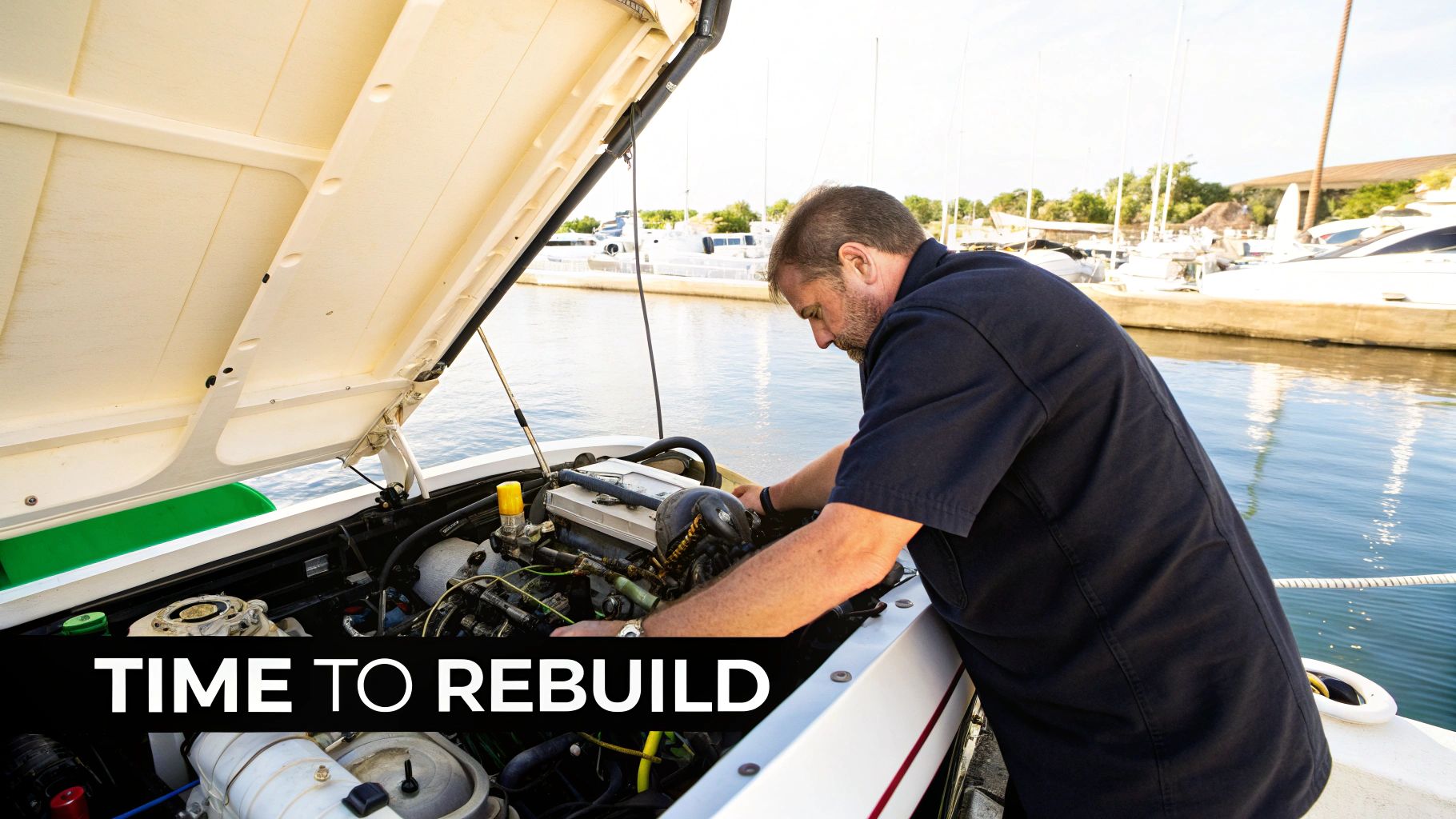
The decision to rebuild usually isn't sparked by a sudden, dramatic failure. More often, it's a slow burn. Your engine will give you little clues, subtle warnings that something is wearing down internally. Catching these signs early is the key to avoiding a much bigger—and more expensive—problem later on.
Think of it this way: rebuilding is like a nut-and-bolt restoration of a classic car. You're not just swapping out one bad part. You're meticulously disassembling the entire engine, inspecting every piece, and machining or replacing components to restore that "like new" performance. This is how you guarantee reliability and get peace of mind for the long haul.
Early Warning Signs To Watch For
A catastrophic engine failure is impossible to miss. But the real signs that point toward needing a rebuild are far more subtle and can be easy to brush off. Learning to spot them is the best way to protect your investment.
Keep your senses tuned for these classic symptoms:
- A Slow Loss of Power: Is your yacht having trouble getting up to speed? If you’re pushing the throttle further to get the same performance you used to, that's a classic sign of internal wear and lost compression.
- Burning More Fuel: An engine that suddenly seems thirstier is working too hard. This often points to worn-out piston rings or faulty injectors that are wasting fuel.
- Weird Smoke Signals: The color of your exhaust tells a story. Blue smoke means you're burning oil, white smoke could signal a coolant leak, and excessive black smoke points to an engine that isn't burning its fuel completely.
- Strange Noises: This is your engine literally crying for help. Any knocking, deep tapping, or grinding sounds are serious mechanical red flags telling you that internal parts are failing.
To help you make a quick assessment, here’s a handy table summarizing what these signs could mean.
Quick Diagnostic: Your Engine's Health At A Glance
| Symptom | What It Could Mean | Recommended Action |
|---|---|---|
| Losing Power | Worn piston rings, cylinder glazing, valve issues, or a tired fuel system. | Get a compression test and have a technician inspect the fuel delivery system. |
| Increased Fuel Use | Faulty injectors, worn rings, or incorrect injection timing. | Have injectors tested and professionally analyze engine performance data. |
| Unusual Exhaust Smoke | Oil leaks (blue), coolant leaks (white), or incomplete combustion (black). | Immediately investigate the source. Continued operation can cause severe damage. |
| Knocking or Tapping | Worn bearings, piston slap, or other critical internal component failure. | Shut down the engine as soon as it's safe and call for a professional diagnosis. |
This table is a starting point, but remember that a professional's diagnosis is the only way to be certain.
A rebuilt engine doesn't just mean "fixed"—it means restored. The goal is to return every component to its precise factory tolerance, essentially resetting the clock on its operational life and ensuring reliability for thousands of hours to come.
When To Make The Call
Pulling the trigger on a full rebuild is a big decision. It’s usually the right call when you're experiencing several of these symptoms at once or if your engine has simply racked up a massive number of service hours. The only way to know for sure is to have a professional technician perform a thorough diagnostic to confirm the extent of the internal wear.
For a deeper look at what a full rebuild involves, you can check out our comprehensive guide on the advantages of a rebuilt marine engine. At the end of the day, this isn't just about fixing a problem—it's about making a strategic choice to protect your vessel's performance, safety, and value for many years to come.
Rebuild, Repair, or Replace? Making the Right Call for Your Engine
When your marine diesel starts to falter, you’re standing at a fork in the road. Do you repair the immediate problem, replace the entire engine, or go for a complete rebuild? This is a major decision, one that impacts not just your wallet but your safety and reliability on the water for years to come. Each path has its own set of pros and cons, and knowing the difference is key to making a smart investment.
A simple repair can be mighty tempting. It’s usually the fastest and cheapest route, designed to fix one specific problem. But think of it like putting a patch on a single leaky shingle while ignoring the rest of an aging roof. It stops the drip for now, but it does nothing about the systemic wear and tear that caused the problem in the first place. A repair is a band-aid, not a long-term cure.
At the other extreme, you have a full replacement. The allure of a brand-new, straight-from-the-factory engine with a full warranty is hard to deny. But this path comes with a hefty price tag and often isn't a simple drop-in solution. You might be looking at unexpected and costly modifications to your engine mounts, exhaust, and electrical systems to make it fit.
The Smart Middle Ground: Rebuilding Your Engine
This is where rebuilding your diesel engine shines as the powerful, strategic middle ground. A professional rebuild isn't just a repair; it's a complete, top-to-bottom overhaul that brings your engine back to its original factory specs—or even better. We're talking about a full disassembly where every single component is cleaned, meticulously inspected, and measured against the original manufacturer's tolerances. Anything that's worn is replaced, and critical surfaces are precision-machined back to perfection.
The result? An engine that performs like new because, for all intents and purposes, its internal workings are new. Often, a rebuild allows for modern upgrades—like superior seals, more resilient materials, and updated parts—that can actually make your engine more efficient and reliable than the day it was first built.
Rebuilding is the ultimate renewal. It gives you the "like-new" performance of a replacement engine but at a fraction of the cost, resetting the clock on your engine's life.
This approach makes incredible financial sense. The aftermarket for remanufacturing diesel engines is booming for a reason: it delivers incredible value. Consider this: rebuilding diesel engines can slash your costs by up to 60-70% compared to buying a new unit. For any boat owner, that's a game-changer. A quality rebuild doesn't just save money upfront; it can also boost your fuel efficiency by 10-20% and add another 10-15 years of reliable service. The growth of the diesel engine market highlights just how many people are realizing this value.
Rebuild vs Repair vs Replace: A Comparative Analysis
Choosing the right path forward requires a clear understanding of what each option truly entails. This table breaks down the key factors to help you weigh the costs, benefits, and long-term value of each decision.
| Factor | Rebuild | Repair | Replace |
|---|---|---|---|
| Cost | Moderate (30-40% of a new engine) | Low (Addresses only the failed part) | High (The most expensive option) |
| Time | Moderate (Weeks to a month) | Fast (Days) | Long (Can involve long lead times) |
| Longevity | Excellent (Resets engine life to zero hours) | Poor (Fixes one issue, others may follow) | Excellent (Brand-new engine life) |
| Value | High (Restores full performance for less) | Situational (Good for minor, isolated issues) | Moderate (High cost, but new warranty) |
In the end, the table highlights a clear truth: while repairs are for minor hiccups and replacements are for catastrophic failures, a rebuild offers the most balanced and strategic value for an aging engine.
Making the Right Choice for Your Vessel
So, how do you decide what’s right for your boat? It really comes down to your engine’s specific condition and what you want to achieve long-term.
- Choose a Repair When: The problem is small, isolated, and doesn't involve the engine's core. A failing alternator, a leaky hose, or a bad sensor are all perfect candidates for a simple repair. This works when the engine block and internal parts are still in great shape.
- Choose a Replacement When: You’ve had a catastrophic failure—think a cracked block or severe internal corrosion that has compromised the engine's integrity. In these rare situations, rebuilding might not be cost-effective or even possible.
- Choose a Rebuild When: You're dealing with systemic, internal wear and tear. If you're seeing symptoms like a loss of power, excessive smoke, high fuel consumption, or low compression, it's a clear sign the core components are tired. A rebuild is the only solution that gets to the root cause of all these issues at once, guaranteeing you a reliable season on the water.
Ultimately, rebuilding your diesel is an investment in longevity, performance, and peace of mind. It's the definitive answer for an engine that's been a faithful workhorse but is ready for a new lease on life.
The Marine Diesel Rebuild Process From Start To Finish
Let's pull back the curtain on what a marine diesel rebuild really involves. It can seem like a daunting, complex job, but when you break it down, it's a logical and precise process. This isn't a shop manual, but rather an expert's look at the journey your engine takes, designed to give you confidence in the work being done. Think of it less like a puzzle and more like a carefully planned operation, moving from dockside diagnosis to a final, successful sea trial.
The whole thing kicks off right at your vessel. Before a single wrench is turned, our technicians perform a thorough diagnostic to make sure a rebuild is truly the right call. Once we get the green light, the engine is methodically disconnected from all your boat's systems and carefully lifted out. This crucial first step lays the groundwork for everything that follows.
This flow chart gives you a quick visual on where a rebuild fits into your options.
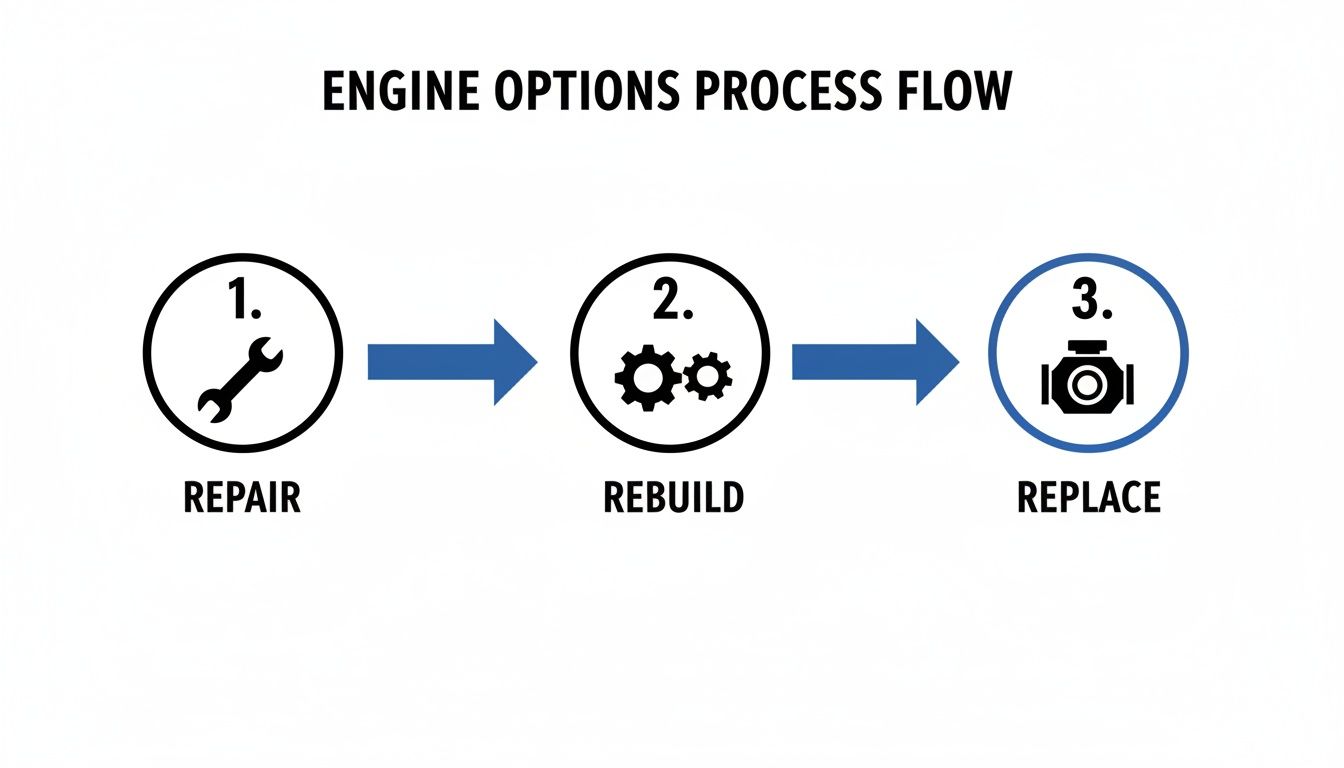
As you can see, a simple repair targets a specific problem, while a full replacement is a fresh start. A rebuild sits right in the middle, offering a complete, top-to-bottom restoration of your existing engine.
Complete Disassembly and Meticulous Inspection
With the engine in our shop, the real work begins with a full teardown. Every single part—from the massive engine block and crankshaft down to the individual pistons, rods, and cylinder heads—is systematically taken apart. We treat it like an archaeological dig, carefully uncovering the engine’s history and condition layer by layer. There's no room for guesswork here.
After disassembly, each component gets a deep clean to remove years of built-up gunk, carbon, and oil. Only then can we move on to the most critical phase: a painstaking inspection. Using precision instruments like micrometers, we measure every part against the original manufacturer's specs. This is where experience is everything. Wear measured in thousandths of an inch can kill performance, and it takes a seasoned eye to spot the hairline stress fractures that could cause a catastrophic failure down the road.
Precision Machining and Component Restoration
Anything that doesn't meet those exacting factory tolerances is sent for precision machining. This is where the renewal truly happens. The engine block might be "decked" to ensure a perfectly flat surface for the head gasket, while the cylinders are bored and honed to create that perfect, cross-hatched surface for new piston rings to seal against. The crankshaft is often ground and polished to guarantee a smooth, frictionless spin.
A professional rebuild is defined by its precision. The goal is to bring every critical surface and tolerance back to its original factory specification, effectively resetting the engine's internal clock to zero.
This isn’t just about fixing what’s obviously broken. It's about proactively strengthening any potential weak spots. The machining work is the foundation of a quality rebuild, ensuring the engine’s core geometry is absolutely perfect before we even think about putting it back together.
Reassembly and Rigorous Testing
Once the core components are restored to like-new condition, the reassembly can start. This is so much more than just bolting parts together; it’s a meticulous process that includes a whole host of brand-new, top-quality parts.
Key replacement parts typically include:
- Pistons and Piston Rings: This is ground zero for restoring compression and power.
- Bearings, Seals, and Gaskets: We install a complete set to ensure a leak-free engine that holds pressure perfectly.
- Valves and Lifters: Crucial for proper engine timing and efficient breathing.
- Oil and Water Pumps: These are the heart and lungs of your engine’s cooling and lubrication systems; we don't take chances.
Assembling the engine is a deliberate, step-by-step procedure where every single bolt is torqued to exact specifications. During this stage, we also rebuild and test vital subsystems. To get a better sense of that, you can check out our guide on the details of a professional diesel fuel injector rebuild.
Finally, long before your engine sees your boat again, we mount it on a test stand. We run it through a series of break-in cycles, watching oil pressure, coolant temps, and overall performance like a hawk to make any final adjustments. The job isn't done until it's reinstalled in your vessel and we complete a final sea trial, proving your newly rebuilt engine is more than ready for whatever the open water has in store.
What to Expect for Your Rebuild: The Real Story on Cost and Timeline
When you’re facing a potential marine diesel rebuild, two big questions always surface right away: "What's this going to cost me?" and "How long will my boat be out of commission?" There’s no simple, universal answer. The final numbers depend entirely on the unique situation inside your engine room.
Think of it like this: a minor engine refresh is a lot like a simple kitchen remodel, whereas a full-blown rebuild after a catastrophic failure is more like gutting the house down to the studs. The scope of the work defines everything. An engine that just needs a standard overhaul is one thing, but if we open it up to find a scored crankshaft or a cracked cylinder head, the project becomes much more involved—and so does the price tag.
The Factors That Actually Drive the Cost
Your final invoice is a direct reflection of several key variables. The make and model of your engine is a big one, as parts for some high-performance or less common brands can be harder to source and more expensive. But the real wild card is what we find once we get inside.
Here’s a breakdown of what really moves the needle on cost:
- Engine Size and Complexity: It's simple math. A massive V12 MTU has more parts and takes more time to work on than a straightforward inline-six. More cylinders, more complexity, more labor.
- The Price of Parts: Do you want to stick with OEM (Original Equipment Manufacturer) parts, or are you comfortable with high-quality aftermarket components? This choice can significantly swing the final cost.
- The Extent of the Damage: This is the biggest unknown until we're deep into the teardown. If the block, crankshaft, or heads need to be sent out for specialized machining, that will add to both the cost and the timeline.
- Labor: This covers all the hours our expert technicians spend on disassembly, meticulous inspection, precision machining, and careful reassembly.
On average, a professional rebuild will run you 30% to 50% of the cost of a brand-new replacement engine. It’s a smart financial move that breathes new life into your vessel without the astronomical expense of a complete replacement.
So, How Long Will It Take?
The timeline for a rebuild can be just as variable as the cost, typically landing somewhere between a few weeks and a month or more. The clock starts ticking the moment we begin removing the engine and doesn't stop until you've signed off on a successful sea trial.
Here are the main things that influence the schedule:
- Parts Availability: This is often the biggest hurdle. If we're waiting on a specific part to be shipped, especially for an older or more obscure engine, the project is on hold.
- Machine Shop Backlog: If major components need machining, we're subject to the machine shop's schedule. Getting in their queue can sometimes add days or even weeks.
- Our Current Workload: A busy shop means we have other commitments. We schedule jobs carefully to ensure every engine gets the attention it deserves, which can affect when we can start.
The On-Site Advantage: Slashing Time and Costs
One of the biggest hidden expenses in any engine job is logistics. The old-school way involves hauling your vessel out, trucking the engine to a shop, and letting the yard fees pile up before a single bolt is turned. It's slow and incredibly expensive.
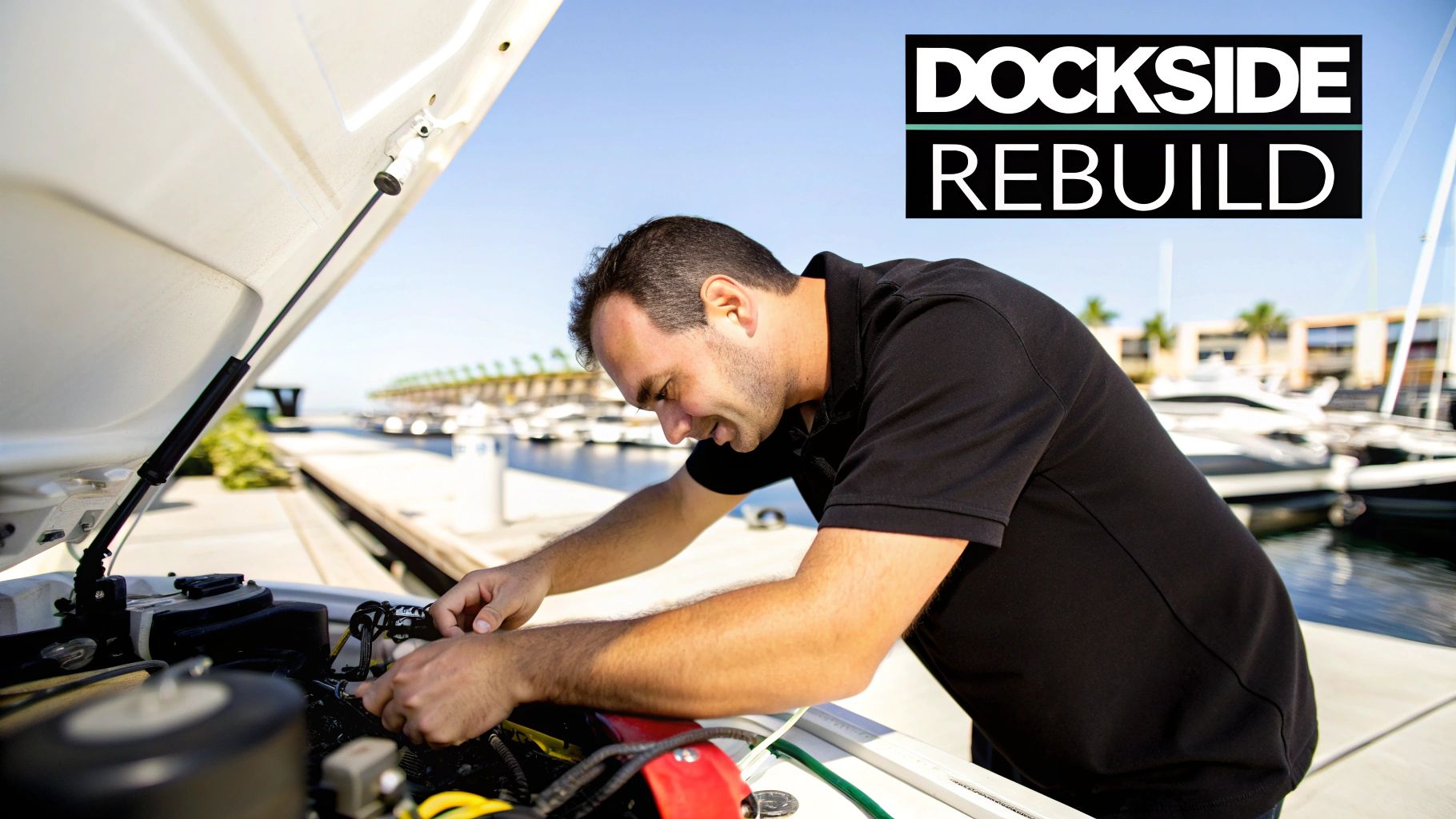
This is exactly why our on-site service model is such a game-changer. We come to you. By handling the engine removal and reinstallation right at your dock, we completely eliminate the need for a haul-out and all the associated costs. It’s a smarter approach that not only saves you thousands but gets you back on the water where you belong, much faster.
The GTM Advantage: Expert On-Site Service In South Florida
For most yacht owners in South Florida, the thought of a major engine rebuild is a logistical nightmare. It usually means battling for marina schedules, arranging a pricey haul-out, and then watching your boat gather dust in a shipyard for weeks, maybe even months. That downtime is more than just an inconvenience—it's canceled plans, lost time on the water, and a steady financial drain.
At GTM International, we knew there had to be a better way. We’ve built our reputation on a simple but powerful idea: bring the factory-level expertise right to your dock. Our on-site service model completely flips the script on rebuilding diesel engines, transforming a drawn-out, stressful project into an efficient process managed right where your vessel sits.
This is about more than just convenience. It’s about sidestepping all the hidden costs and delays that come standard with the old shipyard model. No more haul-out fees, no yard storage bills, and no more waiting in line for a service bay to open up.
A Fort Lauderdale Case Study in Efficiency
Let me tell you about a client with a 90-foot yacht docked right here in Fort Lauderdale. Their twin MTU engines were starting to show the tell-tale signs of wear—losing power and burning way too much fuel. A major rebuild was on the horizon. The conventional path would have meant at least six to eight weeks in a yard, with costs piling up into the tens of thousands before a single wrench was turned.
Instead, they called us. Our certified technicians showed up at their slip with everything needed for a complete, top-to-bottom engine rebuild. We managed the entire job on-site, from pulling the engines to running the final sea trials. The result? The yacht was back out on the water in less than four weeks, saving the owner nearly a month of downtime and an estimated $20,000 in yard fees alone.
Our philosophy is simple: World-class engine work shouldn't force you to uproot your vessel. We bring the expertise, the tools, and the dedication directly to you, protecting both your time and your budget.
This focus on on-site service is more important than ever. The global market for diesel engine refurbishment is booming as owners realize the value in extending engine life. On-site diagnostics and repairs are at the heart of this trend, helping to prevent the kind of catastrophic breakdowns that cost the U.S. marine industry billions each year. By bringing the experts to the vessel, we help owners get ahead of costly failures and get the most out of their time on the water. You can read more about the growth of the diesel refurbishment market and its industry-wide impact.
Your Partner In Performance And Reliability
When you choose GTM, you're not just hiring a mechanic; you're gaining a dedicated partner. Our team of factory-certified diesel engine specialists is on call 24/7 because we know that engine trouble doesn’t care about business hours. We don’t just patch problems—we focus on superior craftsmanship that guarantees lasting performance and the reliability you can count on.
Our on-site capabilities are comprehensive:
- Complete Diagnostics: We use advanced tools to get a precise picture of your engine's health before we begin any work.
- Full-Service Rebuilds: From disassembly to the final sea trial, we handle the entire process at your location.
- Access to OEM Parts: Thanks to our strong industry relationships, we use only high-quality, genuine parts for every job.
- 24/7 Emergency Support: We are always on standby to provide the fast, responsive service your investment deserves.
By cutting out the shipyard middleman, we deliver a higher standard of service that’s faster, more transparent, and ultimately, far more cost-effective. We put you back in control of your vessel’s maintenance, ensuring your engine is rebuilt to the highest possible standard without all the logistical headaches.
Got Questions About Rebuilding a Diesel Engine? We Have Answers.
When you're staring down the barrel of a major engine overhaul, questions are a given. It's a complex world, and you need straight answers before making a big decision for your yacht. This is where we clear things up, tackling the most common questions we hear from owners just like you.
Let's get you the last few pieces of the puzzle so you can move forward with confidence.
How Long Does a Rebuilt Marine Diesel Engine Last?
Think of a professional rebuild as hitting the reset button on your engine's life. When it's done right by certified technicians using top-shelf parts, a rebuilt marine diesel should last just as long as a brand-new one.
With the right care and maintenance moving forward, you’re looking at another 10-15 years or thousands of hours of dependable service. The key takeaway here is that the lifespan is directly tied to the quality of the work. That's why we live and breathe by manufacturer specs—it's the only way to guarantee factory-level durability.
Is a Rebuilt Engine as Reliable as a New One?
Absolutely. In some cases, it can be even better. A rebuild isn't just about swapping out worn-out parts. It's a golden opportunity to upgrade your engine with modern components and engineering updates that simply didn't exist when it first rolled off the line.
A rebuild is a meticulous, hands-on process. Every single component is stripped down, inspected, and measured against the original factory tolerances. That level of detailed attention can often exceed the quality control of a mass-production assembly line, resulting in an engine that’s exceptionally tough and trustworthy.
What’s the Difference Between Remanufactured and Rebuilt?
These terms get thrown around a lot, and it's easy to get them mixed up. But there’s a crucial technical difference, and knowing it helps you understand the true value you're getting.
- Rebuilt: This generally means the engine is taken apart and only the specific parts that have failed or worn out are replaced to get it running again.
- Remanufactured: This is a much deeper, more comprehensive process. The engine is completely disassembled, and every single component is cleaned, inspected, and brought back to the original manufacturer's strict specifications in a controlled environment.
At GTM International, our process is on par with remanufacturing standards. We're not just fixing what's broken; we're giving your engine a complete restoration.
Can You Rebuild Any Brand of Marine Diesel Engine?
Our factory-certified technicians have the tools and training to rebuild and service engines from all the major players in the marine world. We're specialists in the big names like MTU, MAN, and CAT. Our deep-seated expertise and direct access to genuine OEM parts mean we can deliver world-class results on a wide variety of engine models—all right at your dock.
Your vessel is more than just a boat; it's a major investment that deserves the best care from people who truly understand the unforgiving demands of the open water. At GTM International, we bring that certified expertise and an unwavering commitment to quality directly to your slip, saving you hassle, time, and money.
Ready to bring back your engine’s power and peace of mind? Contact us today for a consultation and see what our on-site service advantage is all about.
