

At its heart, the Cummins 4BT is a legend for a reason. We're talking about a 3.9-liter, inline four-cylinder diesel engine celebrated for its near-bulletproof reliability and incredible torque. Key stats you'll always hear tossed around are its 4.02-inch bore, 4.72-inch stroke, and a dry weight that tips the scales at around 750-780 pounds. Straight from the factory, you can expect power ratings to fall somewhere between 105 to 130 horsepower.
Quick Reference: 4BT Specs at a Glance
Whether you're a seasoned marine mechanic, a custom boat builder, or a yacht owner in South Florida, you know that having the core technical data on hand is non-negotiable. It’s the foundation for everything from a simple service job to a full-blown repower project. This section is designed to be your go-to cheat sheet for the standard 4BT.
Before we dive into the nitty-gritty of different model years, fuel pumps, and marine conversions, let's establish a solid baseline. This table boils down the essential numbers you'll need most often.
Core Cummins 4BT Engine Specifications at a Glance
This table is your quick lookup for the fundamental specs of the standard Cummins 4BT 3.9L engine. From internal dimensions to its physical footprint, these are the numbers that form the starting point for any project or diagnostic work.
| Specification | Value |
|---|---|
| Engine Type | Inline 4-Cylinder Diesel |
| Displacement | 3.9 Liters (239 cubic inches) |
| Bore | 4.02 inches (102 mm) |
| Stroke | 4.72 inches (120 mm) |
| Compression Ratio | 17.5:1 (Typical) |
| Aspiration | Turbocharged (Standard on 4BT) |
| Stock Horsepower Range | 105 – 130 HP |
| Stock Torque Range | 265 – 327 lb-ft |
| Dry Weight | Approx. 750 – 780 lbs (340 – 354 kg) |
| Length | 30.6 inches (777 mm) |
| Width | 24.6 inches (625 mm) |
| Height | 37.7 inches (958 mm) |
Think of these figures as the engine's DNA. That long-stroke design, for example, is precisely why the 4BT is famous for generating so much grunt right off idle—a trait that's invaluable in marine applications where you need to push a lot of weight through the water. Its compact physical size is the other major win, giving you a powerful, torquey package that can fit where many bulkier V-style engines simply can't.
Getting to Know the 4BT Model Variants and Power Ratings
When you're looking at a Cummins 4BT, it's crucial to understand that they're not all the same beast. The letters tacked on after "4B" in the model name tell you everything you need to know about how the engine breathes and cools itself, which directly impacts its power potential and where that power kicks in.
Let's start with the basics. The original 4B is a naturally aspirated engine. It relies purely on atmospheric pressure to get air into the cylinders, making it the simplest and least powerful of the bunch. You'll usually find these workhorses in low-demand industrial gear where bulletproof reliability is more important than raw power.
Things get interesting with the 4BT, where the "T" stands for turbocharged. This is the model most people know and love. By forcing more air into the cylinders, the turbo gives the engine a serious bump in both horsepower and torque. This is why it became the go-to choice for everything from bread van repowers to marine conversions.
This quick spec sheet gives you a solid overview of the 4BT's core numbers, like displacement, typical horsepower range, and dry weight.
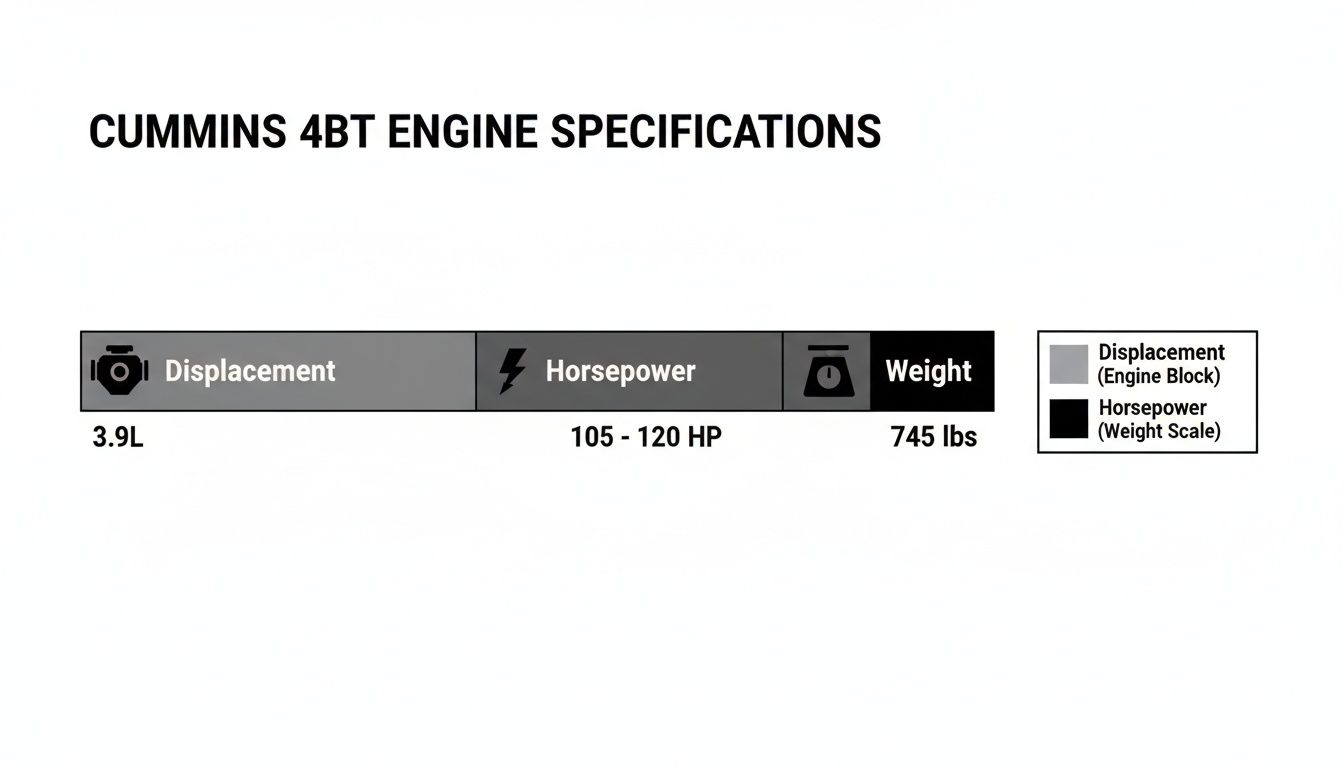
As you can see, the engine's considerable weight and displacement are offset by a power output that can vary quite a bit depending on the specific model you're dealing with.
Understanding the Aftercooled Models
To squeeze even more performance out of the platform, Cummins introduced aftercooling. An aftercooler (often called an intercooler) cools down the hot, compressed air coming from the turbo before it enters the engine. Why? Because cooler air is denser, packing more oxygen into the combustion chamber for a bigger, more powerful burn. This is where we get into the next level of 4BTs.
The 4BTA model features both a turbo and an aftercooler ("T" for turbo, "A" for aftercooled). The performance jump is significant. For example, where a standard 4BT might be rated at 105 horsepower, a similar 4BTA could easily be pushing 120-130 horsepower or more, with a healthy torque increase to match.
The real magic is how these factory upgrades work together. The aftercooler isn't just a bolt-on; it's what allows Cummins to apply a more aggressive fuel tune from the factory without cooking the engine. This translates directly to higher, safer, and more reliable power.
Finding the Top Dogs of the 4BT Family
At the top of the food chain, you'll find the 4BTAA, where the second "A" specifies an Air-to-Air aftercooler. By mixing and matching different turbo and aftercooler setups, Cummins could fine-tune the engine for a huge range of jobs, from delivery trucks to marine generators.
Over the years, the 4BT platform saw numerous upgrades to its valvetrain, induction system, and fueling. The 4BTA pushed common factory ratings up to around 170 horsepower and 420 lb-ft of torque in some applications. Other variants, like certain 4BTAA models, were documented at roughly 130 horsepower and 327 lb-ft, depending on their intended market and emissions gear. If you want to dive deeper into these performance mods, the folks at StreetTrucksMag.com have some great insights.
Diving Into the 4BT's Core Engine Architecture
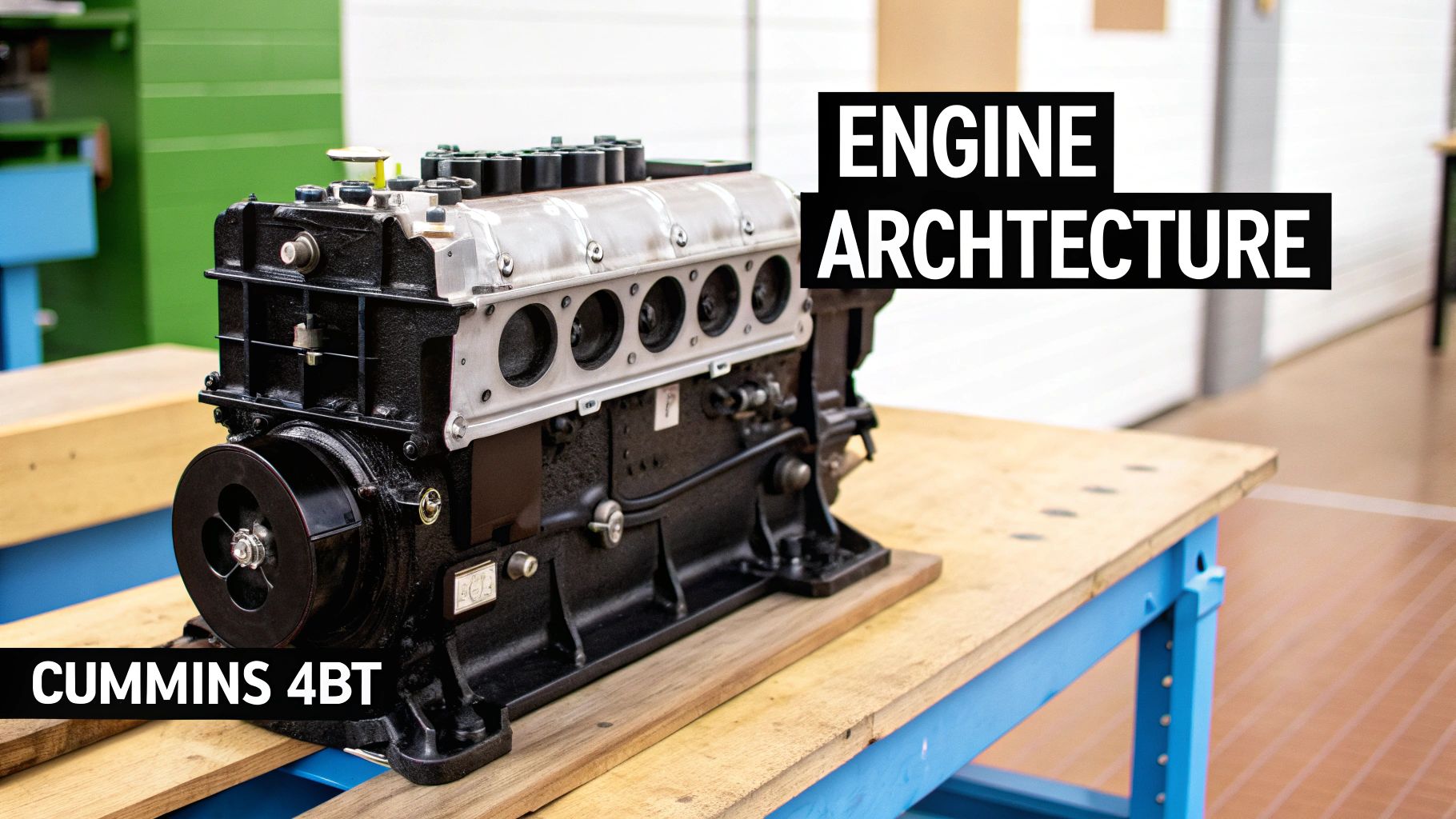
To really get why the Cummins 4BT is a legend, you have to look past the paint and accessories and get right to its mechanical heart. The engine's reputation for being nearly indestructible starts right here, with its core architecture. Every piece, from the block and head down to the crank and pistons, was engineered for brutal commercial service, creating a foundation that simply laughs at abuse that would send lesser engines to the scrap yard.
It all starts with a massive, deep-skirt engine block cast from high-grade iron. This "parent-bore" design is incredibly rigid, which cuts down on flex and keeps the crankshaft and main bearings perfectly aligned, even when you're pushing it hard. This is exactly why the 4BT can handle huge bumps in power and torque without tearing itself apart, making it a darling of the performance and repower communities.
Sitting on top of that stout block is an equally tough cast-iron cylinder head. Sure, it's heavy, but that mass provides phenomenal thermal stability and fights off warping—a critical trait for any turbocharged diesel, especially one working hard in a hot engine room. This block-and-head combo is the bedrock of the 4BT's reliability.
Inside the Beast: The Design Philosophy
Pop the head off a 4BT, and its internal components tell a story. This engine was deliberately built for low-speed grunt and a long, hard life. The whole design philosophy screams brute force over high-revving horsepower, and you can see it in the engine's core dimensions. This is what gives the 4BT its signature character and makes it the perfect tool for so many tough jobs.
When the Cummins 4BT first rolled out for the 1983 model year, it was aimed squarely at the industrial and light-commercial world. Its designers made a key choice: a long-stroke geometry, with a bore of 4.02 inches and a stroke of 4.72 inches. This undersquare design is all about maximizing torque. Early models stuck to a simple two-valve-per-cylinder layout and fully mechanical direct injection, which made them dead-simple to work on and maintain. You can find a great breakdown of its history and specs over at DieselResource.com.
That long-stroke design is the 4BT's secret weapon. By having the piston travel a greater distance up and down the cylinder, the engine gets more leverage on the crankshaft with every single power stroke. The result? A mountain of torque available right from idle.
This is a godsend in marine applications. You need to spin a big prop at low RPMs for efficient, quiet cruising, and that's exactly what the 4BT was born to do. It doesn't need to scream to get the job done; it makes its power right where you live.
The Valvetrain and Rotating Assembly: Built to Last
The valvetrain on most 4BTs is a straightforward overhead valve (OHV) setup, but with one crucial detail: a gear-driven camshaft. By using a train of solid steel gears instead of a timing belt or chain, Cummins eliminated one of the most common and catastrophic failure points in modern engines. It’s a big part of why these things have a "million-mile" reputation.
The rotating assembly is just as ridiculously overbuilt.
- Crankshaft: It's forged steel, ready for just about anything you can throw at it.
- Connecting Rods: These are beefy, heavy-duty I-beam rods.
- Pistons: They're cast aluminum, but designed specifically to handle the immense cylinder pressures of a turbo-diesel.
Every single component was chosen for maximum durability. This engine was meant to run all day, every day, in a delivery truck or a piece of farm equipment—a level of toughness that translates directly into peace of mind for any yacht owner in South Florida.
Fuel Systems and Turbochargers: The Heart of 4BT Power
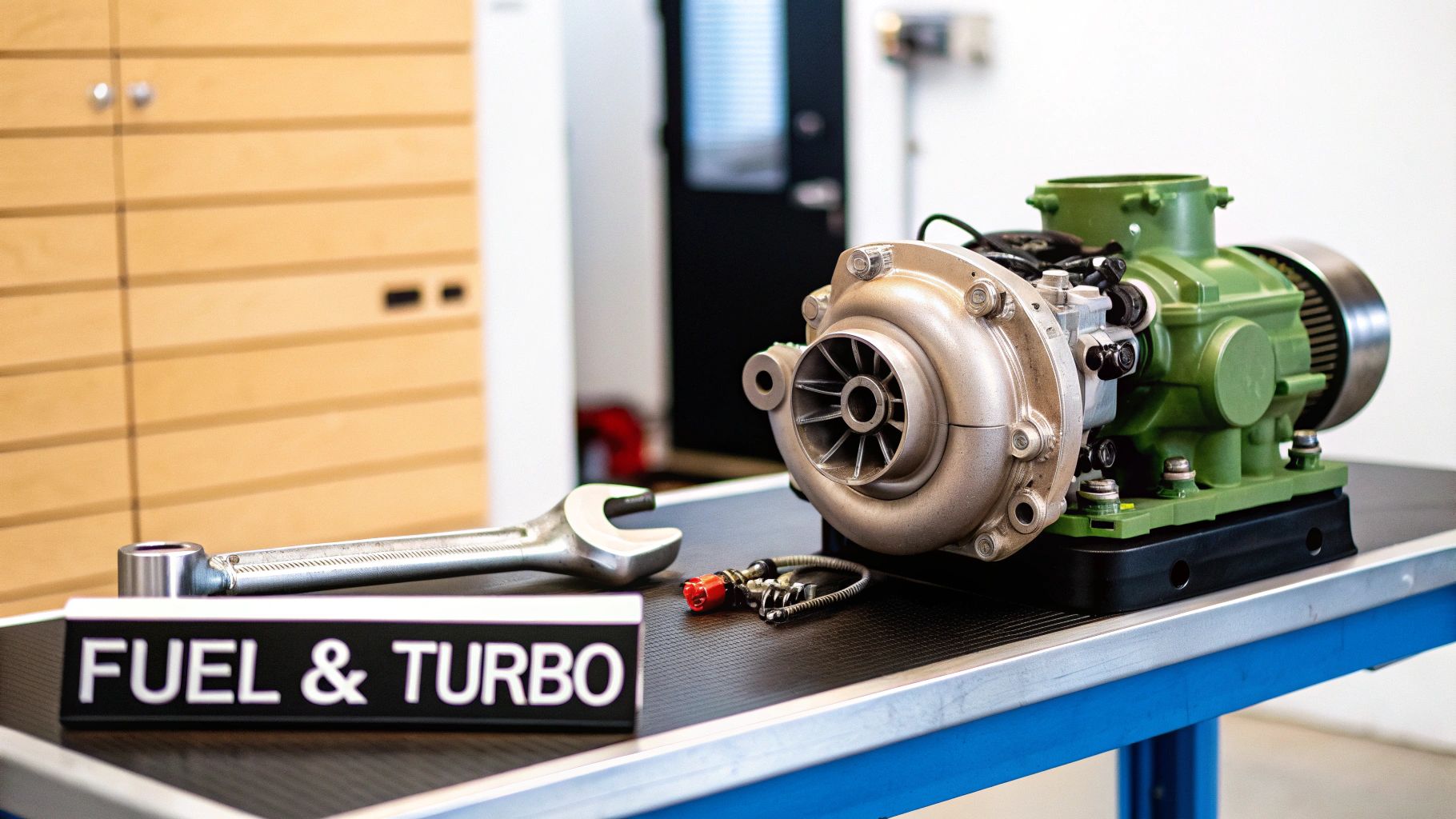
When you get down to brass tacks, the Cummins 4BT's legendary power and near-bulletproof reliability come from two key places: its fuel system and its turbocharger. These aren't just parts bolted to the side of the engine; they define its personality. How it makes power, where it makes it, and how long it keeps making it all comes back to how it breathes and how it's fed.
For anyone running one of these engines, especially in a demanding marine environment, getting familiar with these systems is non-negotiable. It's the key to proper tuning, smart troubleshooting, and keeping that engine running for thousands of hours.
Mechanical Injection Pumps: The Soul of the Machine
The injection pump is the heart of the fuel system, and over its long production run, the 4BT came with a few different mechanical options. Each one has its own character, directly influencing the engine’s power curve, how you can tune it, and its overall feel.
The two big players you'll almost always run into are the Bosch VE rotary pump and the coveted Bosch P7100 inline pump, better known to enthusiasts as the "P-pump." They're both tough as nails, but they go about their business in very different ways.
- Bosch VE Pump: This is the compact, rotary-style pump you’ll find on many 4BTs. It’s known for a smooth power curve and respectable fuel economy, making it a fantastic pump for stock or lightly modified engines. Its single-plunger design is efficient, but it does have its limits when you start chasing big horsepower numbers.
- Bosch P7100 "P-Pump": For the performance crowd, the P-pump is the one you want. This beast of an inline pump uses an individual plunger for each cylinder, giving it the ability to move a massive volume of fuel. It can support huge power gains and is built so tough it's almost legendary.
The love for the P-pump goes beyond just raw power. It's brutally simple and strong. Being 100% mechanical means zero complex electronics to fail offshore, which is why it's a top choice for serious vehicle swaps and marine applications where you simply can't afford a failure.
Turbocharger Basics: Putting the "T" in 4BT
That "T" in the 4BT name stands for turbocharged, and the stock turbo is a crucial piece of the puzzle. Most of the early engines left the factory with a Holset H1C bolted to the manifold. It’s a workhorse of a turbo, perfectly matched to the engine's original power output.
The H1C is engineered for a quick spool and strong torque right off idle—exactly what you need to get a heavy hull up on plane or a truck moving off the line. It's incredibly reliable, but if you're planning to push power levels well past stock, it will eventually become a restriction. If you're curious about turbo tech on larger marine diesels, you might find our article on the Detroit Series 60 turbo interesting.
Swapping the turbo is one of the first and most effective upgrades for a 4BT. A bigger turbo can flow more air and support more horsepower, but there's a trade-off: you can introduce more turbo lag. The real art is in choosing a turbo that matches your power goals without sacrificing the responsive, punchy feel that makes the 4BT so great to begin with.
Planning Your Install: The Tale of the Tape
Any engine swap lives or dies by one simple rule: will it fit? Before you even think about picking up a wrench for your project, whether it's a trail-ready truck or a sportfisher here in South Florida, you absolutely have to know the engine's physical dimensions. These specs are your project's blueprint, and getting them right upfront saves a world of headache and fabrication costs down the line.
The 4BT's inline-four layout is its secret weapon, especially when you're working with a tight engine bay. Forget about the wide, sprawling shoulders of a V8; the 4BT’s lean profile lets it slip into spots where other powerplants just can't. It's a huge part of why this engine has become a legend in the conversion world.
For anyone refitting a yacht, the 4BT's size is a massive advantage. Its relatively short length and narrow build often mean you can get away with far less cutting and welding on engine beds and bulkheads. That translates directly to saving time and a lot of money on labor.
Core Dimensions You Can't Ignore
When you head out to the boat with a tape measure, these are the numbers that truly matter. The standard 4BT is a dense, powerful package, packing a lot of punch into a surprisingly manageable footprint.
- Overall Length: You're looking at about 30.6 inches (777 mm) from the fan hub to the back of the bellhousing adapter.
- Overall Width: It comes in at roughly 24.6 inches (625 mm), which is noticeably slimmer than most V8s you might be considering.
- Overall Height: From the bottom of the oil pan to the very top, it stands around 37.7 inches (958 mm).
- Dry Weight: This is a heavy-duty engine, tipping the scales at a hefty 750-780 pounds (340-354 kg). You'll need to account for this when figuring out your boat's balance and choosing the right engine hoist.
These are the foundational specs every builder needs to memorize. They’ll dictate everything from how you design your motor mounts to where you can route the exhaust.
Mounting Points and Mating it to a Transmission
Beyond the raw size, you have to understand how the 4BT actually bolts in. The engine block has standardized side mounting bosses, giving you a rock-solid platform for either custom-fabricated or off-the-shelf motor mounts. These points are beefy for a reason—they're built to handle the engine's serious torque and vibration.
The bellhousing pattern is the other piece of the puzzle, as it determines what transmissions you can pair it with. Many 4BTs left the factory with an SAE #3 bellhousing adapter, which is a common industrial standard that opens up plenty of options. For marine use, getting this connection right is the first step toward a reliable powertrain. If your project involves a complete overhaul, looking into a professionally rebuilt marine engine can give you a perfectly matched, ready-to-install setup from the get-go.
Essential Marine Conversion Specifications
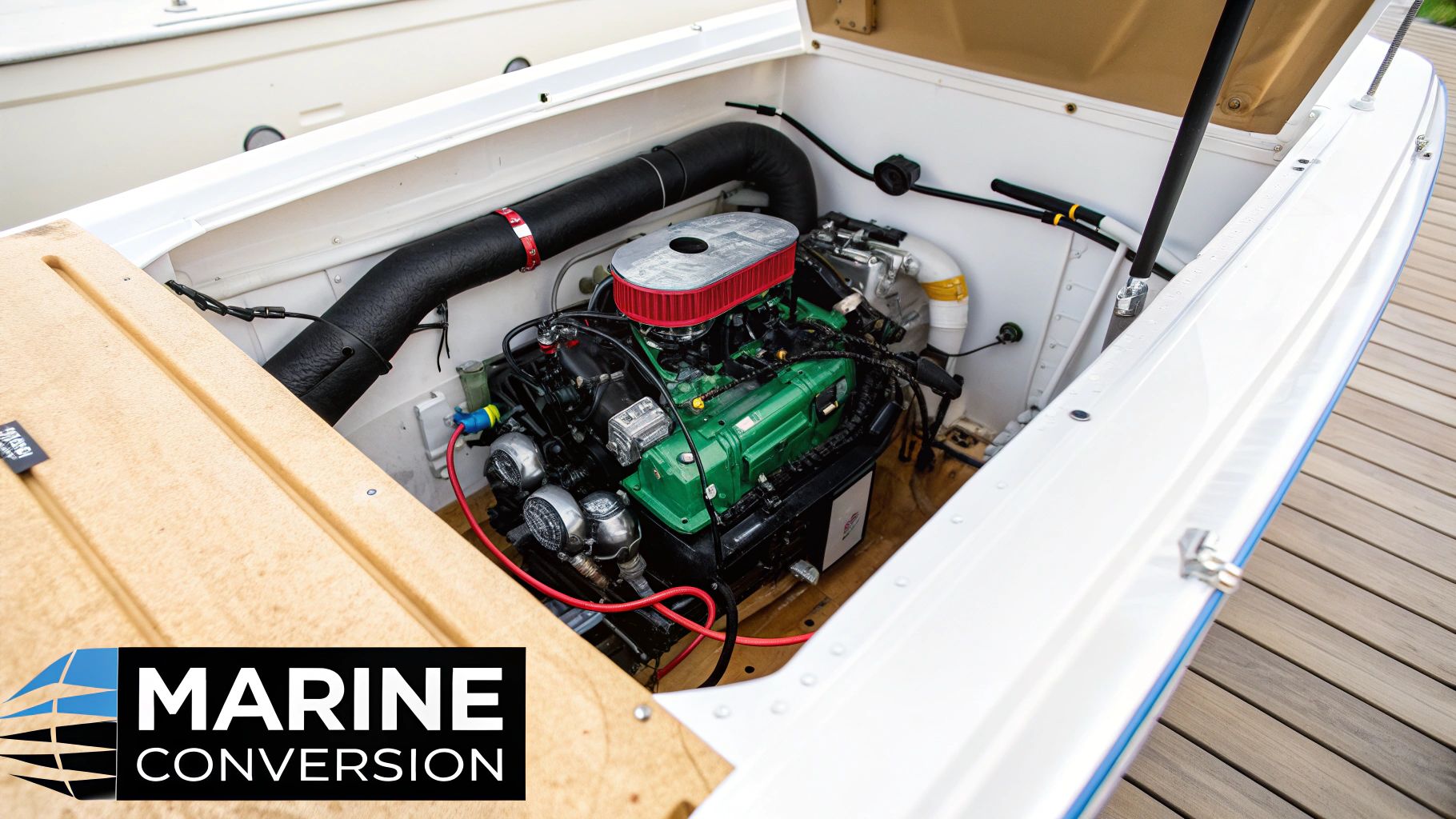
Taking a tough-as-nails industrial Cummins 4BT and turning it into a reliable marine powerhouse is a popular move, and for good reason. The engine’s legendary torque and simple durability make it an incredible candidate for a repower project. But the process, which we call marinization, is a whole lot more involved than just bolting the engine onto new mounts. It demands a specific set of components to prepare the engine for the unforgiving saltwater environment.
Think of it as a complete systems upgrade. You keep the solid core of the engine, but you completely re-engineer its life support—the cooling, exhaust, and transmission—for marine duty. For any yacht owner here in South Florida, nailing these specs is the difference between a trouble-free engine and a constant headache.
The Core of Marinization: Key Components
The absolute heart of any marine conversion is the cooling system. An industrial 4BT cools itself with a radiator and fan, which are completely useless on a boat. Instead, the marine version needs a closed-loop system that uses raw seawater to pull heat from the engine's fresh antifreeze mix.
Several non-negotiable parts make this work:
- Heat Exchanger: This is basically your boat's radiator. It lets you transfer heat from the engine's protected coolant loop to a steady flow of raw seawater. This keeps the engine's temperature right where it needs to be without ever letting corrosive salt water get near the block.
- Raw Water Pump: You'll add a belt-driven or gear-driven pump specifically designed to pull in seawater. It has to be tough enough to deal with the occasional bit of debris and deliver consistent flow.
- Water-Cooled Exhaust Manifold: This is a critical safety and performance piece. It circulates seawater through jackets around the exhaust manifold, which dramatically lowers engine room temperatures and, more importantly, eliminates the serious fire risk of a glowing-hot dry manifold.
A proper marinization kit isn't just a box of parts you bolt on; it's a fully integrated system. Every single component, from the size of the heat exchanger to the angle of the exhaust elbow, has to be matched to the engine's heat output and your boat's specific setup. Getting this right is the secret to long-term reliability.
Matching the Powertrain for Marine Performance
You can't just slap any marine transmission on the back of a 4BT and call it a day. The gear has to be perfectly matched to the engine and the vessel. The whole point is to get the engine operating in its sweet spot—its peak torque band—at your preferred cruising speed. It all comes down to the gear ratio.
Choosing the right marine gear is a careful balancing act. If the ratio is too low (a smaller number), you'll overload the engine. It will lug, blow black smoke, and run hot. On the flip side, a ratio that's too high will keep the engine from ever reaching its optimal RPM, which means you're leaving performance on the table and potentially causing long-term damage.
For the displacement or semi-displacement hulls we see everywhere in South Florida, the goal is to choose a propeller and gear ratio that allows the 4BT to hit its maximum rated RPM at wide-open throttle. This is how you confirm the engine isn't overloaded during normal cruising, which is absolutely vital for its longevity. The great thing about the Cummins 4BT specifications is its wonderfully flat torque curve. Once you have the right gear, it gives you a massive, efficient operating window for quiet, fuel-sipping cruising, with plenty of grunt in reserve for when you need it.
Cummins 4BT Maintenance Schedules and Service
The legendary durability of the Cummins 4BT isn't some happy accident. It’s baked right into the engine's DNA, a direct result of being designed for grueling commercial duty cycles where preventative maintenance is king. If there's one secret to unlocking that famous lifespan, it's this: stick to a consistent service schedule. Skipping the basics is the fastest way I've seen a reliable workhorse turn into a boat owner's biggest headache.
This engine was built for the long haul. In the truck world, it’s not uncommon to see these things hit 300,000–500,000 miles before needing a serious overhaul. That's because they're built with a stout cast-iron block, dead-simple mechanical systems, and a conservative factory tune that keeps stress to a minimum. You can get a great breakdown of why it's considered a diesel legend on TheAutopian.com.
Foundational Service Intervals for Peak Health
For those of us running boats in South Florida, mileage is meaningless. We live and die by operating hours. The constant humidity, saltwater spray, and long stretches of either idling or running hard demand a more vigilant approach. An hours-based schedule ensures you're swapping out fluids and filters before our harsh environment has a chance to break them down.
A solid maintenance plan for a marinized 4BT really boils down to a few critical tasks.
- Engine Oil and Filter: Plan on changing this every 200-250 operating hours or once a year, no matter what. Stick with a quality 15W-40 diesel oil that meets the API CK-4 spec.
- Fuel Filters: Both the primary and secondary filters should be replaced every 400-500 hours or annually. Clean fuel is everything when it comes to protecting your injection pump and injectors from damage.
- Raw Water Impeller: I tell every client to inspect this annually and just replace it every two years, regardless of the hours. A failed impeller is one of the quickest ways to cook an engine.
- Valve Lash Adjustment: Every 2,000 hours, the valve lash needs to be checked and adjusted. This simple procedure is crucial for making sure the engine breathes right, performs efficiently, and doesn't suffer from premature valvetrain wear.
Following these intervals isn't just about avoiding a breakdown; it’s about performance and efficiency. A properly serviced 4BT starts easier, runs smoother, and sips fuel. That saves you real money every time you head out.
When you're dealing with the unique challenges of a marine environment, especially in saltwater, your service plan needs to be dialed in. Small issues can escalate quickly when you're miles from the dock.
Here's a practical checklist tailored for a 4BT living on a boat in South Florida's climate.
Recommended Cummins 4BT Marine Service Schedule
| Service Item | Interval (Operating Hours / Time) | Notes for South Florida Climate |
|---|---|---|
| Engine Oil & Filter | 200-250 hours / Annually | High humidity can introduce moisture into the oil. Do not extend this interval. |
| Fuel Filters (Primary/Secondary) | 400-500 hours / Annually | Humid air promotes algae/bacteria growth in fuel tanks. Change filters religiously. |
| Raw Water Impeller | Inspect Annually, Replace Every 2 Years | Warm saltwater accelerates rubber degradation. Don't wait for it to fail. |
| Valve Lash Adjustment | Every 2,000 hours | Ensures optimal fuel burn and prevents power loss. Critical for long-term health. |
| Coolant/Antifreeze Flush | Every 2 years | Salt air is corrosive. Fresh coolant with proper inhibitors protects internal passages. |
| Heat Exchanger & Aftercooler | Inspect Annually, Clean Every 2-3 Years | Prone to scaling and marine growth, which will lead to overheating. |
| Belts & Hoses | Inspect Before Every Trip | Ozone and heat cause cracking. Check for glazing on belts and soft spots on hoses. |
| Zinc Anodes (Engine) | Inspect Every 250 hours, Replace as needed | Sacrificial anodes are your first line of defense against galvanic corrosion. |
| Air Filter | Inspect Monthly, Replace Annually | A salt-laden, moist air filter restricts airflow and can damage the turbo. |
| Transmission Fluid & Filter | Check Annually, Change per Mfr. Specs | Often overlooked but just as critical as engine oil for reliability. |
This schedule isn't just a suggestion; it's the recipe for a long and trouble-free life for your 4BT. Sticking to it means you can trust your engine when it matters most.
Your Actionable Marine Inspection Checklist
Before you even think about casting off lines, a quick pre-departure check can be the difference between a great day on the water and a call to TowBoatUS. If you run into something that looks more serious than basic maintenance, our team of experts in total diesel repair services is here to help.
Make this a systematic habit:
- Fluid Levels: Pull the dipsticks for the engine oil and check the coolant reservoir. Is the oil milky? That's water. Is there an oily sheen in the coolant? That could be a head gasket.
- Belts and Hoses: Give the belts a quick look for any cracks, fraying, or a shiny, glazed appearance. Squeeze the major coolant and fuel hoses—they shouldn't feel mushy, swollen, or rock-hard.
- Leak Detection: Do a slow walk-around. Look under the engine for any drips of oil, fuel, or coolant. Pay special attention to the areas around gaskets, seals, and where hoses connect.
- Raw Water System: This is a big one. Make sure the seacock is open. Then, pop the lid on your sea strainer and make sure it's clear of seaweed or debris. A clogged strainer will starve your engine of cooling water in a hurry.
Cummins 4BT: Answering Your Top Questions
Even with an engine as famously simple as the 4BT, questions always come up. Whether you're planning a marine repower, a custom truck build, or just trying to understand the beast in your engine room, some things need clarification. Let's tackle the questions we hear most often from yacht captains, mechanics, and hands-on owners.
These are the quick-and-dirty answers, building on the detailed cummins 4bt specifications we covered earlier. Think of it as the final check to make sure you've got the essentials nailed down.
How Much Does A Cummins 4BT Actually Weigh?
This is usually the first question on anyone's mind before a swap, and for good reason. A standard Cummins 4BT tips the scales between 750 and 780 pounds, dry. Keep in mind, that number can creep up once you add the flywheel, starter, and your specific bellhousing adapter.
It's a seriously dense package, a testament to its heavy-duty, cast-iron roots. When you're dropping one into a boat, that weight is a critical factor for maintaining proper balance and trim. Always, always use a properly rated engine hoist, and make sure your mounts are engineered to handle not just the static weight, but the raw torque and vibration this engine is famous for.
Can You Get More Horsepower Out of a 4BT?
Absolutely. In fact, it's almost expected. The factory ratings of 105 to 130 horsepower are famously conservative. The 4BT’s overbuilt design is a tuner's dream, and getting to a reliable 200-250 horsepower is surprisingly straightforward with the right parts.
Pushing for more power usually comes down to a few key areas:
- More Fuel: The mechanical injection pumps, especially the Bosch P7100, are incredibly easy to tune. Some simple adjustments with basic hand tools can unlock a huge bump in power.
- Better Airflow: The stock Holset H1C turbo is decent, but swapping it for a modern, more efficient unit is a game-changer. It lets the engine breathe easier and supports much higher power levels.
- Cooler Air: As you crank up the boost, you have to manage intake temperatures. Adding an aftercooler (or intercooler in automotive terms) is non-negotiable for making dense, power-rich air.
Frankly, the beauty of the 4BT is its mechanical nature. You don't need a laptop or specialized software to make it sing. Most of the go-fast adjustments can be done right there in the engine bay, which is why it's remained so popular for so long.
This proven upgrade path is a huge part of the engine's legacy. It lets you build the exact power you need for your application.
Is the 4BT Just Half of a 6BT?
That's a common way to think about it, and it's mostly right. The 4BT shares a ton of its DNA and many of its parts with its legendary big brother, the 5.9L 6BT 12-valve. The bore and stroke are identical, which means key components like pistons, connecting rods, injectors, and valvetrain parts are often interchangeable.
This parts commonality is a massive win for owners. It makes finding and affording service parts incredibly easy, tapping into the massive supply chain built for the millions of 6BTs that powered Dodge Ram trucks. But they're not carbon copies—the 4BT has its own crankshaft, camshaft, and block. It’s also internally balanced, unlike the externally balanced 6BT.
What Is The Best Oil For a Cummins 4BT?
Stick to the basics and you can't go wrong. For the vast majority of these engines, a high-quality 15W-40 heavy-duty diesel oil is the go-to. The key is to look for a modern API rating like CK-4, which ensures the oil has the right additive package to handle the soot and stress of a hard-working turbo diesel.
Your specific environment might call for a slight change:
- Normal Use: A good 15W-40 conventional or synthetic blend is perfect.
- Cold Weather: If you're dealing with cold starts, a 10W-30 or a full synthetic 5W-40 will flow better and reduce wear on startup.
Here in South Florida's warm marine environment, a robust 15W-40 is the ideal choice year-round. More important than the brand is the interval. Changing your oil and filter every 200-250 operating hours is the single best thing you can do for the engine's long-term health.
At GTM International, we live and breathe legendary engines like the Cummins 4BT. Whether you need an expert pre-purchase inspection on a repowered yacht or on-site diagnostics and repair in South Florida, our certified mobile technicians have you covered. See how professional marine diesel service is done by visiting us at https://www.marinetechsvcs.com.
