
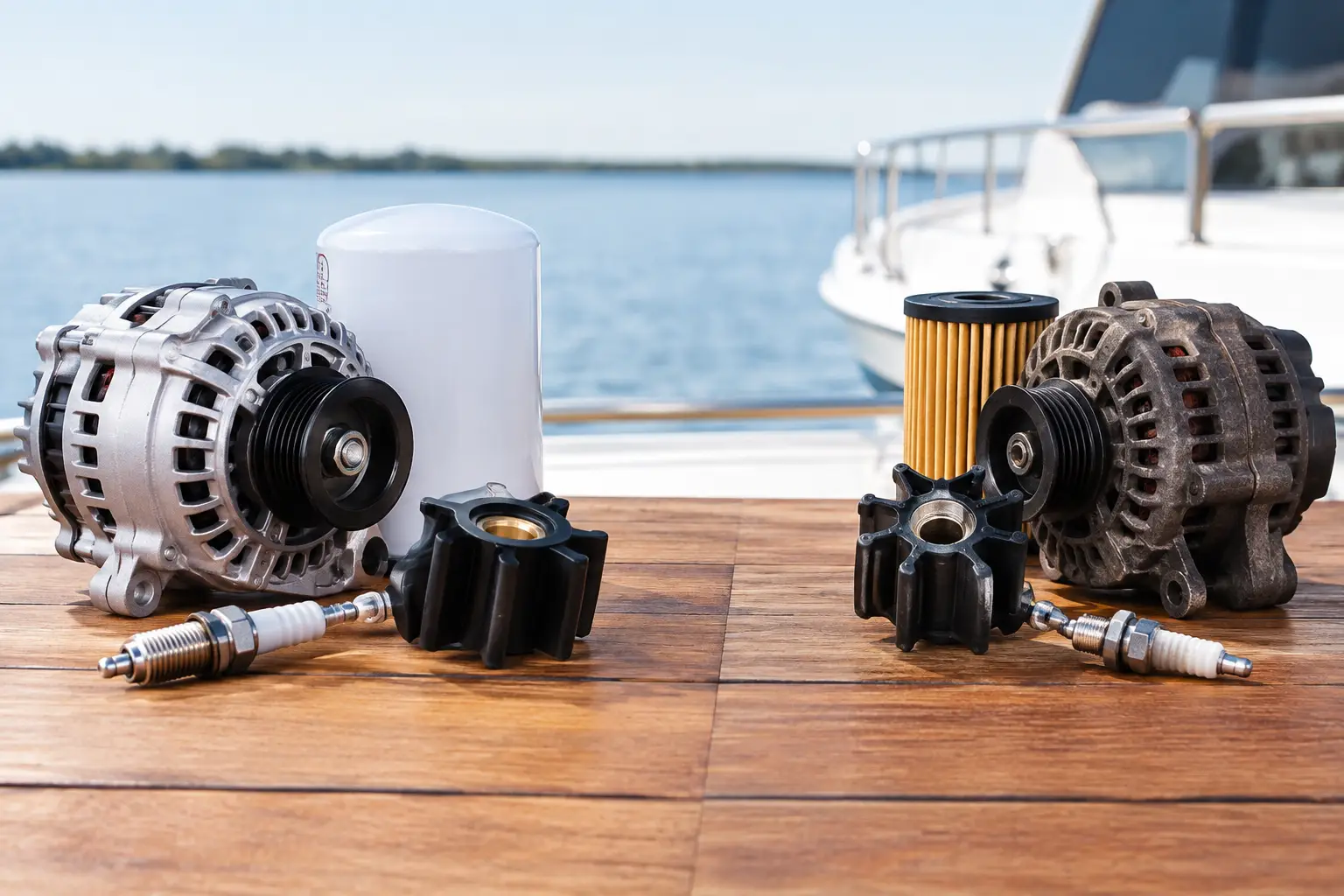
A failed raw-water pump, injector, steering component, or generator sensor does not care whether a vessel is tied up in West Palm Beach or running offshore. It only cares whether the replacement part fits, performs, and holds up under load. That is why the OEM versus aftermarket marine parts decision deserves more thought than simply choosing the lowest price on an invoice.
For yacht owners, captains, and fleet operators, the right choice depends on the system involved, the vessel’s operating profile, the quality of the available aftermarket option, and the cost of downtime if something goes wrong. A good marine technician approaches parts selection like a doctor choosing a treatment: diagnose the real issue first, then prescribe the part that gives the vessel the best path back to reliable service.
OEM Versus Aftermarket Marine Parts: The Real Difference
OEM stands for original equipment manufacturer. An OEM part is supplied by the engine, generator, or system manufacturer, or produced to that manufacturer’s official specification and sold through its approved parts channel. For a CAT, MAN, or MTU engine, an OEM component is intended to match the design, tolerances, materials, and performance requirements of that specific platform.
Aftermarket parts are made by companies other than the original manufacturer. That category is broad. Some aftermarket manufacturers produce excellent components for marine applications, sometimes supplying the same type of parts used throughout the industry. Others make lower-cost replacements with less consistent materials, fit, testing, or quality control.
The label alone does not tell the whole story. OEM does not automatically mean every part is the only acceptable choice, and aftermarket does not automatically mean inferior. The practical question is whether a particular component is proven for the application and whether saving money upfront creates risk later.
Why OEM parts command a higher price
OEM parts often cost more because they carry manufacturer engineering, documentation, distribution, and warranty support. On a high-value diesel yacht, that added cost can be justified by exact fitment and confidence that the component works properly with the engine’s fuel, cooling, electronic, and monitoring systems.
That matters most when a part affects engine protection, emissions equipment, fuel delivery, electronic controls, or safety. A sensor that reports incorrect temperatures, for example, can cause more than an annoying alarm. It can lead to improper troubleshooting, reduced performance, or failure to identify an overheating condition before damage occurs.
OEM parts also reduce uncertainty when a vessel is under a manufacturer warranty or an extended service agreement. Installing an unapproved substitute in a sensitive system can complicate a future claim, even if the replacement part did not directly cause the problem.
When Aftermarket Marine Parts Can Be a Smart Choice
A quality aftermarket option can make sense for routine, non-proprietary, or commonly sourced service items. Many boats use filters, belts, hoses, seals, bearings, impellers, and electrical components that are available from reputable manufacturers at a meaningful savings.
The key is not to treat all replacement parts as interchangeable. A belt may look correct but have the wrong length, compound, or load rating. A hose may fit the connection but not tolerate the heat, pressure, fuel exposure, or saltwater environment found in a marine engine room. The cheapest part becomes expensive quickly when it fails early or causes an avoidable service call.
For older vessels, aftermarket parts can also help keep maintenance practical when OEM inventory is limited, discontinued, or priced beyond reason. In those cases, a technician should verify measurements, specifications, compatibility, and the reputation of the replacement manufacturer before installation.
Good candidates for proven aftermarket options
Aftermarket parts are often worth considering when the component is well understood, readily cross-referenced, and not central to a proprietary control system. Common examples include:
- Filters, zincs, gaskets, seals, and selected hose assemblies
- Belts, clamps, bearings, and certain standard fasteners
- Some raw-water pump service kits and cooling-system wear items
- Non-proprietary lighting, switches, connectors, and accessory hardware
Even within these categories, quality varies. A marine-rated component from a respected supplier is very different from a generic part with uncertain specifications. Marine use introduces vibration, humidity, heat cycles, salt exposure, and long periods of high load that many automotive or industrial substitutes were never designed to handle.
Where OEM Parts Are Usually the Better Investment
Certain systems leave little room for experimentation. If the part can shut down an engine, damage a major component, compromise safety, or strand the vessel, OEM is often the sensible choice.
Fuel-system components are a prime example. Modern diesel injection systems operate at extremely high pressures and tight tolerances. An injector, high-pressure fuel component, or electronically controlled fuel sensor that does not meet specifications can affect combustion, engine protection, and long-term reliability. The same caution applies to engine control modules, proprietary sensors, turbocharger components, and critical generator controls.
Cooling components also require careful judgment. A gasket or seal from a proven aftermarket manufacturer may be appropriate, while a specialized cooler component, thermostat housing sensor, or engine-specific impeller configuration may call for OEM. The technician must consider more than whether the part physically fits. Flow rate, material composition, corrosion resistance, and calibration all matter.
For steering and electrical repairs, safety should carry extra weight. A part that affects steering response, charging capacity, battery isolation, bilge systems, or navigation-related electrical reliability should be selected based on verified marine suitability, not price alone.
The Cost of Downtime Changes the Math
Parts pricing is only one line on the total repair cost. For a yacht waiting on a charter, a captain managing a schedule, or an owner planning a trip, a failed lower-cost part can create fuel, labor, docking, travel, and lost-use expenses that far exceed the original savings.
This is especially true along the South Florida coast, where vessel schedules, weather windows, and seasonal traffic can make delays costly. If an OEM part offers materially better availability, warranty protection, or confidence in a critical repair, it may be the more economical option over the life of the job.
On the other hand, paying a premium for an OEM-branded standard consumable when a verified equivalent is immediately available may not serve the owner’s budget. The goal is not to choose the most expensive part. It is to choose the part that delivers dependable service at the right total cost.
How a Professional Technician Makes the Call
A proper recommendation begins with diagnosis, not a catalog search. Before ordering a part, the technician should confirm the root cause of the failure. Replacing a failed pump without checking for restricted flow, damaged hoses, contaminated fluid, or an electrical problem can lead to another breakdown regardless of which brand of part is installed.
The next step is to identify the engine model, serial number, system configuration, and operating history. Two vessels with the same engine family may use different components based on production year, horsepower rating, electronic package, or previous modifications. This is one reason professional verification is so valuable on 50- to 500-foot vessels with complex diesel, generator, electrical, and steering systems.
A clear recommendation should explain the trade-off in plain terms: what the OEM part costs, what a qualified aftermarket option costs, what warranty applies, and what risk or benefit comes with each choice. Owners should never be pressured into a part selection they do not understand.
Get the Part and the Diagnosis Right
GTM International provides mobile marine diagnostics and repair throughout the South Florida coastal corridor, bringing experienced service directly to the vessel. Whether the repair involves a diesel engine, generator, cooler, electrical system, or steering component, the priority is to identify the problem correctly and recommend parts that protect uptime without wasting your maintenance budget.
When a critical system needs attention, do not let a low purchase price make the decision for you. Ask which part is specified for the job, why it is recommended, and what the vessel stands to lose if it fails before the next service interval. That conversation can save time, money, and stress long after the repair is complete.
